Tuesday, April 20, 2010

Kick-Ass: Meta-Comic Juices the Genre

It's easy to see why Kick-Ass - a movie about a real nerdy kid without any superpowers who decides to don a superhero outfit and fight crime - has been winning fans since before its release. Based on a comic by the same name, the movie is - like many comics - a peon to high-school adolescent anxieties. As well, it's a deeply self-referential parody of comic-books of the Marvel / DC Comics variety.

Part of the real charm of Kick-Ass may be actor Aaron Johnson, playing lead hero Dave Lizewski, and his fro / glasses look. Johnson gets the transformation from geeky high-school nerd into slightly less geeky, svelt superhero just right, and his costume is the genius heart of the movie. Stuffing away his fro and bulky clothes and emphasizing his dewy eyes and Angelina Jolie-style pouty lips, the green costume transforms the awkward Johnson not into a superhero so much as a supremely cool, American Idol-style singer/dancer. Kick-Ass has a propensity to really get his ass kicked - and, truth be told, has no abilities at fighting crime - but he does have just the right chemistry for instant celebrity, and gets himself videotaped and distributed on YouTube, where he becomes an overnight sensation.

What Dave doesn't realize is that there are some other masked crusaders out there - specifically, Hit Girl, and her doting ex-cop father, Big Daddy, who actually are rather Matrix-y good at kicking ass and killing bad guys. Hit Girl gets to save Kick-Ass's shit when it looks like he's going down at the hands of a particularly nasty gangster, and the three become a kind of crime-fighting syndicate (although with most of the fighting not being done by Kick-Ass). Evil mob boss Frank D'Amico provides most of the dramatic arc from there, setting himself up as Kick-Ass's arch enemy.

The movie has a fine time directly quoting - some might say ripping off, in Scary Movie style - its inspirations, particularly Spider Man (which provides the story-line DNA), although the movie ends with the slightly evil Iron Mist declaring, "wait until they get a load of me," as a way of signaling his intentions against the many powerless superheros that may be out there. (Implying that not only have these characters watched The Incredibles - which came out what, last year? - they have since devised an entire literary theory of existence around Brad Bird of Pixar.)

As meta as it may seem, and as cute as Johnson may be in that mask, the film ends up being rather conventional, sticking to the stock superhero narrative and taking few real chances. It's also incredibly violent given that we are positing that this is a "real" world and not a "superhero" one. But the violence requires us to transition our thinking into superhero reality (even Spiderman doesn't have this high of a body count). What starts as an innocent enough tweak on superhero lore ends up a violent vigilante murder-fest, and we end up not so much in superhero-land as a kind of teenage Sin City.

I liked this film, but I really felt with so many appealing characters, it could have done so much more. The business with the mob bosses and gangsters are all rather stock comic stuff, and not too inspired. Kick-Ass does need a foil to be ironic against, however, so it's a promising start nevertheless. If this thing has legs for a sequel or two, it wouldn't be the worst thing in the world.

Tuesday, April 13, 2010

Clash of the Titans Reanimates B-Movie Classic

Hollywood is once again in remake mode, searching for classic stories with built in audiences. It’s hard to say whether remakes of The A-Team or The Karate Kid will meet with success. One of the crap-shoots in remaking a cultural icon (the original of which may or may not have any intrinsic value) is the chance that the product will be exponentially worse than a mediocre original: witness such travesties as Bewitched, Get Smart, or (one shudders), the 1998 version of McHale’s Navy.

Of course, every now and then, Hollywood ekes out a win in this process, if not transforming the source material into something loftier, at least reimagining it with enough flare to thoroughly entertain a modern audience who may or may not be familiar with the original. Something like this happened with Lost In Space and, of course, the recent Star Trek.

This is the situation with the current Clash of the Titans – a remake of the much-beloved-if-quirky stop-motion 1981 original by famed animator Ray Harryhausen, and a rare win in the remake department. What we have may not be Oscar material, but it’s certainly worth $9.50 and a tub of popcorn to entertain the kids on a pre-summer Saturday afternoon.

What audiences loved about the original, however, wasn’t so much the engrossing story or the amazing acting (the bare-chested Harry Hamlin was there more for his ‘acting talents’ than his acting talents), as it was Harryhausen’s endearing if quirky special effects. The stop-time marching skeletons and menacing Medusa where favorites of young boys since they clearly could relate to their own play with model making and fanciful stories of demi-gods and goddesses, and the movie had a bit of that making-it-up-as-we-go-along quality that one gets from the best of youthful play. Chancy, then, to redo this movie using standard CGI techniques (since the 3D is now the standard for many a film coming out this summer, it may be more of a distraction than anything) without adding anything genuinely unique to the visuals.

In our modernized version of the story, the movie opens with a young woman and infant being rescued from the sea (like a bounty of tuna) by an old fisherman. The woman is dead, but the infant is the young Perseus, a demi-god (borne by Zeus of a human mother), destined to be the man who leads the Argosians in their rebellion against the vengeful god Hades (played with coy understatement by Ralph Fiennes). Though the opening posturing by the gods is a bit pedantically irksome (Zeus and Hades, particularly, who really don’t get along, engage in some stultifying Olympian Exposition 101), the feeling exhibited by this father for his adopted son is promising, and draws us in to the yarn.

Eighteen years later, when Hades inadvertently kills Perseus’s adopted family while wreaking havoc on the insolent population of Argos, Perseus finds himself a captive in the city, and the only volunteer willing to lead a battalion in a war against the gods.

Sam Worthington, who plays Perseus, seems to be ubiquitous lately, carrying the lead in every major sci-fi since the summer of 2009. As “demi-god” Perseus we perhaps get our first glimpse as to why. Brooding, soulful, yet stout of heart, he was born to play the comic-book hero: a softy who transforms, though a process of inner soul-searching, into a man of steal (and as my Bubbie used to say, not hard on the eyes either). He’s obviously way too old for this part (essentially that of a precocious teenager learning to be a leader), but who cares? Clearly if Hollywood continues to have a hard time finding athletic young men with this much emotional openness, Worthington is in for another bonanza year leading roles.

Perseus leads his charges through the (familiar, one hopes) story – battling the deformed Calibos, talking to the Stygian witches, cutting the head of Medusa, and finally confronting the invincible Kraken. (The one hazard of taking your kids to see the film will be having to hear endless recitations of that fine immortal phrase - “release the Kraken!”). What could have been a stultifying series of remade confrontations comes to life from the casual modern dialogue (“if these are gods, I want nothing to do with them”) and the well-timed CGI effects designed to thrill modern audiences (including some nifty scorpion fights, some deeply sexually disturbed creepy witches, a battle-royale at the Argos walls, and flying bats from hell). Sure, one can recite the movies they are all borrowed from (Transformers, Pan’s Labyrinth, Lord of the Rings, and Harry Potter, respectively), but remakes are nothing without their more recent cultural touchstones. The point is that the tone is kept consistently at the right temperature between blast-em-up and campy, and with the exception of those pompous gods, the story zips along with only a few minor pit stops for exposition. Harryhousen might not have been too impressed with the 3D, but he’d approve of how director Louis Leterrier has re-animated his story.

Thursday, April 1, 2010

Ghost Writer: Liberal Paranoia Makes Entertaining Thriller

Roman Polanski's Ghost Writer packages up the liberal paranoia of the Bush era into a tightly wrought little thriller about a freelance writer (played by Ewan McGregor) who's hired to ghostwrite the biography of ex British Prime Minister Adam Lang (played by Pierce Brosnan), a Labour party standard-bearer who was seemingly all too willing to go along with America's war in the middle East and anti-terrorism policies of secret rendition (read: Tony Blair).

What makes the story work is Polanski's willingness to submerge the questionable politics of the story and focus on the atmospherics of the thriller. McGregor's character is charmed into reluctantly taking the position of ghost writer on Lang's biography after Lang's first writer - a loyal assistant - dies in a mysterious boat accident off the shore of the Martha's Vinyard island where Lang and his party have decamped. The opening shots show a lone BMW wagon sitting on a commuter boat after all the other cars have departed, it's driver ominously missing. Polanski gives the scene all the foreboding of Scorsese's Shutter Island, all foghorns and clanking orchestra. Clearly this was no "accident" and McGregor has put himself in mortal danger as he inevitably begins to uncover the clues that led to his former colleague's demise.

It may amuse you to find McGregor's character all too willing to continuously make the unwise decisions that put his life in further danger - such as going to bed with Lang's wife, Ruth - an unfulfilled political "widow" who bedevils her husband with her demands and who's brooding intelligence is a powerful seductive force for the bemused ghost writer. Or agreeing to meet outside a dark, out-of-the-way hotel with a "deep throat" operative who claims to have the goods on Lang. Or confronting one of Lang's old Harvard professors, a potential CIA operative, with claims that Lang has been compromised by the agency.

In each of these events, The Ghost travels ineluctably down the road that puts him into the position to be hunted, just like his predecessor. Polanski infuses enough tension (and lovely, raining black-and-white character of the bleak New England coast) into these scenes that you forget that McGregor is being such an ass (he could, at any point, easily share his information with some authorities): instead, you find yourself eager, like McGregor, to unravel the mystery of what it is the CIA is desperately trying to protect about Lang. There's also enough character in Lang's entourage to entertain us along the way - thanks to the amusing prissiness of Lang's factotum, Kim Cattrall, who adds a spicy bit of gold-hearted unctuousness in the cold, modernist beach house that is the Lang's redoubt.

McGregor and Brosnan also deserve a lot of the credit for keeping this fable going: each man brings a kind of intellectual, distracted air to their performance - going head to head with their intimacies and suspicions - yet they complement each other nicely, with McGregor ultimately the charming new seducer and Brosnan the defensive old guard (especially when it comes to the affections of the pivotal Ruth).

In the end, the ghost writer's propensity for bad decision making leads us to a preposterous confrontation (and rather flippant end to our story), but in the intervening hour and a half, Polanski does a great job of delivering a political thriller. We mostly avoid stultifying political debates about torture and the war on terror (although Brosnan does deliver a bang-up oratory at a key moment, holding the film's crucial mystery together). Although the underlying paranoid proposition about a compromised British leader may be preposterous (the idea that a Labour leader could only be anti-terrorism if the CIA were pulling his strings comes out of a leftist paranoid worldview as Manichian as the Tea Partier's right-wing version), for those who enjoy a good bookish political yarn, or a lighthearted derivation of The Man Who Knew Too Much crossed with Three Days of the Condor, the movie delivers the goods.

Saturday, March 13, 2010

Alice in Wonderland: Tim Burton's Looking Glass

Tim Burton and Alice in Wonderland go together like fish and chips, so it's not unexpected that you come out of the movie thinking, "yeah, it's about time he did that." The dark tale of an English teenage girl tripping her way past March Hares and hookah-smoking caterpillars to face down the Queen of Hearts is such a natural for the director of Edward Scissorhands, Sleepy Hollow, and Big Fish that your only question may be, what took him so long?

Burton has such a wonderful time directing his two favorite actors - Johnny Depp (as the Mad Hatter) and Helena Bonham Carter (as the Queen of Hearts) - amongst the zany logic of Wonderland that the clever interaction between these two is the definite highlight of the movie. Bonham Carter's inflated head bobbles with lip-smacking indulgence and impossible proportion on her diminutive frame, while Depp, purple-eyed and feverish, perplexes the pompous Queen with a bevy of hat tricks. The two trade witticisms while the queen rests her weary peds on a (deliciously alive) pork belly, or plays croquet with living flamingos and chipmunks, and they're a bit like an aging hippy couple rehashing old arguments while dreaming themselves into a really far-out flashback.

Which is to say that it's not only Burton's visual style - all eye-popping and Escher-like - that's put to good use throughout most of this flick. His sense of oblong dialogue also serves him well as he directs his favorites in their logic-busting conversations. The other characters, however, lack the fabulousness of Burton's stars. Alice herself (played straight-down-the-line by relative newcomer, Mia Wasikowska), despite her constant shrinking and growing, offers much less magic. Anne Hathaway, as the White Queen, hams it up like she stumbled out of a high-school play. The animated creatures - including the March Hare, the door mouse, the dangerous Jabberwock, the Queen's card-guards, and the bad-doggy Bandersnatch - also have a bit of a cartoon flatness, although the Cheshire Cat has the pleasantly trippy touch of appearing and disappearing amidst a slowly fading puff of purplish cat-mist.

But where the movie really falls flat is the story. Bookended with an entirely non-Lewis-Carroll anecdote about Alice's all-too-dull real life, screenwriter Linda Woolverton falls into the writer's trap of the intentional fallacy: making Alice's tedious real-life tribulations over a potential marriage to an uncouth earl dull not only to Alice but to the audience as well. The throughline of Alice - which is basically a Disney-fied mashup of both of Carol's "Alice" books as well as his Jaberwocky poem - turns Alice into a modern teenager whose visit to Wonderland is an instructional lesson in having more spunk. She's decidedly older than the Alice of Wonderland (in the movie, the Wonderland story happens as but a brief flashback from a younger Alice's memory). I suppose this may have been Disney's squeamishness about too much fantasy trippiness around too young a heroine - and its desire to attract an older audience as well. That may have been a good instinct, yet Woolverton's book-end story is so second-rate to Carroll's Wonderland imagination (even Lewis Carroll never repeated the magic he struck with "Alice") that we leave the movie decidedly deflated from Burton's highlights with the Queen and the Hatter, almost as if we'd ended the film by accidentally stumbling on the last five minutes of a particularly lame after-school special. Alice, in her real life, is being married off after the death of her father to the eligible son of her father's benefactor. As the oafish bore is about to propose in front of all of London society, at the last minute, she goes chasing after the white rabbit, and falls down his rabbit hole into Wonderland. Though a few of the characters Alice meets along the way vaguely resemble the real-life she left behind, there's little to tie these two realities together, so the additional information about her real life feels not only uninspired, but unnecessary.

Wolverton also gives Alice's adventure a decidedly three-act structure (all the better for her heroine to experience the necessary Disney character arc) - with Alice's catharsis coming from learning how to take hold of the vorpal blade in a big battle between the Queen of Hearts and the White Queen (of chessboard fame, from "Through the Looking Glass"), which is also quite disappointing for those familiar with Carroll's source material, which intentionally rambles as an episodic adventure defying easy closure or movie-fied resolutions. Whether it was necessary to redefine this story as a coming-of-age fairy tale I suppose depends on who you think this movie is for. Admittedly, it is a bit of a reversal - unlike Burton's other work, where the hero is the unconventional character, in Alice, the heroine, flighty as she is, is the most conventional of the crazy characters she meets along the way. So it's only logical that she would lead the whole kit and caboodle to some kind of revolt. The kids in the audience will be all right with the lesson in leadership, I just found it all a bit, well, familiar.

Burton tries his best to break out of Wolverton's three-act straight jacket. The Queen's feistiness and self-adoration is so enjoyable that when she squeals "off with his head," as she inevitably does every few minutes, we share a wonderful guilty thrill at the moment of imperious pleasure. That's the Burton we know and love: highlighting the dark passions and endearing us to the unconventional. It's Lewis Carroll as well. It's just too bad that both of them have been stuffed into a studio tent-pole movie that's too conventional by half.

Sunday, February 21, 2010

Ajami: Middle East Pulp That Isn't Just Fiction

This story set in the Ajami neighborhood of Yaffa - a cultural clash of Arab Israelis, illegal Palestinians, Christian Arabs, Muslims and Jews - is remarkable not only for the story it tells, but the story of its making, both of which are worth notice.

Ajami relates the travails of a series of young people - a Muslim Israeli teenager and his younger brother, an illegal Palestinian restaurant worker, the Christian Arab benefactor he works for, an Arab Israeli cook and his Jewish girlfriend, and a Jewish cop with a missing brother. Their stories, involving drugs, assassinations, spontaneous violence, repayment of debts, and dangerous romances, are told in five separate non-sequential sequences that all eventually come together at the end...much like an Arab-Israeli Pulp Fiction.

But the movie is even more remarkable when you consider how it was made: by two filmmakers, one Arab and one Jewish, who decided to become friends in order to join their stories and collaborate over a period of two years. And who enlisted all the actors in the film from actual young people - non-actors - living in the neighborhood, who were given characters and situations and asked to essentially improvise their lines.

What results is a film that is remarkably fresh...with hugely appealing characters and emotionally charged realistic dialogue. I guess you might call this Arab/Israeli mumblecore, but whatever it is, it's fascinatingly great filmmaking.

The main character is Omar, an open-faced, charming young Muslim Israeli who has the unfortunate luck to have an uncle who unthinkingly killed a criminal Bedouin who was trying to shake down his restaurant. The Bedouin gang took the shooting personally, and is out for revenge: first shooting Omar's uncle, then going after Omar himself. Omar's only way to get the death sentence lifted is to appeal to a local restaurant owner, a Christian Arab who can negotiate a truce...and who also happens to have an eligible daughter who likes herself a little bit of that illicit Omar (without her father's knowing, of course).

The story takes off from there, eventually intersecting the lives of the other characters: the illegal Palestinian, whose mother has bone cancer; the Jewish cop, whose brother has gone missing; and the Arab cook who just wants to hang loose with his Israeli chick.

Even though the stories are all deeply specific to the Ajami neighborhood, and suffused with the tensions between Arab and Jew, Muslim and Christian, and so on, they stay focused on everyday life - that is, if gangs, drugs, and teenage romance are your everyday life - rather than the Palestinian/Israeli conflict itself...which remains in the background, merely the permanent environment against which these lives play out. One could easily imagine similar stories of young people taking place in the barrios of L.A. or the streets of Miami, only the religious and ethnic conflicts here are certainly more complicated.

Yet Scandar Copti and Yaron Shandi - our two writer/directors - manage to let us understand the cultural context as well as the deep tragedies and exuberance for life that comprise this neighborhood of permanent conflict and violence. Each character in our story is appealing: a young person of good intention just trying to survive in the world. Yet each character gets ineluctably caught up in the violence of the neighborhood. The scenes where families mourn the sudden violence and news of death on all sides of this conflict are each authentically moving; no doubt such authenticity from these non-actors comes from their own real-life experience of such tragedies.

This movie, to me, represents a real step forward from our Middle-Eastern filmmakers. Not just atmospheric, and not just exploring a subject of political or human interest - the film also has its own internal filmic life, the camera always capturing a fascinating interaction of character, the writing always taking us in fresh direction, but never forgetting the ultimate thread of the story. Copti and Shandi deliver something, I fear, that Tarrantino has never quite. Not just snappy dialogue and entertaining storytelling that references the gangland filmmaking tradition, but a movie about something real as well. Unlike Tarrantino's films, the violence in Ajami is really felt, politically relevant...and deeply mourned.

Shutter Island: Scorsese Makes Psychology Thrilling

Before you even walk into Shutter Island, you know it has all the elements of a good Scorsese drama: New England cops, stern guards, weird weather, period atmospherics, classical references, and Leonardo diCaprio. The only question is...what kind of movie is it? A police procedural, where two marshals from the mainland are invited to an isolated island of the criminally insane to track down an inmate who's gone missing? Or is it something else?

Scorsese doesn't answer this question until nearly the end of the film, and it's his ability to keep this question in suspense throughout that really elevates this material. This is, if you haven't learned already, a movie with a twist - and though I've only seen it once so far, I suspect that it really requires two viewings to fully appreciate all the intricate detail. It's hard to even talk about a movie like this without suggesting, perhaps, more than you should know going in - so those who wish to discover this movie completely for themselves should perhaps stop reading now.

As DiCaprio (playing Teddy Daniels, a World War Two veteran who's now a Federal Marshal) and his new partner, Chuck (played by Mark Ruffalo) first approach the island, they're in a boat, and Teddy is throwing up. He gets seasick, apparently, and as he and Chuck meet each other and talk, Teddy tells him he's not married - his wife passed away in a fire in his apartment. So Teddy is thoroughly devoted to his work.

That work, at first, seems to be to come to Shutter Island and interrogate the good doctors (played wonderfully by Ben Kingsley and Max von Sydow), along with the orderlies and nurses, about the apparently impossible disappearance of a patient - Rachel - from her cell. Rachel has vanished from the guarded cell without her shoes, and without any way off the cliff-strewn island. As Teddy and Chuck interview patients and explore the island, however, the patients warn Teddy to get away: and Teddy becomes increasingly suspicious that something more sinister is going on.

Teddy's suspicions are heightened by a few factors: first, there are the dreams...disturbing images of his dead wife, bloody, wet, and on fire. Dreams as well of his time in Germany, at the Dachau concentration camp, where the bodies of dead prisoners were stacked like sacks of grain, and the German guard committed suicide, but ineffectually, leaving Teddy to watch him slowly die. Could the doctors have some reason to keep Teddy off his guard, to maybe even slip something in his food that would cause these disturbing dreams? Then there's that doctor played by von Sydow - Dr. Naehring - he's a German himself, and Teddy becomes suspicious he may be importing some of the most notorious Nazi techniques here to America.

There's also another ward of patients - Ward C - where the most dangerous of the insane are kept. As the weather on the island gets worse, and they hide together in a cemetery, Teddy confesses to his partner Chuck that he really has an ulterior motive for coming to the island. He believes that his wife's death wasn't just an accident. A pyromaniac who lived in their apartment, a man named Laeddis, was held accountable for the fire. Teddy believes that Laeddis is here, on this island, being held in that notorious Ward C, and Teddy is here to find him.

As Teddy intensifies his hunt, he apparently starts gathering the evidence he needs: evidence of another missing patient being held in the asylum. Of the missing Rachel. Of experiments on the inmates. Of Laeddis himself. And all this evidence is leading Teddy to an ultimate confrontation with Kingsley's Dr. Cawley: if Cawley even intends to ever let Teddy and Chuck off the island with what they've learned.

When that confrontation comes, along with the revelations (the "twist" if you will), the movie asks us to reconsider everything that's come before. When one does, one sees that all the clues were there all along - not just in the atmospherics of Shutter Island, in the creaky castles and windblown crags, but also in the visuals (the streaming of thousands of mice from a cave, the bisected wound on Laeddis's face), the music (which punctuates certain scenes, giving them an odd hyperreality), and the careful choice of metaphoric dialogue.

To some, the heightened music and atmospherics may seem a cheap horror gimmick a la that used in another recent release, Wolfman. But there is a clear purpose (it serves intentionally to delineate the different levels of reality in the film), and perhaps a second viewing might make it all seem, in fact, more essentially clever and thematic.

Dr. Naehring introduces one of the movie's most powerful themes: that the etymology for the word "dream" in German comes from "trauma" or "wound." He leaps from there to the idea of "monster" but there is also an etymological connection to "lie" and "deceive": both of which are decidedly relevant. In a world just emerging from war, murder, and the atrocities of the Nazis, we are asked to confront some of man's most inner evil: there indeed is a great wound to uncover here, lies being told, and monsters that lurk. In the end, Teddy faces a choice. His final words to us suggest that the choice he does make is both deliberate...and monstrous.

Personally, I love movies like this - those that become more than what they seem, and ask us to go back and puzzle the pieces together. The movie can also be read on many different levels: as a psychological thriller, yes, but perhaps also as a political allegory, not only for the 1950's, but also for our own time, so faced as we are with our own atrocities, our own violent nature, our own deep denials. My only quibble is how late into the film Scorsese springs his twist, and how little time that leaves us to assemble the pieces and contemplate the connections. Some people might even feel a little big conned by the film. I would have preferred that a little more doubt had crept in a bit earlier - but then, I suppose, that wouldn't have been a cinematically dramatic. The scene leading up to the big reveal has Teddy running up a metal, spiral staircase in a tall lighthouse - shot with camera angles reminiscent of another 1950's story of a detective facing a psychological moment of truth, Alfred Hitchcock's Vertigo. The reference is at once both clever and a little bit trite, the type of gesture reminiscent of Brian de Palma, which in fact may be the style Scorsese is going for here.

Like de Palma, Scorsese has created not a movie so much as a series of fever dreams and cinematic gestures; unlike dePalma, Scorsese wraps it up with a master story-teller's touch...though perhaps he does so a bit too quickly, and with a bit too much exposition. The techniques employed by the good Dr. Crawly do seem to come straight out of the B movie psychoanalysis handbook. But however it is we find ourselves getting to Teddy's final words, they certainly are chilling.

Saturday, February 20, 2010

The Wolfman: All Bark and No Bite

Given the commercial success the vampire classes have been having lately (with everything from Showtime's "True Blood" to teenage Twilight), it's only natural the the lycanthropes would wish to get in on the action. Thus the effort to remake the 1941 classic Wolf Man by Jurassic Park III director Joe Johnston seems a logical, if disappointing, development.

Despite the largely well-done casting (Anthony Hopkins and Hugo Weaving especially have fun chewing the scenery as the Elder Sir. John Talbot and the erstwhile inspector Abberline, respectively), this remake of the story is largely lackluster, relying mostly on an overly loud soundtrack of crashing booms and high-pitched violins to create any purely artificial thrills. Benicio del Toro also makes a too stolid Wolfman - playing it humorously straight and making the 1 hour and 42 minute flick seem interminably long.

Part of the disappointment is the way in which the story has been changed from the original to make this Wolfman more a obviously predicable tale about family dynasty dynamics than a psychological exploration of male rage and aggression: as if thrills can be derived from only the most obvious plot developments, when quite the opposite is true (as Martin Scorcese's Shutter Island so ably shows). del Toro, as prodigal son Lawrence Talbot, returns to Talbot castle after his brother has been mutilated by a lunging lycanthrope. Naturally, Sr. Talbot isn't saying much, but wolfishly protects his brood, until Lawrence inherits the wound himself, and slowly turns. Watching Hopkins and del Toro go at it at the end in their big furry costumes seemed more like some kind of weird Sesame Street Wrestling match than a climax to a serious thriller, and by this time I was more than happy to see either of them bite the dust.

Johnston stages this as a straight-on remake trying to masquerade as a modern horror flick, with painstaking details on Victorian settings but little budget left over for creative Foley (the loud horror-movie crash he uses every time Talbot gets startled by a dog or a...wolf?...is always the same, and quickly become tiresome). But with little inspiration in the story or the direction, the long stretches of bloody mutilations - besides being needlessly over the top - actually become a bit, well, boring.

There were so many other ways he could have played this film. He could have really delved into the creative psychology of the man/monster...as Scorcese does in Shutter Island, delivering an intelligent as well as involving thriller. Or just given it a bit of camp, a la Van Helsing, at least injecting some popcorn munching fun.

Perhaps most disappointingly, he could have also tried to explore what makes wolf men sexy. We've got sexy vampires steaming up screens both large and small lately, but these pale vampish creatures have nothing on Wolfman potential. A beefed up Michael Sheen in Underworld: Rise of the Lycans suggested what a bit of wolf-sex-appeal could add to the Sylvan folklore. Here we have an entire film devoted to the subject.

I happen believe that if wolf men were really given their full predatory sexual due, they'd make "True Blood" seem like a Sunday school program. Unfortunately, what Johnston offers us are big overstuffed Ewoks with little brains and even less romantic bravura. I just hope he hasn't killed the Wolfman cinematic ethos forever.

Wolfman


Ewok

Thursday, February 11, 2010

The Lovely Bones: Afterlife Murder Mystery


Why did director Peter Jackson take on directing the Alice Sebold story of a fourteen year old teenage girl, Susie Salmon, who’s murdered by a sexual predator and must learn to let go of her attachment to the world in a protracted “in between” existence in the afterlife? Probably because at first, this would seem a complete departure from Jackson’s earlier work, Lord of the Rings and King Kong.

Susie is a typical teenage girl living in the mundane 1970’s: she makes ships in a bottle with her father, hangs out at the mall, has a zany, chain-smoking grandmother (Susan Sarandon), writes in her diary, and has a first crush on a boy – Ray, a lithe and elegant Indian Brit who adds an air of foreign romance to Susie’s Midwestern suburban life. She finally meets Ray one day in the hall at school, and he invites her to a date under the gazebo at the mall, where she intends to have her first kiss.

But Susie's innocuous teenage world is cut short when she's intercepted on her walk home by sinister neighbor, George Harvey. Stanley Tucci just received a best supporting actor nomination for this role, and clearly it's the star turn (along with Sarandon) in the film, though I felt that most of George's sinisterness comes from a single Tucci gesture: a kind of coughing inflection that turns involuntarily into a momentary hungry smile every time he speaks of Susie. It's a pretty dead-on illustration of a super-creep, but he does keep you on the edge of your seat waiting for that lustful grin to once again erupt.

Jackson goes to great pains to fully place us into the 1970's style, and this, for me, is where the movie is its most successful, because the style itself becomes a kind of character, as once Susie leaves this mortal coil and enters her imagined dream world, it's populated with heavy symbolism from that 1970's life she once inhabited: the flights of wooden birds in her father's study become a flight of tree leaves turning into birds; the ships in bottles become real ship-size bottle ships that crash into shore when her father's grief drives him to bust up his prize collection. Even that mall gazebo takes a symbolic turn as Susie's center of gravity and symbolic self.

Here, then, one might begin to see the similarities to Jackson's earlier work. The teenage Susie's 1970's world of Partridge family and shopping malls is not too dissimilar from the idealized home of the Hobbits, and the existential threat to this world posed by creepy George is no less distressing than Mordor itself. And if one looks at The Lovely Bones as a kind of Lord of the Rings for our times, then I think the incoherent mythology of the afterlife it portrays starts to make a bit more sense.

This interpretation of Susie as a kind of floating spirit that needs to learn to accept her own death is startling and wonderful, at first: the moment when Susie is killed and only hours later realizes what's happening is handled with enough originality and grace to take your breath away (she breezes past another young girl, running to escape George's clutches, and eventually finds her family, and then her killer). But I say "incoherent" because thereafter, it's not quite clear if Susie's incarnation follows the traditional ghostly rules of something like Ghost, if she's more in a momentary psychological fantasy land (like the cloyingly awful What Dreams May Come), or if this is some kind of Catholic interpretation of purgatory. It seems to be a bit of each and none of these - if anything, the vast beautiful psychological landscapes Susie inhabits most closely resemble the cosmic journey taken by Jody Foster in Contact.

However, what rules I think this afterlife does follow are simply mythological - like they were in Lord of the Rings. Like the dead kings who fight the battle of Helms Deep, Susie is obligated to the world, and cannot leave it until she accomplishes one final task: to identify her killer to her family (and also, it seems, to find a way to have that first kiss she was robbed of). All this strikes me as too much like the EST program of a living Californian, rather than the spiritual journey of a dead 1970's Midwesterner. But then this, I suppose, is what most people have now instead of traditional religion: a kind of gauzy, three-act view of the afterlife in which unresolved conflicts must be resolved, and romantic entanglements must be satisfied, even if one must invent old-Hollywood supernatural ways to do it. Jackson does it here, like he does in his other lost worlds.

It just doesn't work as well for me here, however, since the first half of the movie is so grounded in the modern realism of the 1970's. Sarandon's character of the zany, smoking grandmother does add a pleasant irreality...and I wanted more of that. I wanted Sarandon to come back at the end. I wanted more than an icy dose of random fate for George. I wanted more from Jack and Abigail Salmon, Susie's earnest and intense parents, than Mark Wahlberg (terribly cast) and Rachel Weisz could deliver.

That being said, the movie does leave you with a profound sense of sadness and feeling for life: Sebold's poetry breaths enough, and Jackson is elegant enough with his visual metaphors, that one is fully transported by the experience of this movie, even if, like many Hollywood attempts at the afterlife, it illustrates a world designed more to gently sooth than to really understand. There really is no sense to make out of what George does, in this movie, and the movie seems to want to say, that's not the point. That Susie gets a first kiss, finally, isn't the point for me either - since such a kiss is impossible. The movie, then, has no point...other than, that's life. In a way, that's enough by itself to be haunting.

Sunday, January 31, 2010

Academy Awards 2010: Nomination Predictions

Tuesday is the day the nominations come out. As per last year, here are my predictions for this year's nominations. I don't think there are too many surprises, this year. Most of the winners will likely be as they should - except where the huge Avatar field distorts the selections.

Original Screenplay
James Cameron - Avatar
Pedro Almodovar - Broken Embraces
Nancy Myers - It's Complicated
Mark Boal - The Hurt Locker
Quentin Tarantino - Inglourious Basterds

will win: James Cameron, Avatar
should win: Mark Boal, The Hurt Locker

Adapted Screenplay
Nick Hornby - An Education
Wes Anderson - Fantastic Mr. Fox
Joe Penhall - The Road
Geoffrey Fletcher - Precious
Jason Reitman & Sheldon Turner - Up in the Air

will win: Geoffrey Fletcher, Precious
should win: Jason Reitman & Sheldon Turner, Up in the Air

Directing
James Cameron - Avatar
Lone Scherfig - An Education
Wes Anderson - Fantastic Mr. Fox
Katheryn Bigelow - The Hurt Locker
The Cohen Brothers - A Serious Man

will win: James Cameron, Avatar
should win: Katheryn Begelow, The Hurt Locker

Supporting Actress
Zoey Saldana - Avatar
Melanie Laurent - Inglourious Basterds
Penelope Cruz - Nine
Mo'Nique - Precious
Anna Kendrick - Up in the Air

will win: Mo'Nique, Precious
should win: Mo'Nique, Precious

Supporting Actor
Peter Sarsgaard - An Education
Christoph Waltz - Inglourious Basterds
Anthony Mackie - The Hurt Locker
Stanley Tucci - Julie and Julia
Rupert Friend - The Young Victoria

will win: Christoph Waltz, Inglourious Basterds
should win: Christoph Waltz, Inglourious Basterds

Best Actress
Hillary Swank - Amelia
Penelope Cruz - Broken Embraces
Meryl Streep - Julie and Julia
Carie Mulligan - An Education
Emily Blunt - The Young Victoria

will win - Emily Blunt, The Young Victoria
should win - Carie Mulligan, An Education

Best Actor
Sam Rockwell - Moon
Viggo Mortensen - The Road
Colin Firth - A Single Man
Robert Downey Jr. - Sherlock Holmes
George Clooney - Up in the Air

will win - George Clooney, Up in the Air
should win - Colin Firth, A Single Man

Best Film

With ten pictures to choose from this year, this could be a wide-open, zany category. Here's my shot at the ten we're most likely to see.

Avatar

An Education
A Serious Man
Broken Embraces
Fantastic Mr. Fox
The Hurt Locker
Inglourious Basterds
The Road
The Young Victoria
Up In the Air

will win: Avatar
should win: Up in the Air

Saturday, January 23, 2010

The Young Victoria: A Royal Love Story

With two Elizabeth movies, Helen Mirren's The Queen, and a successful Showtime series about The Tudors, it seems a mini-genre has been created about the English royals and their saucy comings and goings and political intrigue; and especially about the way that various men close to power manipulate their Queens, and vice versa.

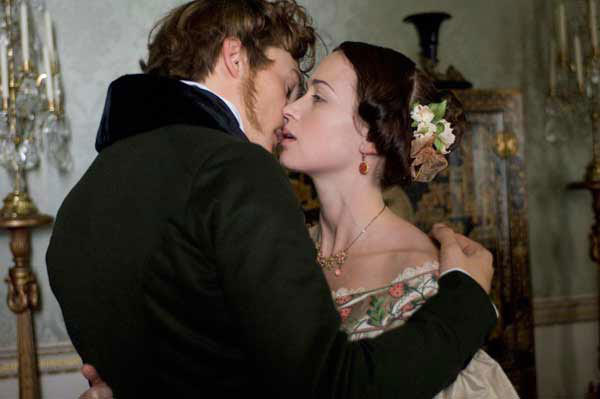
The latest entry in this genre, The Young Victoria - staring a perfectly cast Emily Blunt as the teenage Victoria, and Rupert Friend as her German suitor, Prince Albert - turns out to be a surprisingly tender and moving rendition of the form.

In the Victorian age (1837 - 1901) we're placed somewhere between the bloody intrigue of Elizabeth/The Tudors and the modern polite protocols of today's British Queen, so don't expect any heads to roll or battles to be raged in this outing. In fact, the Victorian era was Britain's high point of peace and prosperity, and the filmmakers are actually quite sly to make a film about the young queen rather than the old, for this is a tale of young hearts and true desire, yet while using the name of a woman ultimately associated with an age of fastidious virtue.

The young Victoria - the little girl being raised as a princess and heir to the throne in the early 1800's - is actually a precocious, lively spirit who is trapped herself in a world of repression by an overprotective mother and her scheming minister, Sir John Conroy, who wishes Victoria to sign the order that would make him official regent upon the death of the King. Victoria stubbornly refuses, innately distrusting Conroy, and knowing that her future is at stake.

It's not too difficult to discern Conroy's character given the way he treats Victoria's dog: variously coddling or kicking depending upon his mood. The dog becomes a stand-in for Victoria herself (a nicely used form of metonymy), and it may be with you - as it was with me - that the affection for dogs in this movie eventually softens your heart, and draws you even closer in to the character's fears and desires.

Even though they are royals, the schemes by various Kings and Uncles to have their way with Victoria's royal powers are portrayed with the kind of boisterous of feuding families - replete with birthday-party embarrassments and nuptial snubs. Only one man, it seems, has Victoria's true interests in mind. That man is the young, handsome Prince Albert, who even as he wins Victoria's heart, still must convince her that he's also worthy of her trust.

It actually surprised me, in the end, how the movie takes a turn away from historical melodrama towards passionate love story. This Queen is perhaps more than those that have come before someone our modern selves can relate to: a younger sister, perhaps, who must learn how to take her place in a dangerous world amongst self-interested family, and decipher with whom she can fully open her heart. Blunt wins us over into the dilemma of the character (as does Rupert Friend as Prince Albert), and even if the movie doesn't quite follow the official history, the ending becomes surprisingly moving, as any story of young people finding true love, told with feeling and felicity, ultimately can be.

It's interesting, then, that a movie genre with such a background of intrigue, social station, and politics ultimately becomes about something else: about the dynamics of young love, and how new lovers, who may be, in fact, the most inspired people on earth, can support the best in each other. It's a bit of a turn from where we started, with plots and contrivances to control the heir and manipulate the throne. But then, perhaps this is like the drift of the Victorian age itself, becoming less about power than about symbolism: and in the case of Victoria and Albert, symbolism for finding the goodness in other people, and using our station to improve the world.

And yes, I admit, I did get weepy in the end. But to be honest, I couldn't tell whether it was the love story, or simply sadness at how our current political life, dull and ruthless as it is, so misses such inspiring figureheads: both their stubborn courage, and their bright idealism.

Saturday, January 16, 2010

It's Complicated: William Sonoma Goes Hollywood

The past few weeks, there's been a corporate fight between Cablevision (my local cable channel) and Scripts (the producers of Home and Garden TV and the Travel Channel) that has resulted in HGTV being off the air.

It's been going on long enough that apparently my inner home-show gene activated its survival mechanism and forced me out to see It's Complicated, a barely concocted comedy for women of a certain age, staring Meryl Streep (as Jane) and Alec Baldwin (as Jake) as a divorced couple in their late fifties who discover they still have the hots for each other.

The plot of this inoffensive enough affair is of little consequence, but I do must say that the designer Santa-Barbara style house is fabulous, the flowers perfectly arranged, and food photography worthy of a cover spot on Martha Stewart Living. If William Sonoma were launching a cable channel, this would be its flagship film.

Until I saw this movie, I'd forgotten about the word "yuppie," but there doesn't seem a better adjective that one can trot out from the dictionary of Eighties slang than this to describe this languid affair. It's not so much that the couple in the film both exude the self-absorbed happy-peppy self-indulgence and pre-washed wealth of that over-exposed generation (Alec Baldwin's constant boyish celebration of his naked, unhealthy girth, rubbed in our faces with deluded intimations of supposed sexiness, strikes me as the perfect Yuppie metaphor); it's that the entire production has the feeling of mid-Eighties soap opera of the Dallas/Dynasty variety.

In some cases, the jokes are better (there's a nice zany bit about Jane and Jake being surreptitiously observed by their son-in-law while meeting for a quick poke at a local hotel, as well as a humorously staged scene of pot-induced dating revelations when Jane and her latest boyfriend - Alex, played with sleepy understatement by Steve Martin - and Jake and his wife attend a graduation party for their son). These bits are funny (I laughed, despite myself) and there's no doubt that the intended audience, women in their fifties and sixties, were thoroughly enjoying themselves.

The story is humorous enough when it needs to be, it's just that the self-satisfied wealth (Jane, who lives in a seaside Santa Barbara paradise worth - at least - several million buckaroos, find hers kitchen "limiting" and spends most of the movie planning an addition) and the oblivious narcissism of the characters (she is so out of touch with the world around her that her children are mere happy props in her home style decorations, and she needs a psychiatrist to tell her what to feel) made me want to hate this film, most of the time. Jane and Jake are essentially spoiled well-off sixty-year-old teenagers (there's no way she should could afford that house selling five dollar croissants at her Whole-Foods-ish boutique store): clearly this movie was in the can well before the economy crashed, since it now seems to come from a completely alien world of fantasy upper-middle-class luxury, as if that's the most relevant thing on people's minds.

There's no point summarizing the plot: it goes where you expect. Jane and Jake threaten to get back together, although there's the complicating inconveniences of a new boyfriend for Jane and an existing young wife and kid for Jake, until Jane wises up and realizes...I don't know, that that getting back with Jake wouldn't be complicated enough? That the movie needs a third act? It doesn't much matter.

Part of the problem may be Streep, who is a brilliant dramatic actress but imbues Jane with so much complex interiority that we take her predicament too seriously. Someone like Diane Keaton (who basically performed the same role in Nancy Meyer's earlier version of this story, Something's Gotta Give) would have been more over-the-top, with a heightened comedic reality that might have softened the yuppie ostentation a bit. Watching Streep pick perfect ripe tomatoes in her overstuffed, manicured garden while analyzing her affair with ex-husband Jake is a cliche almost to the point of creepiness: the scene had me ready to find a Saturday-Night-Live actor burst into the frame at any moment to make some self-aware postmodern remark about Jakob Krutzfeld disease or Haitian refugees or something else equally deflating. But unfortunately, that didn't happen.

I may be being too hard on this film. It's not like any animals were killed (though a few more cute dogs might have heightened my enjoyment), it's competently directed (even if Jane and Jake's three kids bounce and hug like Tellitubies every time they enter a scene), and it's certainly passable enough - and probably enjoyable, if you're the target demographic for stuff like this. If you're not, however, don't say I didn't warn you.

Friday, January 15, 2010

Broken Embraces: Almodóvar Matures

For the first hour of Broken Embraces, the latest soap opera from the flamboyant and prolific Spanish director Pedro Almodóvar, you feel you are watching the director’s best film yet. At turns intriguing, surprising, mysterious, and human, the movie opens with an insight into character, memory, and personal history that’s keenly observant to the point of elevating this material above anything that has come from Almodóvar before.

Mateo Blanca (who has, for some mysterious reason, assumed an alias of “Harry Caine”) is a blind screenplay writer, who busies himself picking up sympathetic women on the streets to pass the time when he’s not being consumed by his latest inspiration. (Come to think of it, that could well be a straight version of our director, Almodóvar.) He’s being assisted in his writing life through the attentive care of a woman and younger man (Judit and Diego) – as we later find out, the woman is his former production manager, the young man her son. One fateful morning, a young man named Ray X shows up at Harry’s door, demanding to be seen. Ray X apparently knows much more about Harry’s life than a person should, and is threatening to write some kind of film, vaguely related to Harry’s past.

But of course, the star name in this movie is Penelope Cruz: who plays the character of Lena. Cruz doesn’t show up in the film until this moment, when Harry pulls out a photograph of her from his drawer to show it to his spooky, inquisitive visitor. But she is, indeed, the subject of the movie: Harry’s lost love, the tale of which we find out through an extensive flashback as Harry relates the story to the young Diego while he’s in the hospital, recovering from an unintentional overdose of GMBH.

The story that Harry relates about Lena – including her possessive boyfriend, the head of a powerful bank, as well as Ray X, the spooky young hopeful writer – eventually intersects with Judit and Diego, Harry’s devoted friends (one of whom has a fateful confession to make), and all the threads of the tale eventually come together as superb melodrama.

As my companion in the theater noted, Almodóvar is a kind of Spanish version of Woody Allen – providing knowing set pieces of lives of artistic import and modern relationships. Almodóvar just provides a few twists on the typical Woody Allen approach: more gay, more Spanish, more melodramatic, and more modern. That makes him more interesting – willing to fly a bit higher, and take a few more dramatic risks – and yet, like Woody, Almodóvar insists on bringing his films, at the end, back down to a simple tale of “slice of life” and the quiet desperations of his middle class characters.

We can see the tightly controlled tone of the first half of the movie loosening up as Almodóvar navigates his way to the end – jumping between heightened pathos and incidental slice-of-life. This modulation of high/low is a signature Almodóvar style that, at first, he seemed to be growing out of here. Though that’s a bit disappointing, the ending makes sense of what’s come before in a satisfying enough way: Ray X eventually provides the missing part of the story that Harry has been searching for: what actually happened that night that Harry (then Mateo) went blind, and lost Lena forever.

There are a few things I think Almodóvar might have done that might have tied up his themes a bit more neatly: for instance, why does Diego not hide from Harry, as has been hidden from him, the reality of that fateful moment, which has been captured, in delicious irony, on film? It seems an obvious opportunity to plumb Diego’s character, and its relationship to Mateo, that Almodóvar has missed. After all, in a story about history, memory, and innocence, the next generation is what an audience comes to care most about - and indeed, represents the concerns of a mature story-teller. Instead, Almodóvar seems to have become enamored of his recreation of his earlier movie – the film-within-a-film that’s his re-telling of Women of the Verge – which is a neat trick...but the kind of thing we might expect from a younger director, and not nearly as important to the story as the boy and his future has become.

Which is why Almodóvar’s focus in the last half hour of the film (after the momentous confessions begin) seems to be off – broader, scattered, with the humorous irony of his early films but lacking the confidence and subtly we’ve been treated to until this point. In the end, Broken Embraces is about how a movie director chooses to perceive – and edit – the painful and pleasurable moments of the past, as well as how we relive our histories through the lives around us. Almodóvar manages to keep that delicate tone in balance for most of the movie, and just a few more delicate scenes at the end to tie it all together would have made this a mature masterpiece, indeed.