Showing posts with label Amy Adams. Show all posts

Tuesday, August 18, 2009

Julie and Julia: Should Have Halved The Recipe

I can imagine the conversation that must have gone on when Nora Ephram went to the studios to pitch a movie about Julia Child. "Julia Child?" some twenty-two year old executive must have said. "How will movie-goers related to a deceased French cook?" (or perhaps worse, "who's that?"). The solution: license two books, one about Julia Child, and the other the book based on the blog by the young woman who spent a year cooking all of Julia Child's recipes ("The Julie/Julia Project"). It's about Julia, see, but younger audiences will relate to the young chick.

Then mix thoroughly and voila: audiences will flock. Unfortunately, rich as the ingredients are, the final confection falls flat, and probably due to all that mixing.

The Julia story – played by the always wonderful Meryl Streep and supported by an equally wonderful Stanly Tucci – tells a warm and tender story about how an American diplomat’s wife, stranded in Paris, learns to cook in order to pass the time, and eventually finds her métier in besting the stuffy French and translating French cooking for the “servantless” American audience. Julia and her husband are very much in love, and the story is really about how women in the Fifties, servants to their husbands, were still able to occasionally find acclaim and satisfaction by discovering their hidden talents (if they were lucky enough to have husbands with the right careers, and the right politics).

Then there’s the Julie story – about a modern, twenty-something Brooklynite who discovers Julie Child’s cookbook and decides to cook every recipe over the course of a year. This tale is rather the opposite. Dour and unrelenting, this Julie has been turned into a stock Nora Ephram heroine: winey, self-absorbed almost to the point of weird obsession, more than a bit neurotic and the last person any man would want to spend any time with (the voice exhibited in the Julie/Julia Project blog is much more accessible than the character played by Amy Adams, and one feels sympathy with this author for what Ephram has done to the character.)

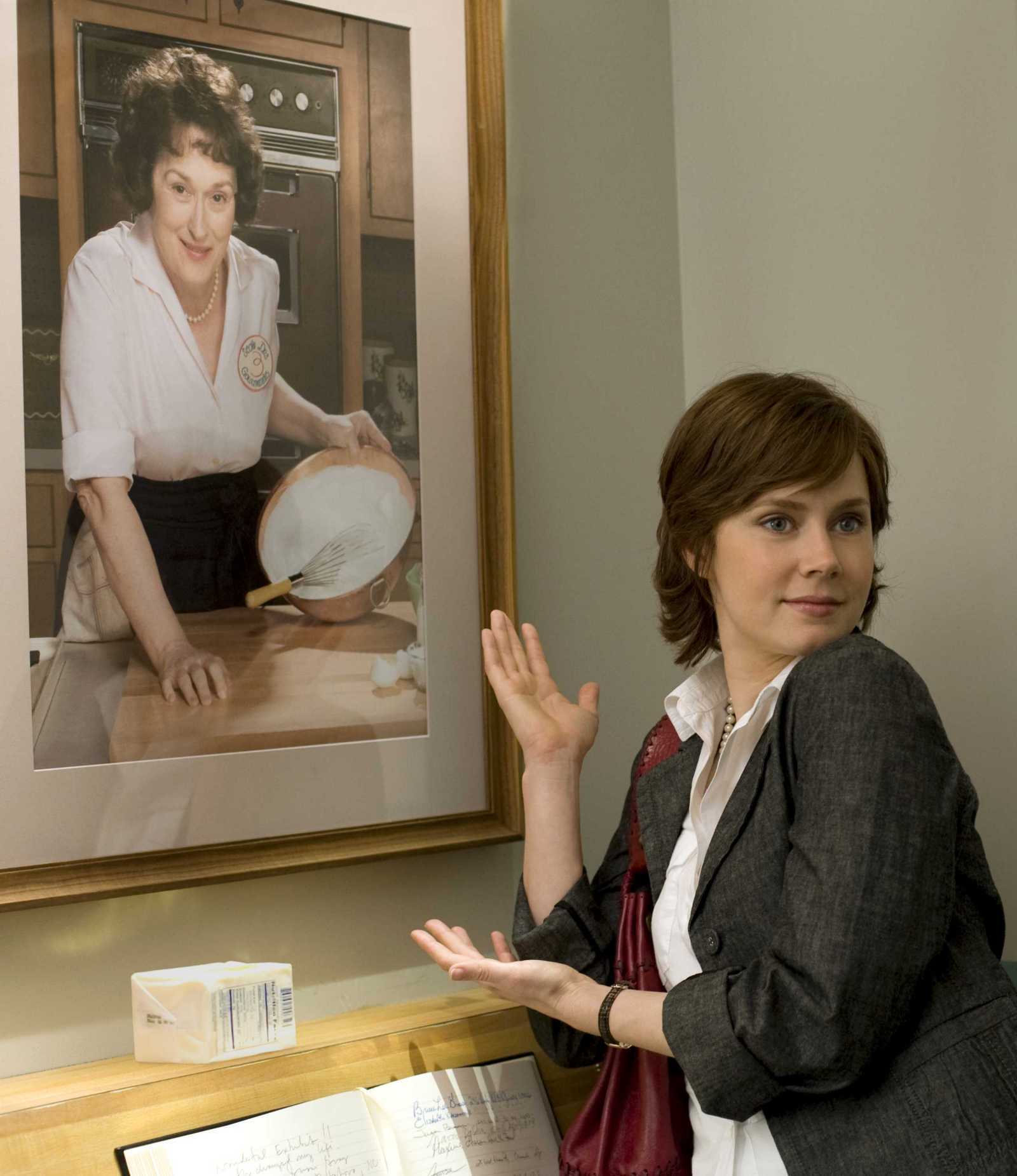
Ephram chops up the Julia story and sprinkles in the Julie story, shifting the mood between uplift and whiney, to the point that by the time the movie finishes, with Julie reminiscing in the Smithsonian over Julia’s kitchen, we feel cheated of both stories – the Julia story seems to be just getting going, and the Julie story should have ended long before, after an interminable sojourn in Julia’s footsteps with no new insight.

I don’t think the problem is necessarily Amy Adams (who’s serviceable enough) so much as it is Ephram’s cloyingly morose view of her heroine (and the fact that her story line must compete against the incomparable Streep, who elevates everything she touches). Adam’s Julie is a beleaguered assistant at the Lower Manhattan Redevelopment Corporation, hating her job and hating her new spacious brownstone loft, with its expansive deck and room for elaborate dinner parties, over a pizzeria in Queens. Yeah, that’s tough. Ephram shoots Julie’s trudge to work through the New York subway system through the “drab” filter, washing out colors and packing the frame with mundane details of office cubicle desk life. In part, this is meant to be a contrast to the romantic view of Julia’s 1950’s Paris, but it struck me as ungrateful: ninety percent of Manhattan’s middle-class intelligentsia lives this life, and enjoy it rather much – thank you. And I know the people working at the Redevelopment offices, and they are quite happy to be doing what they see as important, meaningful work.

Not so our Julie, who is pained by every workplace phone call and finds having a marvelously sexy and supportive husband who actually has a job he likes a real drag. My feeling is that this is all rather changed from the original blog project, which was written for quite different reasons (mainly to occupy time while unemployed, and establish a career). That Ephram changes the motivations of the heroine does significant damage to the story, I believe. I’d find it much more interesting to learn the strategic process of a happy blogger – or to just get the straight story of Julia Child’s life – than to sit through the sad lamentations of a female Woody Allen who draws inspiration from an imagined cooking Yenta. Yes, Woddy populates his New York portraits with nebbishes too; the difference is, he’s funny.

All of which makes it more painful to report just how wonderful Steep is in the backstory role. Julia Child is a character of easy parody, but Streep creates a person that is far deeper than, yet still recognizable as, the character we think we know. As Child, she brings the same kind of kooky intensity to discovering Paris and ingratiating herself into Parisian society that she later does to cooking and writing. Stanley Tucci lives up to his role as Mr. Child, loving his wife and lending his sympathetic ear as she finds her passion, and the straight story line of how Julia became Julia is the most moving and interesting thing in the film.

All the more reason to be disappointed by that ending in the Smithsonian, which stops us short of finding out the really interesting parts of Julia’s life, and refocuses back on the sad symbolism of our nebbishy heroine. I was fascinated by Julia Child’s kitchen – and curious to learn more of how she mixed her home life with her career. But by this time, I was thoroughly fed up, as it were, with the elaborately layered soft terrine of audience appeal Ephram was trying to make instead. Julia herself would have stripped out all that gooey gunk and served it to us straight, and perhaps raw.

Monday, May 25, 2009

Night at the Museum: Battle of the Smithsonian Merchandise

I was dreading Night at the Museum: Battle of the Smithsonian, until I saw the trailer, and actually laughed at a few of the jokes. That's because I thought the first movie was one of the lamer films to come out the of Ben Stiller ouevre - well below Zoolander and hanging out slightly below Dodgeball on the Stiller scale. And maybe I'm not a big fan of Stiller's borscht-belt humor. But I felt the first Museum was moribundly slow, overly pretentious, and leaden with Stiller shtick. Yes, the coming to life was a cool concept, but it was buried under too much schmaltz and plot device to be worth wading through.

So I'm pleased to report that the sequel vastly improves upon the original. Gone is the over-long backstory setup (Stiller's character, Larry Daley, is now a successful inventor, and that's all we need know). Gone, too, is most of Stiller's camping for the camera (there are just a few such moments) and the lard ass direction of venerable comedians like Dick Van Dyke and Mickey Rooney. Instead of trying to create a Ben Stiller movie with a cool "coming to life" effect, the makers of the sequel have a much clearer idea of who the audience for this film is: little kids. And they have gone after them squarely.

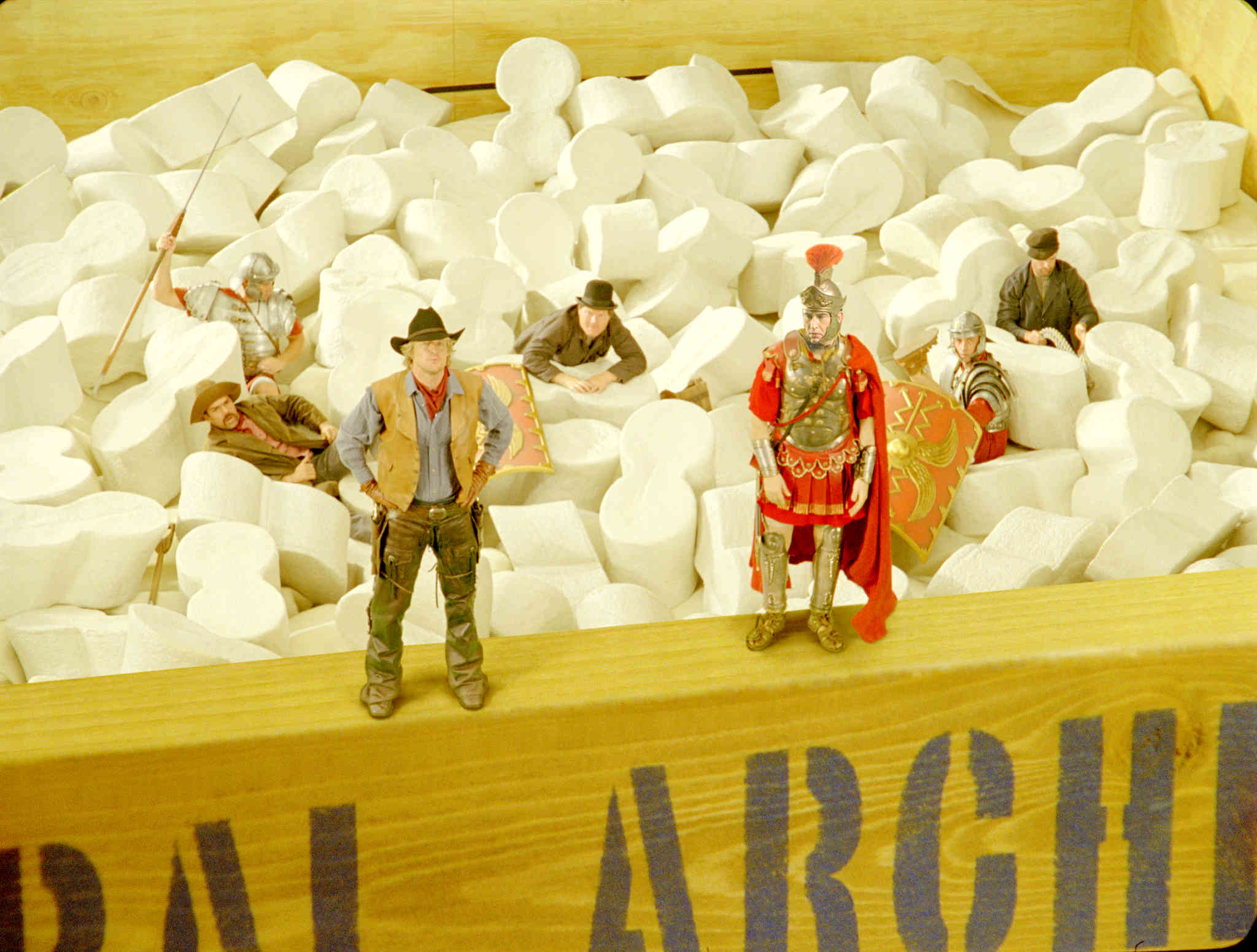
Pretty much all of the original museum come-to-lifers are recruited for this second chance at Stiller humor, including Robin Williams as Teddy Roosevelt, and Owen Wilson as the tiny Jedediah Smith and Steve Coogan as his miniature rival, Octavius. This time, the exhibits at New York's Natural History Museum are being shipped down to the Smithsonian for long-term storage. When Ankmenrah's tablet ends up going with them, it comes into the posession of his elder brother, Kahmunrah (played with sniveling effetery by Hank Azaria). Azaria's performance of this cream-puff villain is aimed squarely at the Sponge-Bob Squarepants set. Meanwhile, the tablet performs its same magic on the creatures at the Smithsonian, pitting them in battle against the visitors from New York and creating the same come-to-life wonder as the first movie.

What makes this outing more bearable is that Stiller is given more of a back seat to the interesting incarnations, which include characters from the Smithsonian archives, the Air and Space Museum, as well as the Lincoln Memorial and the Art Galleries. The creativity of these new animations is quite fun - including the animated art and the industrious NASA flight engineers.

Indeed, this movie ends up being quite an effective advertisement for the art, exhibits, and history stored in the museum. The kids we were sitting with were having a great old time. And if this movie instill in kids an interest or love of visiting the museum, I'll rate it a great success.

As for the adults who accompany them, well, you could do worse for two hours. You could have to see the original. At least Jonah Hill has an uncredited walk-on as a security guard, the animated artwork is cool, and Amy Adams makes a passable Emilia Erhart.

So how would I rate this film? If you're five years old or less, I'd give it five stars: it's a classic, right up there with Teletubbies and Spongebob. When it comes to entertaining little kids, these guys hit the nail on the head. For everyone else, I'd give it two. So that's how I get to my average of three.

Sunday, December 28, 2008

Doubt: A Study of Opposing Faiths. And Acting Styles


It's just at the climax of Doubt - at the point where Meryl Streep's Sister Beauvier and Phillip Seymour Hoffman's Father Flynn confront each other behind closed doors, and one of them ultimately relents - that you realize that the end of this marvelously acted drama is going to come sooner than you expected.

Not that the movie, at one hour and forty-four minutes, is unusually short. But the story seems unusually quickly resolved...at least on film.

In other words, despite the amazing performances by the two principles - and by Amy Adams as the innocently naive Sister James, as well - the movie suffers a bit from that old syndrome of theater directors translating their work to film: what works in a theater, in front of a live audience, struggles as a movie to deliver the same sense of satisfaction. And why? Because theater is a medium of words; movies are a medium of images. The images in this movie are rich, textured recreations of a 1960's Catholic school. Unless that holds some special nostalgia for you (and it doesn't for me), there's little else other than the words and acting of this parable of inquisition to hang your hat on.

But supreme acting it is. I would normally be writing a review about how much better it would be to see this story on the stage - but unless you had Streep going up the stalwart Hoffman, you would miss two amazing performances from two of our best actors. So it's worth buying a ticket, and especially so to see Streep give yet more evidence of why she's probably the best actor on earth.

Streep's Sister Beauvier represents, of course, the old ways of the church: relying on strict discipline and the aura of fear to keep young minds in line. What Streep does so well, of course, is make this a complicated character, not a stereotype. Sister Beauvier is strict, of course, but also capricious, humorous, self-deprecating, even compassionate, and convinced of her convictions, and the rightness of her actions. She has something to teach the young, idealistic, and somewhat incompetent Sister James about how to command respect, not just obedience, and Sister James listens, and learns. She learns a little too well, and becomes an unwitting accomplice to Sister Beauvier's suspicions about Father Flynn, and what he may be doing behind closed doors with some of the more susceptible alter boys.

Hoffman's Father Flynn, for his part, is the opposite, or counterpoint, to Sister Beauvier's strict authority: a full-figured fellow who loves life and hearty appetites, he represents the new age of Sixties enlightenment...a kind of early flower child, who points out that the word of the lord is "Love" and that doubt is an emotion that creates a human community. He also, it turns out, is a man of as much principal as Sister Beauvier. Hoffman brings the kind of iconoclastic intensity of his character Gust Avrakotos from "Charlie Wilson's War," only better groomed and cherub-cheeked. He is no real radical, of course, but his sermons of doubt and deeds of compassion do create a radical disruption to Sister Beauvier's community of austerity.

That the two would ultimately go up against each other is what this story is about. As is the truth behind the accusation that sets the conflict in motion.

All of which is to say, it is a great story, marvelously acted, and full of superbly delivered words, the most moving of which are no doubt Streep's amazing soliloquy to Adams at the end, a kind of poetic coda to the title of the play. Shanley frames his story so that, as one might say, the ultimate villain, and hero, is what you're meant to debate. All of which I appreciate, for I love a good ripping tale that leaves you with such delicious dinner conversation at the end (I think of the play "Art," which I saw in London, which has the same moral open-endedness and conversational effect).

My only qualm is that this marvelous play wasn't filmed by someone with a little more distance on the material who would have felt free to make the changes necessary to make it a superb movie. More on the boy's family, on Father Flynn's acquaintances, on other parishioners might have taken the movie out of its claustrophobic stage-set experience. The movie reminds me a bit of the series Mad Men, especially the character of Peggy Olson and her relationship with religion. But where Mad Men sets Peggy into a broad context of diverse characters, Doubt stays focused on the conflict between Sister Beauvier and Father Flynn. In a theater with live performance, such tight focus creates a gripping experience of high drama. On the more distant movie screen, it creates moments of brilliantly composed acting, and a feeling that all that acting should have someplace more definitive to go.