Showing posts with label Stanley Tucci. Show all posts

Sunday, December 5, 2010

Burlesque: Rehashed Glitz for the Holidays

I wish there was more to this movie staring Christina Aquilera as an impossibly talented ingenue who comes to L.A., moves in next to a burlesque night-club (run, of course, by Cher), and connives her way into the ensemble and to eventually being headliner of the show. The movie follows tried-and-true hollywood formula (they've been telling this story ever since All About Eve: Chicago was the latest incarnation) and offers few surprises...except for the music. The music is actually much better than one might expect for a film of this type (aimed at gay men and teenyboppers) and thank god, too, as it's what gets you through the sappy storyline.

Surprisingly, Aquilera gets most of the numbers - that woman can sing. We only get two Cher numbers, but it's nice to see her vocals still resonate. One forgets that Cher is also quite an actress (does anyone remember Silkwood? Mask? Moonstruck?). Cher was an Eighties sensation and she and Stanley Tucci (as her gay manager) are the adults in the film. They liven up their scenes with lighthearted banter while the rest of the characters make somber sincerity out of their tinfoil lines.

When Aquilera's character, Ali, arrives in Los Angeles - with just $200 dollars in her pocket - my first thought was that this could be the very same opening about how women end up being hookers in L.A. But this isn't a movie about lost dreams and the hard realities of the street. In fact, just the opposite: it's a pure fairy tale where the princess comes to town in order to conquer the world, in just three easy lessons. Perhaps the most inane aspect of the movie is the romance between Ali and the bartender who first introduces her to the society of the club, Jack (played by Cam Gigandet in eye liner, three-day beard, and 1% body fat). "I thought you were gay," Ali tells Jack while sleeping over at his apartment (his girlfriend is conveniently away in Paris). No - not gay, just gay bait. The two of them slink about each other for the remainder of the movie, setting up sit-com-like reasons for not consummating their mutual lust until the absolute moment when its no longer possible to put off. The whole affair is impossible to watch except for Gigandet traipsing shirtless in order to entertain the ladies (and gay boys) in the audience. This is one of those films where anything that happens between the characters makes no sense other than as pure titillation.

Of course, the plot hinges on whether Cher's Tess will lose the club, whether Ali and Jack will ever get it on, and how all will come out right in the end. In between we're entertained with various burlesque numbers - singing and dancing - that's probably worth the $10 price of admission considering there's little else of musical note at the movies these days.

The producers of this movie are clearly trying to capture three different audiences at once: teenage girls, gay men, and women of a certain age who like the old Hollywood musicals. That gives this movie a bit of a feel of the Palm Springs Follies...though I have to say, with performances from knock-out singers like Aquilera and Cher, Burlesque certainly delivers the numbers.

Thursday, October 7, 2010

Easy A: Sluts and Nerds Rule!

Easy A continues the trend of high-school flicks like Clueless and Juno about smart-mouthed, brainy high-school girls and their foibles. A kind of female Porky’s for the drama-club set, films like Easy A center on the outsiders, not the insiders, but offer the same kind of high-school love triangles, popularity issues, and show-downs at either the high-school dance or the big game. Instead of the nerds and outcasts being the antagonists (as they are in a film like Porkys), the bad-guys in these drama-club high-school films tend to be the jocks and the Christians, who in fair turnabout are portrayed in pure caricature. This film doesn’t disappoint.

While it may not have the wit-a-minute dialogue of Clueless or the clever hijinks of Juno (and the device of narrating the movie into a web-cam wears a bit thin), it holds its own, due largely to the engaging performance of Emma Stone (Superbad, Zombieland) as lead character Olive, a girl whose lies about her dating life threaten to ruin her reputation.

Perhaps in attempt to embrace the literary kids in the audience, a reigning trope of these movies is to borrow some kind of high-school literature to mold the plot around (Jane Austin’s "Emma", in the case of Clueless: Othello and Taming of the Shrew have also served). In this case the English assignment is Nathanial Hawthorne’s "The Scarlet Letter" (there’s even a short summary of the plot, for those who haven’t read it). Olive’s problem, it seems, is that she’s invisible. And as Oscar Wilde said, “one can live down anything except a good reputation.” So she seeks, perhaps perversely, to go about destroying it. When the rumor-mill starts to fly around school that Olive is a slut (even though she hasn’t actually slept with anyone), she literally attaches a scarlet A to her dress, reveling in being the bad girl.

She finds, however, that she can use her bad-girl reputation for good, especially with the guys in school who need their own reputation boost – whether because they are gay, overweight, or sleeping with the guidance councilor. But lending her services as a stage slut, she soon finds there are disadvantages to having destroyed her reputability. For one thing, it’s become harder to get a genuine date.

Except, of course, with the handsome, understanding hunk (Penn Bagley) who’s always hung around in the wings, having a thing for her. She also finds it impossible to get a rise out of her nauseatingly understanding parents (Stanli Tucci and Patricia Clarkson), who are impossibly supportive and hip. (Just to show how hip the parents are, they’ve adopted a black kid – Olive's younger brother – who is given nothing to say in the picture and generally is trotted around like an accessory… a kind of weird liberal racism that would put Angelina Jolie to shame.) None of these super-supportive characters are believable and seem to exist only to eventually extricate Olive out of what is essentially an inextricable situation. (“Glass, china, and reputation are easily cracked, and never mended well,” says Benjamin Franklin. Possibly Olive has not read her Franklin.)

In the end, however, Olive is able to explain the whole thing and restore her reputation, but not before a lively, sexy performance with her toy boy at the pep rally for the big game. It’s a solid number and worth waiting for.

So despite its razor-thin characterizations, I do have to appreciate a movie that celebrates sarcasm, has self-aware, confident teenage gay characters, and takes a few good swipes at religion. The movie also has some nice ironic awareness of teen film form (there’s many a reference to John Hughes pictures) and Lisa Kudrow doing her nutty thing as the guidance councilor. It’s a bit lightweight and some of the cutesiness may make you gag, but a solid entry into the canon.

Thursday, February 11, 2010

The Lovely Bones: Afterlife Murder Mystery


Why did director Peter Jackson take on directing the Alice Sebold story of a fourteen year old teenage girl, Susie Salmon, who’s murdered by a sexual predator and must learn to let go of her attachment to the world in a protracted “in between” existence in the afterlife? Probably because at first, this would seem a complete departure from Jackson’s earlier work, Lord of the Rings and King Kong.

Susie is a typical teenage girl living in the mundane 1970’s: she makes ships in a bottle with her father, hangs out at the mall, has a zany, chain-smoking grandmother (Susan Sarandon), writes in her diary, and has a first crush on a boy – Ray, a lithe and elegant Indian Brit who adds an air of foreign romance to Susie’s Midwestern suburban life. She finally meets Ray one day in the hall at school, and he invites her to a date under the gazebo at the mall, where she intends to have her first kiss.

But Susie's innocuous teenage world is cut short when she's intercepted on her walk home by sinister neighbor, George Harvey. Stanley Tucci just received a best supporting actor nomination for this role, and clearly it's the star turn (along with Sarandon) in the film, though I felt that most of George's sinisterness comes from a single Tucci gesture: a kind of coughing inflection that turns involuntarily into a momentary hungry smile every time he speaks of Susie. It's a pretty dead-on illustration of a super-creep, but he does keep you on the edge of your seat waiting for that lustful grin to once again erupt.

Jackson goes to great pains to fully place us into the 1970's style, and this, for me, is where the movie is its most successful, because the style itself becomes a kind of character, as once Susie leaves this mortal coil and enters her imagined dream world, it's populated with heavy symbolism from that 1970's life she once inhabited: the flights of wooden birds in her father's study become a flight of tree leaves turning into birds; the ships in bottles become real ship-size bottle ships that crash into shore when her father's grief drives him to bust up his prize collection. Even that mall gazebo takes a symbolic turn as Susie's center of gravity and symbolic self.

Here, then, one might begin to see the similarities to Jackson's earlier work. The teenage Susie's 1970's world of Partridge family and shopping malls is not too dissimilar from the idealized home of the Hobbits, and the existential threat to this world posed by creepy George is no less distressing than Mordor itself. And if one looks at The Lovely Bones as a kind of Lord of the Rings for our times, then I think the incoherent mythology of the afterlife it portrays starts to make a bit more sense.

This interpretation of Susie as a kind of floating spirit that needs to learn to accept her own death is startling and wonderful, at first: the moment when Susie is killed and only hours later realizes what's happening is handled with enough originality and grace to take your breath away (she breezes past another young girl, running to escape George's clutches, and eventually finds her family, and then her killer). But I say "incoherent" because thereafter, it's not quite clear if Susie's incarnation follows the traditional ghostly rules of something like Ghost, if she's more in a momentary psychological fantasy land (like the cloyingly awful What Dreams May Come), or if this is some kind of Catholic interpretation of purgatory. It seems to be a bit of each and none of these - if anything, the vast beautiful psychological landscapes Susie inhabits most closely resemble the cosmic journey taken by Jody Foster in Contact.

However, what rules I think this afterlife does follow are simply mythological - like they were in Lord of the Rings. Like the dead kings who fight the battle of Helms Deep, Susie is obligated to the world, and cannot leave it until she accomplishes one final task: to identify her killer to her family (and also, it seems, to find a way to have that first kiss she was robbed of). All this strikes me as too much like the EST program of a living Californian, rather than the spiritual journey of a dead 1970's Midwesterner. But then this, I suppose, is what most people have now instead of traditional religion: a kind of gauzy, three-act view of the afterlife in which unresolved conflicts must be resolved, and romantic entanglements must be satisfied, even if one must invent old-Hollywood supernatural ways to do it. Jackson does it here, like he does in his other lost worlds.

It just doesn't work as well for me here, however, since the first half of the movie is so grounded in the modern realism of the 1970's. Sarandon's character of the zany, smoking grandmother does add a pleasant irreality...and I wanted more of that. I wanted Sarandon to come back at the end. I wanted more than an icy dose of random fate for George. I wanted more from Jack and Abigail Salmon, Susie's earnest and intense parents, than Mark Wahlberg (terribly cast) and Rachel Weisz could deliver.

That being said, the movie does leave you with a profound sense of sadness and feeling for life: Sebold's poetry breaths enough, and Jackson is elegant enough with his visual metaphors, that one is fully transported by the experience of this movie, even if, like many Hollywood attempts at the afterlife, it illustrates a world designed more to gently sooth than to really understand. There really is no sense to make out of what George does, in this movie, and the movie seems to want to say, that's not the point. That Susie gets a first kiss, finally, isn't the point for me either - since such a kiss is impossible. The movie, then, has no point...other than, that's life. In a way, that's enough by itself to be haunting.

Tuesday, August 18, 2009

Julie and Julia: Should Have Halved The Recipe

I can imagine the conversation that must have gone on when Nora Ephram went to the studios to pitch a movie about Julia Child. "Julia Child?" some twenty-two year old executive must have said. "How will movie-goers related to a deceased French cook?" (or perhaps worse, "who's that?"). The solution: license two books, one about Julia Child, and the other the book based on the blog by the young woman who spent a year cooking all of Julia Child's recipes ("The Julie/Julia Project"). It's about Julia, see, but younger audiences will relate to the young chick.

Then mix thoroughly and voila: audiences will flock. Unfortunately, rich as the ingredients are, the final confection falls flat, and probably due to all that mixing.

The Julia story – played by the always wonderful Meryl Streep and supported by an equally wonderful Stanly Tucci – tells a warm and tender story about how an American diplomat’s wife, stranded in Paris, learns to cook in order to pass the time, and eventually finds her métier in besting the stuffy French and translating French cooking for the “servantless” American audience. Julia and her husband are very much in love, and the story is really about how women in the Fifties, servants to their husbands, were still able to occasionally find acclaim and satisfaction by discovering their hidden talents (if they were lucky enough to have husbands with the right careers, and the right politics).

Then there’s the Julie story – about a modern, twenty-something Brooklynite who discovers Julie Child’s cookbook and decides to cook every recipe over the course of a year. This tale is rather the opposite. Dour and unrelenting, this Julie has been turned into a stock Nora Ephram heroine: winey, self-absorbed almost to the point of weird obsession, more than a bit neurotic and the last person any man would want to spend any time with (the voice exhibited in the Julie/Julia Project blog is much more accessible than the character played by Amy Adams, and one feels sympathy with this author for what Ephram has done to the character.)

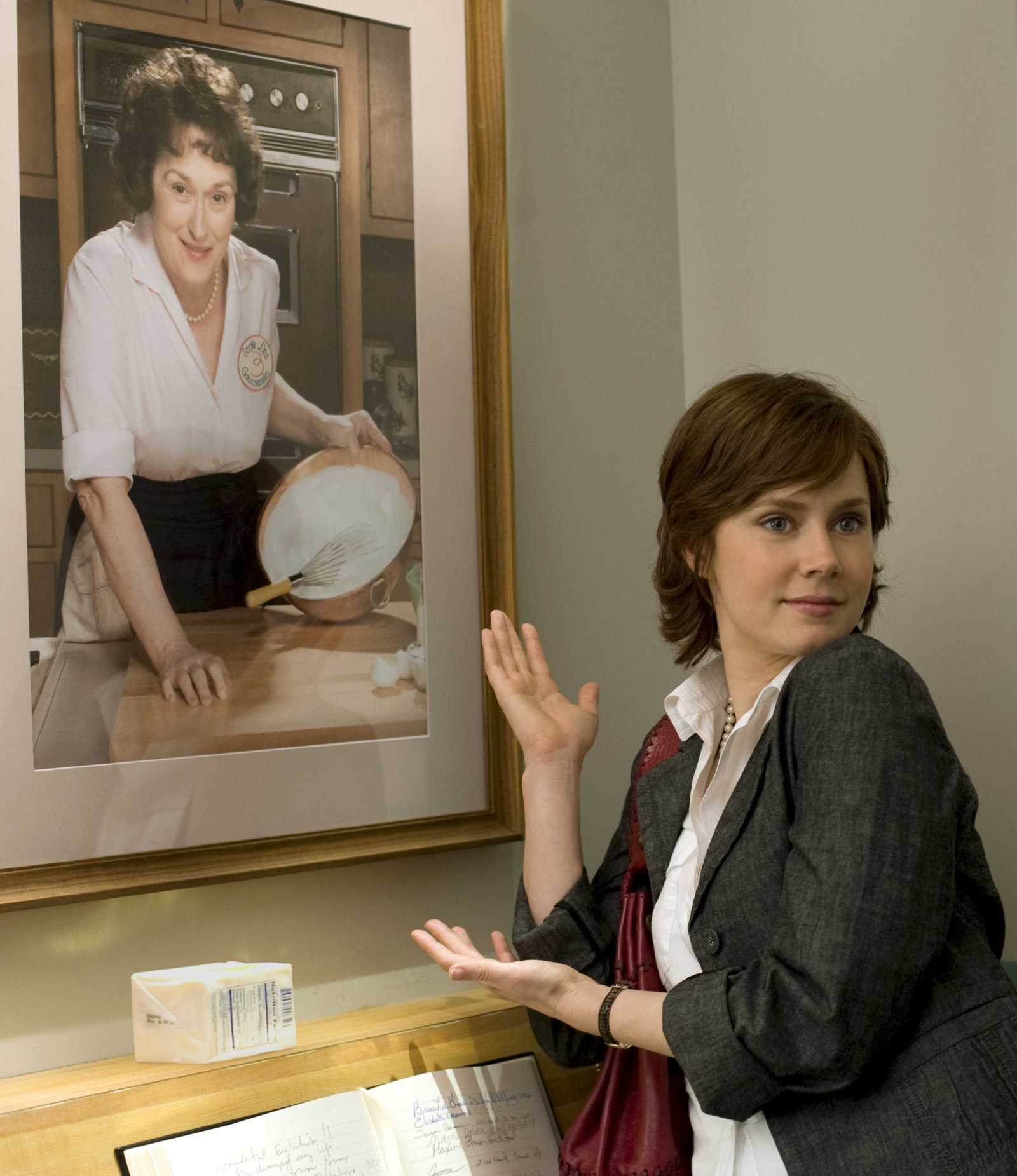
Ephram chops up the Julia story and sprinkles in the Julie story, shifting the mood between uplift and whiney, to the point that by the time the movie finishes, with Julie reminiscing in the Smithsonian over Julia’s kitchen, we feel cheated of both stories – the Julia story seems to be just getting going, and the Julie story should have ended long before, after an interminable sojourn in Julia’s footsteps with no new insight.

I don’t think the problem is necessarily Amy Adams (who’s serviceable enough) so much as it is Ephram’s cloyingly morose view of her heroine (and the fact that her story line must compete against the incomparable Streep, who elevates everything she touches). Adam’s Julie is a beleaguered assistant at the Lower Manhattan Redevelopment Corporation, hating her job and hating her new spacious brownstone loft, with its expansive deck and room for elaborate dinner parties, over a pizzeria in Queens. Yeah, that’s tough. Ephram shoots Julie’s trudge to work through the New York subway system through the “drab” filter, washing out colors and packing the frame with mundane details of office cubicle desk life. In part, this is meant to be a contrast to the romantic view of Julia’s 1950’s Paris, but it struck me as ungrateful: ninety percent of Manhattan’s middle-class intelligentsia lives this life, and enjoy it rather much – thank you. And I know the people working at the Redevelopment offices, and they are quite happy to be doing what they see as important, meaningful work.

Not so our Julie, who is pained by every workplace phone call and finds having a marvelously sexy and supportive husband who actually has a job he likes a real drag. My feeling is that this is all rather changed from the original blog project, which was written for quite different reasons (mainly to occupy time while unemployed, and establish a career). That Ephram changes the motivations of the heroine does significant damage to the story, I believe. I’d find it much more interesting to learn the strategic process of a happy blogger – or to just get the straight story of Julia Child’s life – than to sit through the sad lamentations of a female Woody Allen who draws inspiration from an imagined cooking Yenta. Yes, Woddy populates his New York portraits with nebbishes too; the difference is, he’s funny.

All of which makes it more painful to report just how wonderful Steep is in the backstory role. Julia Child is a character of easy parody, but Streep creates a person that is far deeper than, yet still recognizable as, the character we think we know. As Child, she brings the same kind of kooky intensity to discovering Paris and ingratiating herself into Parisian society that she later does to cooking and writing. Stanley Tucci lives up to his role as Mr. Child, loving his wife and lending his sympathetic ear as she finds her passion, and the straight story line of how Julia became Julia is the most moving and interesting thing in the film.

All the more reason to be disappointed by that ending in the Smithsonian, which stops us short of finding out the really interesting parts of Julia’s life, and refocuses back on the sad symbolism of our nebbishy heroine. I was fascinated by Julia Child’s kitchen – and curious to learn more of how she mixed her home life with her career. But by this time, I was thoroughly fed up, as it were, with the elaborately layered soft terrine of audience appeal Ephram was trying to make instead. Julia herself would have stripped out all that gooey gunk and served it to us straight, and perhaps raw.

Saturday, March 14, 2009

Swing Vote Gets On Base With Predictable Comedy

The best thing about Swing Vote may be that Kevin Costner has finally found a role that's right for him: a do-nothing sarcastic slacker who represents the average American dolt. Costner, though an intelligent writer and director, has never quite had the movie-star acting chops that has made me want to watch him from start to finish as he tries to carry a film. But this is a role that seems to come easy for him, though, as with his character, it certainly doesn't offer many challenges.

The premise of this unlikely dramedy is that the Presidential election comes down to the decision of a single voter in New Mexico (Bud Johnson, played by Costner), whose faulty ballot needs to be recast in order to decide whether the incumbent Republican (Kelsey Grammer) or the Democratic challenger (Dennis Hopper) will win the White House.

Ok: an unlikely scenario, I grant you. That's why the first third of the movie drags, since getting us to this convoluted setup seems more tedious than it needs to be. I wish they'd have just been able to give us a five-minute first act and get to the set-up and second act right away, since that's where the dramedy actually begins.

There's nothing here that can't be predicted by a precocious eleven-year old: first one Presidential political operative (Stanley Tucci) suckers our hero with craven political pandering, then the other one (Nathan Lane) tops it, and back and forth the political football bounces. What keeps this kind of well-trod political satire (think Wag the Dog or State and Main) entertaining is that Costner's Bud Johnson is more a symbol than a man: he is the apathetic American Voter, being courted by Cynical Politicians. There are no laugh-out-loud jokes and the satire is more folksy than cutting, but Lane and Tucci give a nice manic counterpoint to Costner's blankfaced laziness.

Meanwhile, Bud's daughter Molly, played by newcomer Madeline Carroll, represents the earnest wonkishness of those of us who truly care about politics. She the kind of kid who seems predestined to grow up to to be an anchor on the McNeil/Lehrer Nightly Newshour, or, as she suggests, chairman of the Fed (though that's unlikely to be as popular an ambition these days). I found Molly a bit too cloyingly civics-class earnest to really take to heart, but what the story does offer is a rather well-done backstory involving Bud and Molly's mother, played in a remarkably acted cameo by Mare Winningham. Winningham's few minutes blows out the other acting in the film and delivers an emotional punch at just the right moment in the narrative, so that we're successfully launched into the film's one and only possible closing. That turn into the improbable finale is an emotional leapfrog moment where a lot of dramadies fall down, but this one tackles it head on and earns - as well as possible given the premiss's artificiality - its inevitable closing grandiosity.

Which is to say that the film ends with a big speech from Bud where - and I doubt I could possibly spoil anything by saying this - he is revealed to have Character After All. I usually hate speeches like that and this one is no different, but since I've accepted the whole movie on its terms so far, it's the only possible speech that Bud could give to end a movie like this.

So it's not a great movie. But I see something of myself in Molly, and I'm a fan of political satire. You could do worse. So if you have to press me - and I figure I'm hesitating a little like Bud here - I suppose that for the five bucks it costs to rent on an otherwise boring Tuesday night, this movie would get my vote.