Showing posts with label Kate Blanchett. Show all posts

Thursday, April 21, 2011

Hanna: A Reverse Fairy Tale

This stylish assassin drama by director Joe Wright (The Soloist, Atonement) tells the story of Hanna, a teenage girl raised in the woods by her spy father, and who comes of age by evading the U.S. international spy network in order to solve the mystery of who she is.

With a stand-out performance by Eric Banna (as the father), a deliciously arch villainess by Kate Blanchett (as Marissa, the head spy out to get Hanna), and an intriguing mix of girlish deadliness by Saoirse Ronan (as Hanna), the movie features strong principals and a decidedly Brothers Grim atmosphere of scary woods, carnivalesque cities, and even a wonderfully atmospheric appearance by the Big Bad Wolf.

The script is a bit thin on substance – Hanna’s father toughens her up in the isolated woods in order to release her into the world where she will be a super-assassin, capable of simultaneously disarming tourists with her smile and disabling armed grown men three times her weight with a single karate chop. The rest of the script, the CIA chases after her through various exotic locales (again, remnants of the Bush administration here, as the new “cold war” thematic center on Arabian deserts and underground interrogation centers), while Hannah befriends a British family on holiday as a kind of cover, and learns what it means to be a real girl.

What the script lacks in substance, however, the filmmaking more than makes up for in style. Wright’s wide landscape shots give you no familiar objects – so when Hannah first escapes into the desert, for instance, she could well be in Arizona as much as Afghanistan. Similarly, such context is stripped from conversations and city locales, so what we’re seeing could be happening ten years ago as much as today. Even though Hannah’s final destination takes her to Germany, it’s the Germany of fairy tales and goblins, a landscape ripe with visual metaphor, which Wright exploits to the hilt (going so far as to include a scene of one of Hannah’s friends hanging upside down from his Disneyfied mushroom house ceiling, shot through with arrows like a modern day St. Sebastian).

The sensibilities behind this film don’t feel American as much as European – arch, disco-fied, with an undercurrent of political critique (Marissa, for instance, has a perfectly eerie Texas accent). Perhaps the best thing in this film is the music, which features none of the usual rock choices and instead choreographs Hannah’s violence with house rhythms and classical strings. With the music and the heavy visual symbolism, the whole the production has the air of an early 1990’s German art video.

That may be too much style and too little substance for some people. For me, I was fascinated by Blanchett's Marissa – a vulnerable bully, master spy, and wounded, surrogate mother – who chases after Hanna with ruthless efficiency, and masters just the right amount of Texas twang. She's one of our greatest actresses and it’s worth ten dollars to get to see her do her stuff. When you find out who Hanna really is and why Marissa  is after her, it’s all a bit far-fetched/familiar, and something of a let down. But Marissa does get her comeuppance with one of the most interesting Brothers Grim visual metaphors in the movie.

Friday, May 21, 2010

Robin’s in the ‘Hood: Russell Crowe and Ridley Scott Make a Somewhat Pleasing Mess

There are definitely different location directors or some other such issues of inconsistency in this re-telling of the Robin Hood legend, for this unduly long Russell-Crowe vehicle is uneven and at times incoherent...even though it's ultimately interesting throughout the broad middle. However, with its Showtime-level focus on historical “authenticity” mixed with its 300-style fight scenes and “release the Kraken!” level dialogue, I can see how it might be falling in between the cracks of different audiences, racking up poor reviews, and failing to gather the viewings that its studio might hope.

Basically, Russell Crowe and director Ridley Scott have set out to remake the classic Robin Hood story as a star vehicle for Crowe, so though we get appearances from Big John and Friar Tuck, this reimagining is less “one for all” than it is “all for one.” They've also chosen to make this an origin story - essentially the setup for how the band of merry men assemble, all foreplay for the main action to come in a (perchance) next sequel, much like the recent Star Trek. However, the first act of what we get here is practically indecipherable: it seems like we’re watching the outtakes reel from Lord of the Rings. King Richard the Lionheart is sacking French castles on his way back from fighting the crusades (at times, the movie – unintentionally? – slides into Montey-Pythonesque dialogue, including French taunting and phrases like “though shall not pass until thou answereth my riddle”; I was surprised not to be treated to a refrain of “Bring out Your Dead.”) When Richard is slain, Robin sees his opportunity to desert the army (out of moral rectitude, mind you – the army has killed innocent women and children), and he and his band of merry men head for the hills, and eventually to England.

Upon their arrival they find themselves in the midst of castle intrigue, as Richard’s younger brother, John, seeks to defy his mother (and get out from his older brother’s shadow) by appointing a new commissioner: movie heavy Godfrey, whose job is to collect taxes from the noblemen (though his secret plot is to sow dissent so he can lead a French invasion of England). Godfrey suspects that Robin knows his secret, and so the blood feud emerges: this section of the film could well have been right at home in any episode of "The Tudors."

But it’s once we get into this second act – and a clear cat-and-mouse game takes over the plot – that the movie starts to get its legs, and where it began to win me over. Robin is a warm-hearted, stolid sort who ends up hiding out posing as the son of a deceased lord at Nottingham; Sir Walter Loxley (played by Max von Sydow), knows Robin from childhood and asks him to stand in for the deceased son – and play the husband of his daughter-in-law, Maid Marion (Kate Blanchett). The courtship of Robin and Marion is nothing new, but Blanchett and Sydow both bring a commanding force to the movie that centers it emotionally, something the first act lacked totally. Blanchett as always is immensely watchable as a woman fending for her honor and dignity in a world ruined by men.

Given the subject matter of this film – essentially about a King who ruins the wealth of his country through needless foreign wars, and his successor who needs to make up for it by excessively taxing his countrymen at home…and the bandit that will eventually decide to redistribute the wealth on his own – one might expect the film to capture some of the spirit of the Tea Party, or give some other political allegory for our time. But this film largely stays away from political overtones. When Robin finds out that his long-dead father was a “visionary” who foresaw a brotherhood of free Lords who had rights under the King (the film essentially posits Robin Hood as the origin of the Magna Carta), and takes up his cause, it’s less about politics than it is about sons discovering the legacy of their fathers. Ultimately, although the plot puts Robin in the center of the Lords' power struggle against King John, this is a movie about sons becoming leaders – via fighting, courage, honor, and finally, even a sense of love.

So even though this film was dreadful at the beginning, by the time we find Robin giving a speech to the nobleman about uniting to defend England in exchange for rights and liberties, I’ve come to find I rather like this charming lout and his band of good-hearted mercenaries. I think that’s the effect that Robin Hood is going for: something about how justice and vision are something grown organically, out of the rough-and-tumble of fighting, mead, and mud.

That rough-and-tumble philosophy does pervade all aspects of the film – from the directing, which is all over the place in style, and borrows heavily from modern films ranging from Saving Private Ryan to 300 (we get a beach-invasion scene which seems like the love-child between the two) – to the dialogue, which barely bothers to get the Middle-English colloquialism sounding half-right.

Still, a movie doesn’t have to be perfect – just enjoyable – and by the end, this one is. This is by far no masterpiece, but whether intentionally or not, Crowe and Scott have created a muddy mess with a simplistic but affable moral center: kind of like that Robin Hood character himself.

Saturday, January 10, 2009

Oscar Nomination Predictions for 2009

Okay, it's that time of year: time for my Oscar nomination predictions. I don't claim any special insight or knowledge - just testing my knack for predicting. Feel free to add your comments for anything you've think I've missed or zany picks you would have never included. Since my time is limited and Oscars are long, I'm just focusing on the major awards.

So far, the only major films I don't think I've seen are Frost/Nixon, The Wrestler, and Revolutionary Road, which haven't been released in our area. I reserve the right to update this after I see them.

Screenplay
Peter Morgan - Frost / Nixon
Simon Beaufoy - Slumdog Millionaire
Eric Roth - The Curious Case of Benjamin Button
David Hare - The Reader
John Patrick Shanley - Doubt

will win: Simon Beaufoy - Slumdog Millionaire
should win: David Hare - The Reader

Directing
Clint Eastwood - Gran Torino
David Fincher - The Curious Case of Benjamin Button
Gus van Sant - Milk
Danny Boyle - Slumdog Millionaire
Stephen Daldry - The Reader

will win: Danny Boyle - Slumdog Millionaire
should win: Stephen Daldry - The Reader

Supporting Actress
Kate Winslet - The Reader
Francis McDormand - Burn After Reading
Taraja P. Henson - The Curious Case of Benjamin Button
Amy Adams - Doubt
Penelope Cruz - Vickie Christina Barcelona

will win: Kate Winslet - The Reader
should win: Kate Winslet - The Reader

Supporting Actor
Heath Ledger - Batman: The Dark Knight
Philip Seymore Hoffman - Doubt
Robert Downey Jr. - Tropic Thunder
David Kross - The Reader
Emile Hirsch - Milk

will win: Heath Ledger - Batman
should win: Heath Ledger - Batman

Lead Actress
Angelina Jolie - The Changeling
Meryl Streep - Doubt
Kate Winslet - Revolutionary Road
Anne Hathaway - Rachel Getting Married
Kate Blanchette - The Curious Case of Banjamin Button

will win: Angelina Jolie - The Changeling
should win: Meryl Streep - Doubt

Lead Actor
Sean Penn - Milk
Brad Pitt - The Curious Case of Benjamin Button
Clint Eastwood - Gran Torino
Mickey Rourke - The Wrestler
Leonardo diCaprio - Revolutionary Road

will win: Clint Eastwood- Gran Torino
should win: Sean Penn - Milk

Best Film
The Curious Case of Benjamin Button
Milk
The Reader

Frost / Nixon
Slumdog Millionaire

will win: Slumdog Millionaire
should win: The Reader

Friday, January 2, 2009

The Curious Case of Benjamin Button - Hollywood Tearjerker Extraordinaire

The pitch for Benjamin Button must have gone like this: imagine the elderly Rose from Titanic remembering the romance of her life, only instead of a sinking ship, the story she tells is Forest Gump. In quasi-reverse.
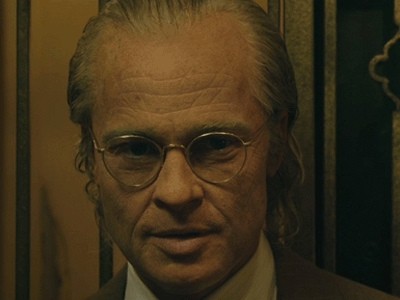
For that's basically the setup for this Hollywood tear-jerker told in the best cinematic race-for-the-Oscar's fashion. Every year we're owed one of these big, special-effects, poignant Hollywood romances: if it's not Forest Gump in 1994 or Titanic in 1997, then it's The Aviator in 2004 or Atonement in 2007. They all have four basic things in common: big Hollywood names, sweeping historical recreations, heartbreaking romance, and attention-grabbing special effects at their core.

Not being a big fan of Hollywood's schmaltzy side and certainly only quasi-impressed with Forest Gump or Titanic, I must say that The Curious Case of Benjamin Button is one of the best of the lot of this sort of thing. It will certainly be all over this year's Oscar list, being a shoe-in for well-deserved nominations for makeup, effects, and art direction, as well as doubtlessly laying claim to a few of the bigger noms such as possibly for movie, screenplay, direction, and acting. This is the kind of movie that Oscar loves - or used to love, at any rate - and this one doesn't disappoint.

Let's start off with that special effect. Gump had its groundbreaking rotoscoping into historical footage (soon to become commercially commonplace). Titanic had its sinking ship; Atonement its impossibly long take of the invasion at Normandy. Benjamin Button is most like Titanic in that its special effect, the amazing aging and youthing of actor Brad Pitt, itself becomes a kind of central character in the film, one that plays an essential role in the story. Each scene in which Benjamin appears you are riveted looking at him and trying to figure out how they did that. And also, in each scene, you know something the other characters may or may not: which is that Benjamin's appearance and his chronological age are at odds (except, of course, when they meet, in the middle), and so the poignancy of his interactions: his first job, his first drink, his first love - are heightened by Benjamin's curse of being so ripped out of time. The amazing pleasure of this movie is watching how the characters interact with an old man who's actually quite young...or vice versa (though there's less of the vice versa than I'd hoped), and Fincher does an excellent job of mining cinematic gold out of Benjamin's strange and oddly affecting interactions with the people who enter and leave his life.

Because Benjamin is aging backwards, he is born into something most of us would rather not think too much about: the end of life. So he begins his life befriending people who are soon to leave this world. Fincher's story then amplifies the sorrow of loss through the lens of a man whose backward trajectory through life intensifies and quickens that experience, and you'll be excused the several occasions when you find your self brushing away a tear. Fincher - the director of the horror thriller Seven and the testosteronic Fight Club, as well as the underappreciated serial-killer mystery Zodiac - is a director not known for sentimentality. And perhaps that's what makes him the right man to handle this material; for in another director's hands (I think, perhaps, Speilberg or Zemeckis) this stuff would easily become maudlin pap. Fincher however provides us with what I think has to be one of the most realistic portrayals of aging, dying and loss in movies. After all, the appearance (or disappearance) of wrinkles and the gaining and loss of physical ability is what this movie is about, and in Eric Roth's screenplay you have the feeling you're in the hands of someone who intimately understands the complex emotions at the loss of a parent or the breakup of a marriage. By keeping things matter-of-fact and not shying away from the needles, nurses, and infirmities that accompany the end of life, Fincher's story gains the power it has. And when our hero, Benjamin, inevitably dies - in a way that I'm sure most of you who haven't seen the film must wonder about and that fits plausibly into the story's unique logic - you can't help but marvel at how, by simply reversing it's order, this story effectively highlights the strange and terrifying experience that is human life.

So much for the special effect. Let's turn next to the history. Fincher does an excellent job evoking the time and place he wants: 1920's New Orleans, 1930's Russia, 1960's suburbia, or humorous flashbacks of a man struck repeatedly by lightening during his life in the 1800's, by repeating the techniques that worked so well for him in creating 1970's San Francisco in Zodiac: focusing on important research into the nostalgic details of a few key sets (the paper sleeve of an album, the furnishings of a hotel) and adjusting his lighting and camera work not with the sepia tones of our present-day photographs (except where that works to highlight the humor of the flashbacks) but with a bright-as-day photography of the well-researched art direction into the actual popular colors, fabrics, and fashions of the times. We have gotten used to the stacked movie set filmed in brown tones and know that that's "cue" for nostalgia. Fincher's work is different: we feel we're actually seeing what people alive in 1920's must have seen with their own eyes, not in our photographs, and he punctuates the progress of history with just the right selection of historical background music. This is key to the magic of Fincher's reverse story-line through life as he takes us up to the present day.


And speaking of present day, this again features what at first seems a very odd but ultimately interesting choice: the moment in 2005 when hurricane Katrina is about to slam into New Orleans. That is until you look back on the movie and realize that Fincher's film is a memorial in a very different way. It's a memorial to New Orleans itself, and the people and city lost in that hurricane. (Fincher makes great effect of the metaphors of wheels spinning in reverse - from clocks to carousels to the hurricane itself - to tie all this together). If nothing else, then, Benjamin Button is the most original and moving memorial to the untimely death of an American city that I've ever seen.

Then there's the third facet of these sorts of film: the stars. Some unscientific web voting has that Brad Pitt is s shoe-in for an Oscar nomination. Others feel he'll invariably be snubbed. I myself fall into the shoe-in category, for I think Pitt here gives the best performance of his career in a role that is multiply challenging to say the least. And don't be surprised if Taraja P. Henson as Benjamin's adopted mother receives a nom for supporting actress. Both actors do a great job acting their way across the range of years (though Pitt's is the more believable). And even though Cate Blanchett as the elderly Daisy has to carry the film through a mask of makeup, in her role as the younger Daisy I found her uncharacteristically disappointing. Daisy - Benjamin's great love - is a dancer, but Blanchett's cool demeanor and youthful folly seem strangely artificial, as if Blanchett didn't quite find the right pose for the strange reality of this backwards story. Which is so odd given how good she usually is.

But maybe it's not entirely her fault, and here I arrive at the last pillar of the Hollywood tear-jerker, the love story. This pillar of Button is the weakest of the four, as I find the romance between Benjamin and Daisy to be rather ordinary. It is precisely when the two characters meet in the middle - when they, for a brief moment in time, become an ordinary couple savoring the ordinary and all the more fleeting pleasure of life - that the film loses momentum and originality. Not that it isn't surrounded by originality, and not that we soon don't give way to the inevitable consequence of two people moving in opposite directions through time. But at the very center of Benjamin Button, when we should be finding what's miraculous about life, we find a kind of short montage of coupledom that might be mistaken for a Tide commercial. That may be overly harsh, for there are of course more profound problems hanging over their heads, and in a story of nostalgia, happiness does make for the least interesting memories. But this intersection in the characters' archs doesn't quite meet for me in a way that could bring more of everything in the film together...and so when they part again, it feels we have missed something, and we can't quite put our fingers on what. As Benjamin goes world-weary and wise into his young age, we get a kind of Brad Pitt Seven Years in Tibet retrospective rather than what we would have expected: an insight into that old wish to have the wisdom of age and beauty of youth. But those potential intriguing incidents are oddly quickly skipped over, and even though this film at three hours is already longer than it needs to be, those are the incidents I miss.

But Fincher's last moments of the film - his poignant tribute to the characters in Benjamin's life - is beautiful, heartrenching, and exactly right - so he makes up for it. What he's got here is a film that personally touches you, that salutes your life, as well as the life of a city. I went along with it, all in. For a Hollywood tear-jerker to touch me like that really is an achievement, so even though it has the innevitable touch of schmaltz - and even though its three hour playing time drags out a bit too much - this is the Oscar season movie that doubtlessly everyone will be talking about.