Showing posts with label George Clooney. Show all posts

Monday, December 28, 2009

Up In the Air: A Flawless Dramedy

It seems like such a simple movie: George Clooney plays Ryan Bingham, an experienced corporate downsizer (he fires people for a living), who books enough air time traveling from town to town that he’s about ready to be indoctrinated into the highly elite 10 million mile airline club. Natalie (Anna Kendrick), a young bright newbie, is his charge, accompanying him on the road to learn about the intricacies of the downsizing industry (times are booming, after all). That’s basically the set up, and the rest is about how Natalie learns that firing people his more than an abstraction, and how Clooney's Ryan moves past his well-practiced cynicism to reconnect to his family and his feelings.

Simple, yes, but there’s not a single wrong move in this seemingly simple dramedy that’s both intelligent and amusing, and that captures our present culture with a stroke of seeming luck (there’s not a film in recent memory that could claim to be quite this relevant).

The movie is actually relevant on two fronts at once. The consistent firings throughout the movie – which eventually demonstrate the entire range of possible reaction – certainly capture the drama (and sardonic irony) behind the headlines of the past year and a half. But perhaps even more to the point is how well the movie captures not only the life of so-called “road warriors,” but the two kinds of lifestyles that have evolved in our modern world: the corporate career (which seem to be for ambitious people who have personal issues driving them away from their home habitats – and whose personal lives tend to be, well, a bit emptier), and the stay-at-homes, those folks born between the coasts who have never, really, left the nest, whose personal lives are a bit too filled with family obligations and messy relationships, and look at suspicion and disdain at the first group, even as they secretly admire their sophistication and envy their experience.

Ryan and Natalie are clearly in the first group, and the story takes them from airport to airport (we get a birds eye view of each city before they land for the scene); Ryan finds a girlfriend, Natalie learns how to do her first firings (she’s good at it), and the movie heads inexorably to its confrontations. Ryan’s apartment, where he supposedly “lives” (about 45 days of the year) is an empty white box, and his single relationship of significance is with another fellow traveler of the skies (after sex in a random hotel in a random city, they check their laptops to see when their schedules bring them into proximity again for a quick nookie). Natalie has subordinated her own talents in order to follow her boyfriend to Omaha, and doesn’t seem to see a contradiction in wanting a stellar career and an idealized home life at the same time. Both are due for reckonings, and when they come, they are both amusing and satisfying.

The scenes when Ryan travels home to Wisconsin for his little sister’s wedding are perhaps the most outstanding. Here, the movie feels not just well crafted but also knowingly authentic: Ryan gets to revisit his high school, and share his experiences with his girlfriend (Alex – played wonderfully by Vera Farmiga), while he’s also forced to intervene in a family squabble, and use his powers of persuasion to make the case for marriage (a case, it must be said, he doesn’t really much agree with). It’s almost his cue to start over, to shed his life and re-assess the steady cynicism he’s had to adopt, and he’s like a teenager again, once again taking a chance on a crush, and leaving himself vulnerable.

Which is another reason I so like this film. It’s neither sentimental nor completely cynical. Instead, it simply seems wise. It’s also about how adults relate to each other, another treat we don’t so often get to see in films these days.

That’s why even though it may be simple, and essentially a light-hearted comedy, I really think Up in the Air belongs on the list of the best ten movies of the decade. It’s happens to be something that not only captures the zeitgeist of the times – it turns that into a keen observation about life, and about characters who know a lot but still have something more to learn.

But what’s most deft about this film is how well it’s constructed – from the superb acting to the editing, to the choice of cinematic moments, like the nice, understated ending. Like the people who’ve been “let go” by their firms, by the time they reach the end of the story, life for both Ryan and Natalie is “up in the air,” and for the first time, as Ryan looks out the airplane window, all he sees are clouds, his destination obscured from view. It’s a nice touch for ending a movie that throughout, so surely knows where it’s going.

Friday, November 27, 2009

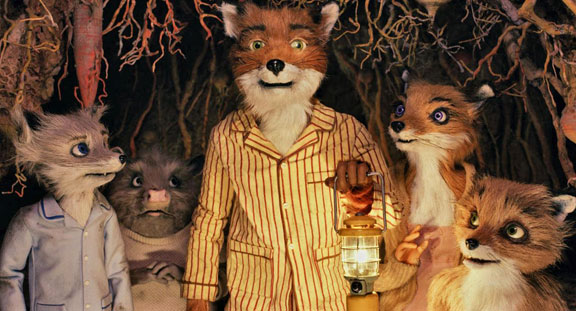
Fantastic Mr. Fox: At Least Fairly Good

Fantastic Mr. Fox, a stop-animation movie adapted from Roahd Dahl's children's book by unconventional auteur Wes Anderson, tells the story of Mr. Fox, a fox-about-town going through a fairly typical mid-life crisis. Now that his wife is a mom, and they have a pup to raise, he's vowed to settle down and stop the dangerous occupation of chicken snatching: but Mr. Fox yearns for his daring days of old, and to perform just one more glorious caper. Unfortunately, his caper goes up against three of the meanest farmers in the neighborhood: the imposing trio of Boggis, Bunce, and Bean.

This simple story has been rewritten by Anderson to focus, more than the original fable, one thinks, on Anderson's typical obsesssion with the existential despair of small family moments. Hence the character of Christopherson - Mr. Fox's nephew, who comes for an extended visit during Foxy's schradenfreud, becoming a rival to Ash, Mr. Fox's nerdish pup.

Let me say here that I've never been a big fan of Wes Anderson (his movies have never really gelled for me), but in working with Dahl's material, I think he finally here finds his voice - and the merging of eccentric fairy tale with existential family dynamic and the endearing quality of decidedly low-tech stop-animation produces just the right combination of quirky introspection.

The best thing in the film, by far, is the catchflung animation and the whimsical way in which the tale is told. By one small example: in explaining the complexities of the animal sport of Whackbat, a crickety thing with several layers of intricate complexities, we're presented with a non-sensical litany of quick rules performed in a monotone by Owen Wilson, all to comic effect. The joke is even better in the second go-around when Ash spontaneously performs his own real-life (stop-time life, whatever) Whackbat impression while getting his father Foxy and Dad's accomplice Kylie out of a tough life-threatening spot with farmer Bean. Seeing it all done with cute stuffed animals makes it even more entertaining.

By the way, that Bean is a determined sucker who pulls no punches in trying to hunt down Foxy and his hoard of animals. The relentlessness is a bit dark for younger children, but does a good job of capturing the heightened drama of adolescence and its sense of irreversibility. That is to say, I've always found existentialism to be a bit of a juvenile philosophy - lacking the stern conviction of nihilism, the formal rigors of phenomenology, or the literary complexities of a full-blown moral universe. But it does suit well a young mind struggling with the unfairness of life and searching for a reason to enjoy it all anyway. That seems to be the focus of the tale here: as much that Ash discovers his own inner fox despite his father's favoritism for his cousin; as it is Mr. Foxy freeing himself from the stultifying shackles of civilization to re-ignite his youthful, foxy nature. What Anderson is saying, apparently, is if you just stop all that worrying, your sleek animal nature will save the day.

Call it "Old Dogs" meets "New Tricks." Like a kid who wants a good excuse to skip school, the story labors laboriously to explain why rakish irresponsibility is cute, and good for an old fox. Mr. Fox's pontifications on the subject hardly make sense, but never-you-mind: it's really more Wes Anderson's movie than it is Roald Dahl's, which means it's really not at all about being a good husband or father or any kind of believable leader: it's just about growing up an awkward child, being challenged, and overcoming odds. Even the sly Mr. Foxy is just a big kid at heart, eager to be appreciated. I, for one, find the animation and writing thoroughly entertaining most of the way through, so I think this time, the kid deserves his due.

Thursday, January 15, 2009

Burn After Reading: Politics Done Coen Brother's Style

Burn After Reading returns the Coen Brothers to their earlier, whimsical comedy stylings making fun of weirdo's, outsiders, and bumblers - movies like Raising Arizona, The Hudsucker Proxy, and The Big Lebowski - where characters with more ambitions than brains hatch cooky plans that get everyone fired, kidnapped, killed, or otherwise in some kind of trouble. The difference is that this time, the brothers Coen have set their bumblers in Washington D.C.: where comic bumbling has kind of become the credo of the past eight years of the Bush administration.

But lest you think this may be a trenchant sendup of Bush politics (a la Oliver Stone's "W"), bear in mind that the Coens have little interest in political points of view. Which in a way makes the Washington DC setting and the spy plot line oddly irrelevant to what the movie is really about - which is the idea of middle-age goofballs dealing with crushing disappointment and grasping for whatever small piece of salvation might happen to fall in their laps.

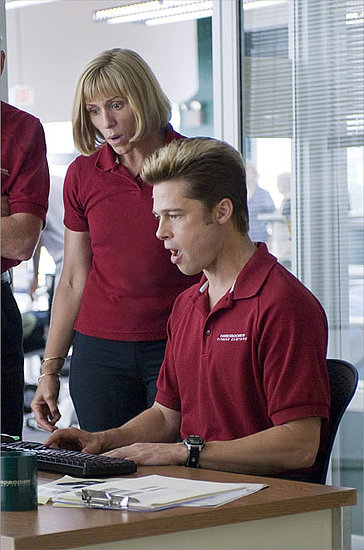
Burn After Reading introduces two sets of D.C. characters operating in different worlds of this highly transient city, whose paths disastrously intersect. The first are two Washington insider couples: washed-up CIA operative Osbourne Cox (John Malcovich) and his cold and distant wife (played by Tilda Swinton), who's having an affair with George Clooney's bumbling federal marshal, Harry Pfarrer, whose self-involved author wife is off in her own book-tour world. These four intersect with the dissatisfied managerial staff of a local gym (Hardbodies), played by the triangle of Fancis McDormand, Brad Pitt, and Richard Jenkins, when the gym managers find Osbourne Cox's diary - which they mistake for confidential CIA secrets - lying on the gym floor. Like Hi in Raising Arizona, Brad Pitt's character gets it in his head that this random find is really a cosmic gift that must be worth something to someone, and off we go.

By the end of the movie, everyone has run into everyone else in one way or another, and all the billiard balls end up falling into their appointed pockets.

Even so, there is unfortunately also a good deal of plotting laziness in this film. The two worlds never have an opportunity to comment on each other, and the fate of the characters seems more random than thematic, as if the brothers realized they had another movie to go make and had to quickly wrap up this one. That all makes the movie feel casually disjointed...closer to the random happenings of Oh Brother, Where Art Thou? than the tightly scripted No Country for Old Men or Fargo. Certainly there is no mistaking a Coen brother's movie, which always muses on the ambitions of overambitious losers and the random intersections of destiny, and usually delivers a healthy dose of mirth, as this one does. And yet, there can be such differences in quality and effect from film to film. Where No Country is deadly serious and important, Burn After Reading seems to go out of it's way to become a film of frivolity that wants to do nothing more than make you smirk for an hour and a half, then quickly forget.

All of which is to say, this is not a serious movie: the potential fun of Bush bashing in the D.C. setting is sadly wasted (with the exception of the promising opening scene), and by the time we get to the end, we may not care that much any more whatever it is the Coens have decided to do with all these bozos.

And yet: Malkovich is marvelous as the put-upon and cast-out spy. Swinton makes a wonderful bitch. McDormand stands out as the not-too-bright but desperately seeking Mr. Right gym manager, Pitt is satisfyingly goofy, and Clooney gives his usual over-the-top weird Cohen performance. And all the supporting actors, spies, and operatives give hilarious scenes spouting hokum, corporate-speak, and hooha in typical Cohen brothers fashion. So while this movie doesn't add up to much, it's certainly a lot of fun getting there.

Yes, Burn After Reading isn't in the top-tier of the Coen's ouevre, a Fargo or No Country. And it doesn't quite have the off-the-wall inspiration of a Big Lebowski. But it definitely qualifies in the Coen's second tier of comedies, the kind that are great fun going but add up to little, a kind of Arizona or Irreconcilable Differences. Now, considering that the Coen's second tier work is better than a lot of people's best stuff, maybe you want to see it.