Showing posts with label Emily Blunt. Show all posts

Saturday, February 20, 2010

The Wolfman: All Bark and No Bite

Given the commercial success the vampire classes have been having lately (with everything from Showtime's "True Blood" to teenage Twilight), it's only natural the the lycanthropes would wish to get in on the action. Thus the effort to remake the 1941 classic Wolf Man by Jurassic Park III director Joe Johnston seems a logical, if disappointing, development.

Despite the largely well-done casting (Anthony Hopkins and Hugo Weaving especially have fun chewing the scenery as the Elder Sir. John Talbot and the erstwhile inspector Abberline, respectively), this remake of the story is largely lackluster, relying mostly on an overly loud soundtrack of crashing booms and high-pitched violins to create any purely artificial thrills. Benicio del Toro also makes a too stolid Wolfman - playing it humorously straight and making the 1 hour and 42 minute flick seem interminably long.

Part of the disappointment is the way in which the story has been changed from the original to make this Wolfman more a obviously predicable tale about family dynasty dynamics than a psychological exploration of male rage and aggression: as if thrills can be derived from only the most obvious plot developments, when quite the opposite is true (as Martin Scorcese's Shutter Island so ably shows). del Toro, as prodigal son Lawrence Talbot, returns to Talbot castle after his brother has been mutilated by a lunging lycanthrope. Naturally, Sr. Talbot isn't saying much, but wolfishly protects his brood, until Lawrence inherits the wound himself, and slowly turns. Watching Hopkins and del Toro go at it at the end in their big furry costumes seemed more like some kind of weird Sesame Street Wrestling match than a climax to a serious thriller, and by this time I was more than happy to see either of them bite the dust.

Johnston stages this as a straight-on remake trying to masquerade as a modern horror flick, with painstaking details on Victorian settings but little budget left over for creative Foley (the loud horror-movie crash he uses every time Talbot gets startled by a dog or a...wolf?...is always the same, and quickly become tiresome). But with little inspiration in the story or the direction, the long stretches of bloody mutilations - besides being needlessly over the top - actually become a bit, well, boring.

There were so many other ways he could have played this film. He could have really delved into the creative psychology of the man/monster...as Scorcese does in Shutter Island, delivering an intelligent as well as involving thriller. Or just given it a bit of camp, a la Van Helsing, at least injecting some popcorn munching fun.

Perhaps most disappointingly, he could have also tried to explore what makes wolf men sexy. We've got sexy vampires steaming up screens both large and small lately, but these pale vampish creatures have nothing on Wolfman potential. A beefed up Michael Sheen in Underworld: Rise of the Lycans suggested what a bit of wolf-sex-appeal could add to the Sylvan folklore. Here we have an entire film devoted to the subject.

I happen believe that if wolf men were really given their full predatory sexual due, they'd make "True Blood" seem like a Sunday school program. Unfortunately, what Johnston offers us are big overstuffed Ewoks with little brains and even less romantic bravura. I just hope he hasn't killed the Wolfman cinematic ethos forever.

Wolfman


Ewok

Saturday, January 23, 2010

The Young Victoria: A Royal Love Story

With two Elizabeth movies, Helen Mirren's The Queen, and a successful Showtime series about The Tudors, it seems a mini-genre has been created about the English royals and their saucy comings and goings and political intrigue; and especially about the way that various men close to power manipulate their Queens, and vice versa.

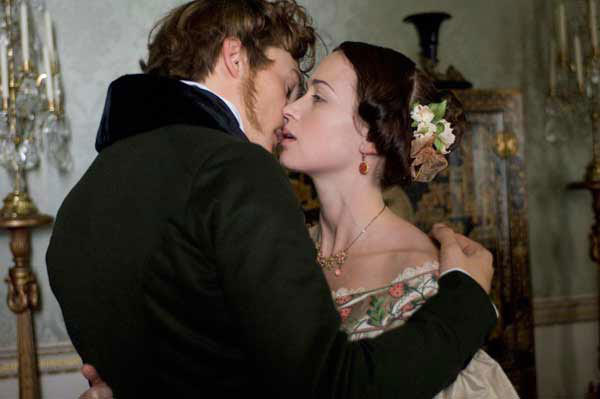
The latest entry in this genre, The Young Victoria - staring a perfectly cast Emily Blunt as the teenage Victoria, and Rupert Friend as her German suitor, Prince Albert - turns out to be a surprisingly tender and moving rendition of the form.

In the Victorian age (1837 - 1901) we're placed somewhere between the bloody intrigue of Elizabeth/The Tudors and the modern polite protocols of today's British Queen, so don't expect any heads to roll or battles to be raged in this outing. In fact, the Victorian era was Britain's high point of peace and prosperity, and the filmmakers are actually quite sly to make a film about the young queen rather than the old, for this is a tale of young hearts and true desire, yet while using the name of a woman ultimately associated with an age of fastidious virtue.

The young Victoria - the little girl being raised as a princess and heir to the throne in the early 1800's - is actually a precocious, lively spirit who is trapped herself in a world of repression by an overprotective mother and her scheming minister, Sir John Conroy, who wishes Victoria to sign the order that would make him official regent upon the death of the King. Victoria stubbornly refuses, innately distrusting Conroy, and knowing that her future is at stake.

It's not too difficult to discern Conroy's character given the way he treats Victoria's dog: variously coddling or kicking depending upon his mood. The dog becomes a stand-in for Victoria herself (a nicely used form of metonymy), and it may be with you - as it was with me - that the affection for dogs in this movie eventually softens your heart, and draws you even closer in to the character's fears and desires.

Even though they are royals, the schemes by various Kings and Uncles to have their way with Victoria's royal powers are portrayed with the kind of boisterous of feuding families - replete with birthday-party embarrassments and nuptial snubs. Only one man, it seems, has Victoria's true interests in mind. That man is the young, handsome Prince Albert, who even as he wins Victoria's heart, still must convince her that he's also worthy of her trust.

It actually surprised me, in the end, how the movie takes a turn away from historical melodrama towards passionate love story. This Queen is perhaps more than those that have come before someone our modern selves can relate to: a younger sister, perhaps, who must learn how to take her place in a dangerous world amongst self-interested family, and decipher with whom she can fully open her heart. Blunt wins us over into the dilemma of the character (as does Rupert Friend as Prince Albert), and even if the movie doesn't quite follow the official history, the ending becomes surprisingly moving, as any story of young people finding true love, told with feeling and felicity, ultimately can be.

It's interesting, then, that a movie genre with such a background of intrigue, social station, and politics ultimately becomes about something else: about the dynamics of young love, and how new lovers, who may be, in fact, the most inspired people on earth, can support the best in each other. It's a bit of a turn from where we started, with plots and contrivances to control the heir and manipulate the throne. But then, perhaps this is like the drift of the Victorian age itself, becoming less about power than about symbolism: and in the case of Victoria and Albert, symbolism for finding the goodness in other people, and using our station to improve the world.

And yes, I admit, I did get weepy in the end. But to be honest, I couldn't tell whether it was the love story, or simply sadness at how our current political life, dull and ruthless as it is, so misses such inspiring figureheads: both their stubborn courage, and their bright idealism.