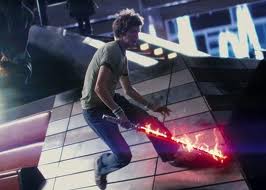
 In Scott Pilgrim versus the World, director Edgar Wright (Shaun of the Dead, Hot Fuzz) sets out to create the imaginative world of a countercultural teenager as seen through the pop-culture maze of video games, computers, and television sit-coms. He uses imaginative sound editing (such as the laugh-track to Good Times and various Batman-esque THWACKS and DOINGS) as well as creative animations, Fight-Club-like closed captioning, rock music, and amplification arrows to create a unique look that crosses Anime comics with various slam-cut edits all to successful result. The effect is that of having one’s head locked inside an iPod that’s being randomly tuned to various internet music stations while simultaneously trying to play Donkey Kong on a unicycle, but it largely works; that is, if you’re a teenager looking to enjoy a unique interpretation of your concerns about dating, dumping, and being dumped.
The namesake, Scott Pilgrim (played with whispiness set on ten by Michael Cera) plays base in a three-man (two man and one woman) local Toronto punk band. Where the movie is most inspired is in how deeply down into local, Toronto punk culture it wants to go, creating a world of cheap basement apartment rentals, band battles, and inside jokes that gives the movie a rare authenticity (one of the most pleasing aspects of the film is how well it avoids the feeling of mass-produced multiplex fare). Scott, improbably, plays the base, and even more improbably, the band is actually good. He does have that oh-too-common teenage movie problem, however, which is a deep insecurity with girls. Currently dating an Asian high-school student (Cera’s character is in his mid-twenties – as are most of the main characters – even though their concerns all feel a bit younger), Cera was mercilessly dumped by an ex-girlfriend who is back in town with an even more awesome band of her own, and he has yet to get over the sting, even as he courts Ramona Flowers, a new-in-town rocker-chick who is even cooler, and has set his strings afire.
Ramona, however, comes with some heavy baggage of her own: specifically, seven “evil X’s,” all of whom Pilgrim must defeat if he is to be able to continue dating her. Those defeats happen as pure video-game send-up, with each evil X vaporizing into a stash of coins at the end of each battle. The movie takes its sweat time setting all this up, but once the game is in play, it’s pretty much Mario Brothers all the way from there.
The evil X’s allow from some fun cameos, including Chris Evans as a Jean-Claude-Van-Dam-like action star with a penchant for skateboards, Brandon Routh as a white-haired rock-boy with Vegan powers, Jason Swartzman as a successful club promoter (yeah, right), and Thomas Jane posing as the Vegan Police. There’s also Kieran Culkin as Pilgrim’s gay roommate (or more accurately, post-gay roommate: the two of them share a bed, and it isn’t an unusual occurrence for Pilgrim to wake up to a few extra warm bodies under the covers). Even if the film follows a traditional win-the-girl / win-your-self-esteem trajectory, it also seems to exist in an alternative youth culture of ambi-sexuality, musical appreciation, and post-modern irony that the script takes for granted, which is secretly quite pleasing. Rather than dumb down the characters, as similar films of this genre might, this film takes youth culture as serious stuff (I think of something like Dude, Where’s My Car, which has a similar cultural tourism but not nearly the same ironic jouissance. Dude may have more laughs per minute, but Pilgrim feels like being beamed with a teenager ray for two hours). I would have loved this movie when I was twenty-two. Even more if I were in a Toronto punk band.
Which may be part of the problem with the movie. The detail is great, but the obsessions here feel very specific, much like a teenager themselves. The technique of the film also begins to grate on the nerves after about ten minutes, since everything in Pilgrim’s purview is given all the attention of an interstitial internet commercial that’s cut off just before the punch line. At twenty minutes I seriously considered walking out; perhaps my old brain simply wasn’t making connections between the noise and bombast fast enough to keep my eyes focused. By thirty minutes in, however, you start to tune out the slam-cut editing and sonic assault and start to assemble the story, though it’s quite possible that younger viewers, who have fewer references in their brain they’re trying to associate, will arrive at that saturation point sooner. There’s also Cera’s unceasing narration, which starts off pedantic but eventually rises to delightful insight once the Evil X’s come on the scene, stirring things up with delightful superpower mischief.
Once it gets going, it’s a wholly original movie, then, but I wouldn’t blame you if you didn’t want to suffer the entire thing. Two hours of purely distilled teenage irony with heavy layers of techno-culture, punk music, Anime, metrosexuality, and video-game philosophy just isn’t for everyone.