Perhaps the best thing that can be said for this final installment in the 8-part franchise is that the story is finally over. Dragged on to the point now where it's already old news that the main actors are appearing nude in arty Broadway productions and being taunted on Saturday Night Live dirty skits, the actors are a bit long-in-the-tooth to still be playing high-school seniors, the mysteries set up ages ago have long faded into memory, and the main feeling one gets from this close of the final chapter is, well, relief.
This final installment is naturally more dark - and more violent - than any that have come before. Not a few students meet their makers and the epic battle between dark and light takes places unflinchingly. As a parable for World War Two (with Voldemort as a kind of Hitleresque figure come to seduce, divide, and conquer the weaker minds of an English prep school), the story delivers a satisfying final confrontation, including a scene where Harry must kill the Voldemort within himself in order to truly defeat evil.
The wizardry behind the special effects are particularly superb in this final chapter. Teachers at Hogwarts, beseaged by leagues of Voldemort's evil-doers, erect a kind of defense force field that has all the charm of fairy dust combined with the power of a Star Trek force field - an appropriate type of white magic that gives the assorted pupils and instructors the precious minutes they need to prepare for battle once Voldemort discovers that Harry is on the grounds. Meanwhile, Harry and friends hunt for the final horcrux where Voldemort has stashed a piece of his soul, wands flash red and white in the ensuing battle, and the familiar school is laid waste as the scene of tremendous explosions and bloodshed. Key to the story, as well, is the revelation of Snape's heretofore unrevealed relationship to Harry, and his true allegiences, as well as the sacrifices all of the adults made in an earlier war in order to keep Harry safe and give him this time and place in the spotlight.
Some may evaluate this then as the best of the Harry Potter lot and it certainly does wrap everything up that one would wish to see summed, zapped, or otherwise disposed of. For me, despite the tremendous effects and satisfaction of denoument, it lacks the artistry of Part 1 (particularly the Deathly Hollows story, which gets rather ignored here in favor of the action scenes). I also miss the tonal tension of the mid-story movies - say Goblet of Fire, with the fun Twiwizard tournament, which may be the best in the series. Those earlier stories got the balance right between serious menace and the structured safety of preparatory school. This final Potter feels simply like all-out war. Effective, to be sure, but also preposterous, no longer a metaphor for high school but story grown a bit too epic for the likes of Hogwarts.
Also, as the story races to tie up characters, relatives, in-laws, and friends, one feels as if there is both too little time being spent and way too much. Some characters rush past - if you haven't read the books, as I haven't, their mention has little import - while others, like Snape, have their stories revealed in an over-edited blur. In final review, with the last four movies all exploring the same Horcrux-based wild goose chase (and all having, basically, the same extended plot), this series could have used way fewer side characters and a couple less feature films. But then I supposed it wouldn't have made as many billions as it has.
If you've made it through the first seven films, there's no doubt you need to see the series reach its final conclusion. What began as a magic-based metaphor for the eternal rituals of secondary school has grown, like a sparrow affected by one of those enlargement spells, into a Manichean epic importing the spectre of fascism and war. Spectacular as it is, this story has gone on just a little bit too long for us to really care.
Showing posts with label 3 stars. Show all posts
Wednesday, August 10, 2011
Friday, July 1, 2011
Midnight in Paris: Woody Allen's Inception
Woody Allen’s latest – Midnight in Paris – holds a special place in my heart, and I suspect in the heart of anybody who’s ever wanted to be a writer. For all of us deluded romantic writers, there was inevitably a time in our lives (typically right after college) when we contemplated moving to Paris and devoting our lives to living in a garret, soaking up the art and atmosphere of Paris, and producing the great American novel, in the tradition of all those great American expatriates of the Twenties: Hemmingway, Fitzgerald, Stein, etc.
Allen takes this writer’s conceit and makes it come true – but in a uniquely Woody Allen fashion. As in movies like Purple Rose of Cairo or Alice, Allen taps into his unique brand of Magical Realism, where characters' fantasies come alive only to illustrate the silliness of their neuroses. In this case, the fantasy of the writer (Gil, played by Owen Wilson)- who finds Paris thrillingly romantic while his fiancĂ© and her Republican parents find it simply noisy, irritating, and a mall for expensive souvenirs and show-ground for pompous ex-boyfriends – comes true precisely at midnight each night. It’s at this bewitching hour when a carriage comes past a quaint old street corner, beckons for the writer to get in, and transports him, temporarily, into the past, where he gets to hobnob with the romantic greats: the actual Hemmingway, Fitzgerald, Stein, and more (including some humorous appearances by surrealists like Dali and Brunuel).
All this happens at night and the writer increasingly finds validation in the passions, inspirations, and energy of his past companions, while increasing the tensions with his alienated fiancĂ© and her insipid parents. While the characters from the past are perfectly impersonated and the scenes of Paris nightlife in the Twenties are perfectly rendered, the present conflict with Gil’s girlfriend and parents feels particularly flat and uninspired, the usual Woody Allen schtick about unhappy relationships and people who really aren’t meant to be together.
It’s no surprise when one of the characters in Gil’s fantasy of the twenties herself has a fantasy about an older artistic time – the Belle Epoque – and like the movie Inception, convinces Gil to travel another level down into the dream into yet another level of romantic delusions. One can imagine Allen watching the movie Inception and thinking, “I know what to do for my next film.”
The real star of this movie, however, is Paris itself. Woody has become the chronicler of great international cities – giving us the creativity of New York, the class formality of London. And clearly, the romanticism of Paris. Allen opens his films with a series of still shots of Paris scenery, taking us through an entire day – including a rainstorm, sights of deserted street corners and parks, and finally the falling night and bright lights on the Champs Elysee. Each shot is held long enough for us to detect the life slowly moving in the background. They are small works of art, like the moments of time spent in the city itself. When the writer debates life and art with the likes of Fitzgerald and Hemmingway, he comes to understand why this city has so inspired so many artists before him.
Like his other magical realist yarns, this one too gets tied up in a nice little bow, and everything resolves neatly in the end. For those of us who aren’t writers, the Inception twist will seem a little predictable, and the relationship tensions flat. For those of us whose memories are jogged by Allen’s exploration of this perennial romantic writer’s notion, the guest starring artistic celebrities will give us the same thrill as they do for Gil, and Allen’s movie may be the best expression ever rendered of the particular romantic fantasy that is Paris.
Allen takes this writer’s conceit and makes it come true – but in a uniquely Woody Allen fashion. As in movies like Purple Rose of Cairo or Alice, Allen taps into his unique brand of Magical Realism, where characters' fantasies come alive only to illustrate the silliness of their neuroses. In this case, the fantasy of the writer (Gil, played by Owen Wilson)- who finds Paris thrillingly romantic while his fiancĂ© and her Republican parents find it simply noisy, irritating, and a mall for expensive souvenirs and show-ground for pompous ex-boyfriends – comes true precisely at midnight each night. It’s at this bewitching hour when a carriage comes past a quaint old street corner, beckons for the writer to get in, and transports him, temporarily, into the past, where he gets to hobnob with the romantic greats: the actual Hemmingway, Fitzgerald, Stein, and more (including some humorous appearances by surrealists like Dali and Brunuel).
All this happens at night and the writer increasingly finds validation in the passions, inspirations, and energy of his past companions, while increasing the tensions with his alienated fiancĂ© and her insipid parents. While the characters from the past are perfectly impersonated and the scenes of Paris nightlife in the Twenties are perfectly rendered, the present conflict with Gil’s girlfriend and parents feels particularly flat and uninspired, the usual Woody Allen schtick about unhappy relationships and people who really aren’t meant to be together.
It’s no surprise when one of the characters in Gil’s fantasy of the twenties herself has a fantasy about an older artistic time – the Belle Epoque – and like the movie Inception, convinces Gil to travel another level down into the dream into yet another level of romantic delusions. One can imagine Allen watching the movie Inception and thinking, “I know what to do for my next film.”
The real star of this movie, however, is Paris itself. Woody has become the chronicler of great international cities – giving us the creativity of New York, the class formality of London. And clearly, the romanticism of Paris. Allen opens his films with a series of still shots of Paris scenery, taking us through an entire day – including a rainstorm, sights of deserted street corners and parks, and finally the falling night and bright lights on the Champs Elysee. Each shot is held long enough for us to detect the life slowly moving in the background. They are small works of art, like the moments of time spent in the city itself. When the writer debates life and art with the likes of Fitzgerald and Hemmingway, he comes to understand why this city has so inspired so many artists before him.
Like his other magical realist yarns, this one too gets tied up in a nice little bow, and everything resolves neatly in the end. For those of us who aren’t writers, the Inception twist will seem a little predictable, and the relationship tensions flat. For those of us whose memories are jogged by Allen’s exploration of this perennial romantic writer’s notion, the guest starring artistic celebrities will give us the same thrill as they do for Gil, and Allen’s movie may be the best expression ever rendered of the particular romantic fantasy that is Paris.
Labels:
3 stars,
comedy,
Owen WIlson,
Rachel McAdems
Sunday, June 12, 2011
Kung Fu Panda Two: Suffering From Sequelitis
As someone said to me before I saw this movie – once Po becomes supreme Kung Fu master and conquers the world, where could the story possibly go from there?
The first Kung Fu Panda surprised and delighted with the concept of a fat boy (Po, voiced by Jack Black) who envies kung fu heroes, and who really learns to master the art of athleticism and power. The sequel struggles mightily with the problem of what dramatic conflict to challenge the master with from here. In fact, it needs to spend the first two thirds laboriously undercutting everything that the first movie built up, by introducing a second major character flaw (the first, obviously, is that pandas would rather eat than fight). But now that this panda is the kung fu hero of the town, we find out that he has another problem he is struggling with – he doesn’t know who he is. That is, he’s been adopted, and there is a terrible repressed memory about his early childhood that is blocking him from his full powers at the time of most need. In order to overcome that repressed memory, he needs to master “inner peace.”This puts the sequel now squarely in the realm of pop psychology, and it loses much because of it. Not only is the psycho-pop struggle of Po’s childhood signaled about fifteen moves back from when it’s necessary, it’s endlessly repeated just in case it hadn’t sunk in the first fourteen times.
Meanwhile we need a new super villain to fight. This one is a Peacock, and he’s invented gun powder. This gives him a technological advantage (or so it would seem) over the older technology of kung fu. One could go in so many directions with this parable of an arms race, but in the end, the movie chooses just one: how will Po overcome his childhood angst to use Kung Fu to defeat the Peacock’s weapons? Boring, I know, and a disappointment for a film series whose first episode surprised us with the humor in the dumpling-loving panda’s unlikely situation. For this reason, this film lacks the first’s wit and for long stretches is even a bit of a slog.
However, taking its inspiration from other fabulously inked children’s series – one thinks of the title sequences of Lemmony Snicket or Wall-E – the animation and art direction here rises above the story, and keeps this uninspired sequel afloat. To illustrate flashbacks, the art takes on a flat, two-dimensional black and white, stop-time quality that is really quite fascinating. Combined with the score, this is once again a case of talented below-the-line staff keeping a studio-forumula production from sinking into irrelevance. Even if adult attentions may flag, there’s enough visual popcorn flashing by on screen to keep the kids fascinated for two hours.
Once the third-act turn comes – and the panda realizes the source of his angst and decides to take action – the story is able to get past the laborious set-up and finally kick into gear. Once that happens, the old magic of the first film finally returns: the characters are moving forward with purpose again. This is where this movie should have started (and just dispensed with the crippling mystery). Po still has to figure out how to overcome the technological advantage of his adversary, but this is the essence of this series charm: we like to see this plush-size panda on purposeful action to overcome stunningly overwhelming odds.
We get 1/3rd a film here then for the price of a whole one. It feels a bit of a rip off. If the trend continues with the next film, it won’t even be worth the price of the rental.
Labels:
3 stars,
Angelina Jolie,
animation,
Jack Black
Sunday, May 22, 2011
Rio and Pirates of the Caribbean: Happy Birds & Angry Pirates
It's not yet Memorial Day, yet it seems that summer is officially here, and it's time to entertain the kiddies.
Rio - Fox's animated entry voiced by Jesse Eisenberg (of Social Network fame) and Anne Hathaway as a pair of rare, Brazilian macaws who are captured by bird pirates and have to find their way back home, gives a feathered furry of a try, replete with tail-feather-shaking musical numbers dropped into the plot (the characters completely stop whatever they are doing when it's time for a song).
The story arc of Rio seems to have been lifted from Pixar's Up: A sentimental opening coda leads to a set-in-their ways pair (Linda, a bookstore owner, who fawns adoringly over her super smart - almost puppy seeming - pet Macaw, Blue) who are interrupted in life by an overly obsequious busy-body (in this case, a Brazilian ornithologist who wants to mate Blue with the only remaining macaw - a beauty whose personality more resembled that of a Shrew - named Jewel). Off the trio go on a misadventures and misfortune, only to learn about love, friendship, and independence. In these days of Pixar, Tron, and Avatar, the animation feels no more advanced than a 1970's Saturday morning cartoon. A few flying shots when Blue finally figures out how to aerodynamically accelerate himself (love and faith are the key) have a fun freedom, but most of the dance numbers hardly make a step forward from the original Mickie Mouse Barn Dance.
More remarkable that this movie - which has all the inspiration of a video game interstitial - is the mobile app it's paired with, Rovio's Angry Birds. The app is quite a sensation (200 million downloads, which has to be a quantum leap above the audience for this movie). One imagines that app is more entertaining than the movie, which spends most of its time on three-year-old monkey jokes. Rio does have a fey and menacing bad guy in the form of a big white parakeet named Nigel (voiced by Jemaine Clement), as well as the voice of Tracy Morgan behind a big sloppy bulldog, but neither of these assets is well exploited. They got a lot of names into this movie, but it's Rovio, the studio behind Angry Birds, who brings any kind of technical panache, and that, unfortunately, can only be experienced on your phone.
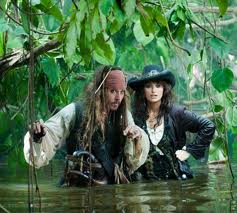
Meanwhile, Disney's fourth attempt at a Pirates movie (On Stranger Tides) finally gets the formula right. Back again is seemingly perpetually anachronistically stoned Jack Sparrow (Johnny Depp), as well as a few favorites like Pirate Barbossa (Geoffrey Rush), as well as a few hardy newcomers (Penelope Cruz, and a marvelously gruff Ian McShane as Blackbeard).
All motion is set in action when the Spanish king discovers the whereabouts of the fountain of youth, and tells his Admiral to set sail. The English king can't let the Spanish best him at the discovery, and so Jack Sparrow is entreated to go after the Spanish. Jack has his own ideas, however, and soon finds himself running from the English (led by Barbossa) and joining camp with Blackbeard and Cruz, as his daughter, as they all race for the treasure of immortality.

This Pirates is directed by Rob Marshall, rather than Gore Verbinksi - who directed the first three - and I must say, what an improvement. While I found the other Pirates glib to the point of being impossible to follow, and full of dead spaces and useless dialogue, this one is all economy and forward action. By this point, Depp has mined all the ironic postmodern gestures in the character and has settled in to a kind of aging, perpetually pubescent swashbuckler who simply wants to pilot a ship again. Meanwhile, Rush and McShane chew the scenery ferociously, and a strong dose of sincerity in the form of a handsome missionary in love with a beautiful young mermaid keeps the emotions anchored. Marshall keeps everyone moving forward towards the fountain and never slows down the pace - from daring escapes to flying sword fights - as the characters race across the seas.
I'm still not that big a fan of the series - as far as pirates go, these are about as mechanical as the Disney ride they're based on. But if I had to pick a pop-corn munching Saturday matinee for the kids, filled with daring escapes, fun bon mots, and exotic locales, this one far outstrips its birdbrained companion.
Rio - Fox's animated entry voiced by Jesse Eisenberg (of Social Network fame) and Anne Hathaway as a pair of rare, Brazilian macaws who are captured by bird pirates and have to find their way back home, gives a feathered furry of a try, replete with tail-feather-shaking musical numbers dropped into the plot (the characters completely stop whatever they are doing when it's time for a song).
The story arc of Rio seems to have been lifted from Pixar's Up: A sentimental opening coda leads to a set-in-their ways pair (Linda, a bookstore owner, who fawns adoringly over her super smart - almost puppy seeming - pet Macaw, Blue) who are interrupted in life by an overly obsequious busy-body (in this case, a Brazilian ornithologist who wants to mate Blue with the only remaining macaw - a beauty whose personality more resembled that of a Shrew - named Jewel). Off the trio go on a misadventures and misfortune, only to learn about love, friendship, and independence. In these days of Pixar, Tron, and Avatar, the animation feels no more advanced than a 1970's Saturday morning cartoon. A few flying shots when Blue finally figures out how to aerodynamically accelerate himself (love and faith are the key) have a fun freedom, but most of the dance numbers hardly make a step forward from the original Mickie Mouse Barn Dance.
More remarkable that this movie - which has all the inspiration of a video game interstitial - is the mobile app it's paired with, Rovio's Angry Birds. The app is quite a sensation (200 million downloads, which has to be a quantum leap above the audience for this movie). One imagines that app is more entertaining than the movie, which spends most of its time on three-year-old monkey jokes. Rio does have a fey and menacing bad guy in the form of a big white parakeet named Nigel (voiced by Jemaine Clement), as well as the voice of Tracy Morgan behind a big sloppy bulldog, but neither of these assets is well exploited. They got a lot of names into this movie, but it's Rovio, the studio behind Angry Birds, who brings any kind of technical panache, and that, unfortunately, can only be experienced on your phone.
Meanwhile, Disney's fourth attempt at a Pirates movie (On Stranger Tides) finally gets the formula right. Back again is seemingly perpetually anachronistically stoned Jack Sparrow (Johnny Depp), as well as a few favorites like Pirate Barbossa (Geoffrey Rush), as well as a few hardy newcomers (Penelope Cruz, and a marvelously gruff Ian McShane as Blackbeard).
All motion is set in action when the Spanish king discovers the whereabouts of the fountain of youth, and tells his Admiral to set sail. The English king can't let the Spanish best him at the discovery, and so Jack Sparrow is entreated to go after the Spanish. Jack has his own ideas, however, and soon finds himself running from the English (led by Barbossa) and joining camp with Blackbeard and Cruz, as his daughter, as they all race for the treasure of immortality.

This Pirates is directed by Rob Marshall, rather than Gore Verbinksi - who directed the first three - and I must say, what an improvement. While I found the other Pirates glib to the point of being impossible to follow, and full of dead spaces and useless dialogue, this one is all economy and forward action. By this point, Depp has mined all the ironic postmodern gestures in the character and has settled in to a kind of aging, perpetually pubescent swashbuckler who simply wants to pilot a ship again. Meanwhile, Rush and McShane chew the scenery ferociously, and a strong dose of sincerity in the form of a handsome missionary in love with a beautiful young mermaid keeps the emotions anchored. Marshall keeps everyone moving forward towards the fountain and never slows down the pace - from daring escapes to flying sword fights - as the characters race across the seas.
I'm still not that big a fan of the series - as far as pirates go, these are about as mechanical as the Disney ride they're based on. But if I had to pick a pop-corn munching Saturday matinee for the kids, filled with daring escapes, fun bon mots, and exotic locales, this one far outstrips its birdbrained companion.
Saturday, April 30, 2011
The Conspirator: History Lesson for Modern Politics
I’m a big history fan so I couldn’t resist seeing Robert Redford’s The Conspirator – about the trial of Mary Surratt, one of the accused southern conspirators who helped plan the assassination of President Lincoln and assist John Wilkes Booth's daring escape.
The movie starts out as any good historical drama should: on the battlefield, with union soldiers hunkered down in a bunker taking heavy artillery. One of those soldiers - Frederick Aiken (James McAvoy) - protects his wounded buddy, Nicholas (Justin Long), while waiting for help to arrive.
I would have loved to have gotten more texture about the war, but this scene is meant for one purpose only: to establish Aiken’s bona fides as a war hero and Union loyalist. It lasts a few minutes and that’s all.
Next we’re swept forward to the evening of Lincoln’s assassination. Those who aren’t history buffs may forget that the assassination wasn’t simply the actions of a lone, disgruntled southern actor taking out his anger on the President. It was a carefully planned coup involving several players that targeted not just the President, but the Vice President and Secretary of State as well. The conspiracy is well underway and we get to see with great fanfare the re-enactment of that fateful evening, including Booth’s ill-fated leap to the stage shouting “Sic Semper Tyranus!” (thus always to tyrants) as well as that botched attempts on Vice President Jackson and Secretary of State William Steward. The evening of the assassination is fascinating, with Secretary of War Edwin Stanton (Kevin Kline) taking control and closing off the city to hunt down the conspirators. This, it seems to me, is real drama.
Unfortunately, writers James Solomon and Gregory Bernstein only want to give us the barest bones of what happened, since their real interest is getting us as quickly as possible to Mary’s trial, and setting up Aiken as her reluctant defense attorney (just as we saw with the British in the HBO "John Adams" mini-series, Mary’s best defense is to have an unassailable paragon of the other side - a Union war hero - represent her, even if he’s at first loath to the task). Booth is hunted down and killed, but the other members of the plot are rounded up and tried. One of those members – John Surratt – can’t be found, so his mother (who runs the boarding house where the plot was hatched) is accused instead, and brought before a military tribunal to stand trial.
And this is where history ends and modern metaphor begins. The calamity that is the assassination of Lincoln and simultaneous Southernist attacks on the Executive Branch of US government is portrayed with all the terrorist coordination of 9/11 (even the idea of synchronizing the attacks for maximum terror seems thoroughly modern) – and the trial of Mary Surratt is clearly a stand-in for our own Guantanamo Bay and military tribunal of prisoners of war. The principals even get to argue the same great debate that we hear on our Sunday talk shows: should justice come swift and hard to rally a shocked and scared nation (Stanton), or must we hold to our values and the constitution even in the face of terrible crimes (Aiken)?
Though the trial of Surratt is factual and the situation a clear parallel, I sincerely doubt that any such discussion in 1865 took place with so modern a phraseology about constitutional values and travesties of justice. Putting the script into an archaic idiom would probably not have helped matters any, as the movie is singularly focused on examining this fine point of legal debate. Still, listening to this script, one cannot help but feel the words dovetail more with 2011 television than eighteen century dialect.
Aiken eventually turns around – no longer loath to represent a woman he believes to be guilty, he soon becomes her most ardent defender, even when it threatens to undo his reputation and end his relationship with his betrothed. This transformation is pre-ordained by the Sunday Schoolhouse nature of the plot, so little time is spent demonstrating Aiken’s change in attitude, it simply comes about when the script demands it.
What disappointed me about all this was how interesting the event itself was, and how thoroughly period the costumes (what I love about historical drama), and yet, all that is but background for what’s essentially a courtroom morality play. I would have loved to have opened up this story and really found out more about the conspiracy, the passion of defeated southerners, and the peculiarities of eighteenth century Washington. Instead we get a kind of "West Wing" in top hat and tails, and the metaphor for Guantanamo Bay and modern-day terrorist trials is all we can focus on.
Though clearly there are parallels between the plot to kill Lincoln and our own 9/11 (the movie points out all of them, even a kind of eighteenth century version of the Terrorist Alert system), I would like to point out to the writers that there are differences, as well. For one, Mary Surratt was an American citizen. For another, we had already been in a long war of brother killing brother that had resulted in the deaths of more Americans than anything since. For a third, the terrorists of today have at their disposal the ability to obliterate millions of people in the blink of an eye. In 1865, it was difficult for anyone to travel more than ten miles in a single day. I mention all these because the movie fails to really let us understand the peculiarities of its generational dilemma and let us draw the conclusions about today for ourselves.
I also mention it because, perhaps unintentionally, this movie has me sympathizing just as much with the older “hang-em-all” Secretary of War as the young man impassioned with constitutional values (perhaps you can also credit this to a gusto performance by Kline, who illustrates Stanton's hard-headed reasonableness all too well). In a way, it’s also an old man versus young man argument: young men can afford the luxury of preserving their ideals; old men have to be satisfied with merely preserving the peace. It’s no surprise if I tell you Mary Surratt’s eventual fate, but I have to say, I wasn’t even convinced by this movie that she was wronged.
Which to me speaks to the movie’s core problem. It wants to both be a historical intrigue as well as a cautionary liberal's morality tale about suspending the constitution in times of war. The lessons from one, however, aren’t as simple as the lessons from the other. I loved this movie when it surprises even itself with the messy, complicated character that history – when really understood – inevitably provides. But when it lapses into modern day liberal bromides, it’s as boring as a Sunday morning sermon.
The movie starts out as any good historical drama should: on the battlefield, with union soldiers hunkered down in a bunker taking heavy artillery. One of those soldiers - Frederick Aiken (James McAvoy) - protects his wounded buddy, Nicholas (Justin Long), while waiting for help to arrive.
I would have loved to have gotten more texture about the war, but this scene is meant for one purpose only: to establish Aiken’s bona fides as a war hero and Union loyalist. It lasts a few minutes and that’s all.
Next we’re swept forward to the evening of Lincoln’s assassination. Those who aren’t history buffs may forget that the assassination wasn’t simply the actions of a lone, disgruntled southern actor taking out his anger on the President. It was a carefully planned coup involving several players that targeted not just the President, but the Vice President and Secretary of State as well. The conspiracy is well underway and we get to see with great fanfare the re-enactment of that fateful evening, including Booth’s ill-fated leap to the stage shouting “Sic Semper Tyranus!” (thus always to tyrants) as well as that botched attempts on Vice President Jackson and Secretary of State William Steward. The evening of the assassination is fascinating, with Secretary of War Edwin Stanton (Kevin Kline) taking control and closing off the city to hunt down the conspirators. This, it seems to me, is real drama.
Unfortunately, writers James Solomon and Gregory Bernstein only want to give us the barest bones of what happened, since their real interest is getting us as quickly as possible to Mary’s trial, and setting up Aiken as her reluctant defense attorney (just as we saw with the British in the HBO "John Adams" mini-series, Mary’s best defense is to have an unassailable paragon of the other side - a Union war hero - represent her, even if he’s at first loath to the task). Booth is hunted down and killed, but the other members of the plot are rounded up and tried. One of those members – John Surratt – can’t be found, so his mother (who runs the boarding house where the plot was hatched) is accused instead, and brought before a military tribunal to stand trial.
And this is where history ends and modern metaphor begins. The calamity that is the assassination of Lincoln and simultaneous Southernist attacks on the Executive Branch of US government is portrayed with all the terrorist coordination of 9/11 (even the idea of synchronizing the attacks for maximum terror seems thoroughly modern) – and the trial of Mary Surratt is clearly a stand-in for our own Guantanamo Bay and military tribunal of prisoners of war. The principals even get to argue the same great debate that we hear on our Sunday talk shows: should justice come swift and hard to rally a shocked and scared nation (Stanton), or must we hold to our values and the constitution even in the face of terrible crimes (Aiken)?
Though the trial of Surratt is factual and the situation a clear parallel, I sincerely doubt that any such discussion in 1865 took place with so modern a phraseology about constitutional values and travesties of justice. Putting the script into an archaic idiom would probably not have helped matters any, as the movie is singularly focused on examining this fine point of legal debate. Still, listening to this script, one cannot help but feel the words dovetail more with 2011 television than eighteen century dialect.
Aiken eventually turns around – no longer loath to represent a woman he believes to be guilty, he soon becomes her most ardent defender, even when it threatens to undo his reputation and end his relationship with his betrothed. This transformation is pre-ordained by the Sunday Schoolhouse nature of the plot, so little time is spent demonstrating Aiken’s change in attitude, it simply comes about when the script demands it.
What disappointed me about all this was how interesting the event itself was, and how thoroughly period the costumes (what I love about historical drama), and yet, all that is but background for what’s essentially a courtroom morality play. I would have loved to have opened up this story and really found out more about the conspiracy, the passion of defeated southerners, and the peculiarities of eighteenth century Washington. Instead we get a kind of "West Wing" in top hat and tails, and the metaphor for Guantanamo Bay and modern-day terrorist trials is all we can focus on.
Though clearly there are parallels between the plot to kill Lincoln and our own 9/11 (the movie points out all of them, even a kind of eighteenth century version of the Terrorist Alert system), I would like to point out to the writers that there are differences, as well. For one, Mary Surratt was an American citizen. For another, we had already been in a long war of brother killing brother that had resulted in the deaths of more Americans than anything since. For a third, the terrorists of today have at their disposal the ability to obliterate millions of people in the blink of an eye. In 1865, it was difficult for anyone to travel more than ten miles in a single day. I mention all these because the movie fails to really let us understand the peculiarities of its generational dilemma and let us draw the conclusions about today for ourselves.
I also mention it because, perhaps unintentionally, this movie has me sympathizing just as much with the older “hang-em-all” Secretary of War as the young man impassioned with constitutional values (perhaps you can also credit this to a gusto performance by Kline, who illustrates Stanton's hard-headed reasonableness all too well). In a way, it’s also an old man versus young man argument: young men can afford the luxury of preserving their ideals; old men have to be satisfied with merely preserving the peace. It’s no surprise if I tell you Mary Surratt’s eventual fate, but I have to say, I wasn’t even convinced by this movie that she was wronged.
Which to me speaks to the movie’s core problem. It wants to both be a historical intrigue as well as a cautionary liberal's morality tale about suspending the constitution in times of war. The lessons from one, however, aren’t as simple as the lessons from the other. I loved this movie when it surprises even itself with the messy, complicated character that history – when really understood – inevitably provides. But when it lapses into modern day liberal bromides, it’s as boring as a Sunday morning sermon.
Labels:
3 stars,
drama,
Evan Rachel Wood,
James McAvoy,
Justin Long,
Kevin Kline
Thursday, April 21, 2011
Hanna: A Reverse Fairy Tale
This stylish assassin drama by director Joe Wright (The Soloist, Atonement) tells the story of Hanna, a teenage girl raised in the woods by her spy father, and who comes of age by evading the U.S. international spy network in order to solve the mystery of who she is.
With a stand-out performance by Eric Banna (as the father), a deliciously arch villainess by Kate Blanchett (as Marissa, the head spy out to get Hanna), and an intriguing mix of girlish deadliness by Saoirse Ronan (as Hanna), the movie features strong principals and a decidedly Brothers Grim atmosphere of scary woods, carnivalesque cities, and even a wonderfully atmospheric appearance by the Big Bad Wolf.
The script is a bit thin on substance – Hanna’s father toughens her up in the isolated woods in order to release her into the world where she will be a super-assassin, capable of simultaneously disarming tourists with her smile and disabling armed grown men three times her weight with a single karate chop. The rest of the script, the CIA chases after her through various exotic locales (again, remnants of the Bush administration here, as the new “cold war” thematic center on Arabian deserts and underground interrogation centers), while Hannah befriends a British family on holiday as a kind of cover, and learns what it means to be a real girl.
What the script lacks in substance, however, the filmmaking more than makes up for in style. Wright’s wide landscape shots give you no familiar objects – so when Hannah first escapes into the desert, for instance, she could well be in Arizona as much as Afghanistan. Similarly, such context is stripped from conversations and city locales, so what we’re seeing could be happening ten years ago as much as today. Even though Hannah’s final destination takes her to Germany, it’s the Germany of fairy tales and goblins, a landscape ripe with visual metaphor, which Wright exploits to the hilt (going so far as to include a scene of one of Hannah’s friends hanging upside down from his Disneyfied mushroom house ceiling, shot through with arrows like a modern day St. Sebastian).
The sensibilities behind this film don’t feel American as much as European – arch, disco-fied, with an undercurrent of political critique (Marissa, for instance, has a perfectly eerie Texas accent). Perhaps the best thing in this film is the music, which features none of the usual rock choices and instead choreographs Hannah’s violence with house rhythms and classical strings. With the music and the heavy visual symbolism, the whole the production has the air of an early 1990’s German art video.
That may be too much style and too little substance for some people. For me, I was fascinated by Blanchett's Marissa – a vulnerable bully, master spy, and wounded, surrogate mother – who chases after Hanna with ruthless efficiency, and masters just the right amount of Texas twang. She's one of our greatest actresses and it’s worth ten dollars to get to see her do her stuff. When you find out who Hanna really is and why Marissa is after her, it’s all a bit far-fetched/familiar, and something of a let down. But Marissa does get her comeuppance with one of the most interesting Brothers Grim visual metaphors in the movie.
With a stand-out performance by Eric Banna (as the father), a deliciously arch villainess by Kate Blanchett (as Marissa, the head spy out to get Hanna), and an intriguing mix of girlish deadliness by Saoirse Ronan (as Hanna), the movie features strong principals and a decidedly Brothers Grim atmosphere of scary woods, carnivalesque cities, and even a wonderfully atmospheric appearance by the Big Bad Wolf.
The script is a bit thin on substance – Hanna’s father toughens her up in the isolated woods in order to release her into the world where she will be a super-assassin, capable of simultaneously disarming tourists with her smile and disabling armed grown men three times her weight with a single karate chop. The rest of the script, the CIA chases after her through various exotic locales (again, remnants of the Bush administration here, as the new “cold war” thematic center on Arabian deserts and underground interrogation centers), while Hannah befriends a British family on holiday as a kind of cover, and learns what it means to be a real girl.What the script lacks in substance, however, the filmmaking more than makes up for in style. Wright’s wide landscape shots give you no familiar objects – so when Hannah first escapes into the desert, for instance, she could well be in Arizona as much as Afghanistan. Similarly, such context is stripped from conversations and city locales, so what we’re seeing could be happening ten years ago as much as today. Even though Hannah’s final destination takes her to Germany, it’s the Germany of fairy tales and goblins, a landscape ripe with visual metaphor, which Wright exploits to the hilt (going so far as to include a scene of one of Hannah’s friends hanging upside down from his Disneyfied mushroom house ceiling, shot through with arrows like a modern day St. Sebastian).
The sensibilities behind this film don’t feel American as much as European – arch, disco-fied, with an undercurrent of political critique (Marissa, for instance, has a perfectly eerie Texas accent). Perhaps the best thing in this film is the music, which features none of the usual rock choices and instead choreographs Hannah’s violence with house rhythms and classical strings. With the music and the heavy visual symbolism, the whole the production has the air of an early 1990’s German art video.
That may be too much style and too little substance for some people. For me, I was fascinated by Blanchett's Marissa – a vulnerable bully, master spy, and wounded, surrogate mother – who chases after Hanna with ruthless efficiency, and masters just the right amount of Texas twang. She's one of our greatest actresses and it’s worth ten dollars to get to see her do her stuff. When you find out who Hanna really is and why Marissa is after her, it’s all a bit far-fetched/familiar, and something of a let down. But Marissa does get her comeuppance with one of the most interesting Brothers Grim visual metaphors in the movie.
Labels:
3 stars,
action,
Eric Bana,
Kate Blanchett
Daybreakers: The Vampire Cure
Vampires seem to be a dime a dozen, these days, appearing everywhere as neophyte apprentices, seductive neighbor boys, thirsty roommates, and assorted background rabble. So I was unusually intrigued by Daybreakers, an austere movie of the vampire ilk, which gives an interesting twist to the steadfast genre.
For what Daybreakers does well is extend vampirism to its logical conclusion: vampires have fed so ravishly on the human population – turning their victims to vampires in the process – that there are hardly any humans left, and the vampire population is starving. The world as we know it has been replaced by a population of vampires – us, really – doppelgangers who inhabit our lives and have adjusted to working at night, shielding their windows, keeping their fangs in check, and ignoring the suffering of other starving vampires around them. In all other respects (or maybe I should say, in those respects), they are just like us. Or rather, too much like us, for in all their speeding subways and frenzied greed, it’s a stinging critique of modern society.
To make matters worse, vampires cannot drink vampire blood – to do so turns them into bat-like monstrous creatures – another interesting twist on the blood/disease metaphor of vampire lore. With other options running out, however, more such deformed creatures are haunting the suburban vampire neighborhoods, breaking into homes and running amuck, before the vampire Army shock-troops can come in and “eradicate” the problem.
Amongst all this despair of a dying society is a young intrepid scientist, Edward Dalton (played with end-of-world ennui by Ethan Hawke), who thinks he might have – naturally – a cure. Or rather, not so much a cure as a palliative, a substitute for human blood that will allow the vampire population to go on. Edward works – again, natch – for a “major vampire pharmaceutical company” which produces vamp taste treats like B negative, and treats its human subjects with about as much care as we treat our lab animals.
What happens is that Edward stumbles upon what looks like might be an actual cure; nevertheless, the forces of society around him and the company he works for still conspire to track him down, eradicate the cure, and preserve their profits. It’s great social critique stuff – the kind that college notebooks are doodled full of – and even though a spaced-out Willem Dafoe and too sincere Claudia Karvan as one of the last remaining humans galumph along with a deadened Hawke through the second act with comical b-movie sincerity, the cool blues and washed out Magritte landscapes of the vampire city are really well thought out, striking just the right note of modern despair.
The movie also delivers some really good splatter and an especially pleasing closing scenario of what might happen when an army full of vampires begins turning, one by one, back into humans. Those who want their vampire flicks to deliver some great gory climax won’t be disappointed.
As someone routinely unimpressed by the genre, then, I felt this move was worth singling out. B-movie horror has been done so much it could be one of the hardest movie genres to do originally any more. Adding a gloss of sly, social critique - and a few flaming vampires flying acrobatically through the air - is one way to freshen up that tired blood.
For what Daybreakers does well is extend vampirism to its logical conclusion: vampires have fed so ravishly on the human population – turning their victims to vampires in the process – that there are hardly any humans left, and the vampire population is starving. The world as we know it has been replaced by a population of vampires – us, really – doppelgangers who inhabit our lives and have adjusted to working at night, shielding their windows, keeping their fangs in check, and ignoring the suffering of other starving vampires around them. In all other respects (or maybe I should say, in those respects), they are just like us. Or rather, too much like us, for in all their speeding subways and frenzied greed, it’s a stinging critique of modern society.
To make matters worse, vampires cannot drink vampire blood – to do so turns them into bat-like monstrous creatures – another interesting twist on the blood/disease metaphor of vampire lore. With other options running out, however, more such deformed creatures are haunting the suburban vampire neighborhoods, breaking into homes and running amuck, before the vampire Army shock-troops can come in and “eradicate” the problem.
Amongst all this despair of a dying society is a young intrepid scientist, Edward Dalton (played with end-of-world ennui by Ethan Hawke), who thinks he might have – naturally – a cure. Or rather, not so much a cure as a palliative, a substitute for human blood that will allow the vampire population to go on. Edward works – again, natch – for a “major vampire pharmaceutical company” which produces vamp taste treats like B negative, and treats its human subjects with about as much care as we treat our lab animals.
What happens is that Edward stumbles upon what looks like might be an actual cure; nevertheless, the forces of society around him and the company he works for still conspire to track him down, eradicate the cure, and preserve their profits. It’s great social critique stuff – the kind that college notebooks are doodled full of – and even though a spaced-out Willem Dafoe and too sincere Claudia Karvan as one of the last remaining humans galumph along with a deadened Hawke through the second act with comical b-movie sincerity, the cool blues and washed out Magritte landscapes of the vampire city are really well thought out, striking just the right note of modern despair.
The movie also delivers some really good splatter and an especially pleasing closing scenario of what might happen when an army full of vampires begins turning, one by one, back into humans. Those who want their vampire flicks to deliver some great gory climax won’t be disappointed.
As someone routinely unimpressed by the genre, then, I felt this move was worth singling out. B-movie horror has been done so much it could be one of the hardest movie genres to do originally any more. Adding a gloss of sly, social critique - and a few flaming vampires flying acrobatically through the air - is one way to freshen up that tired blood.
Labels:
3 stars,
Ethan Hawke,
horror,
Sam Neill,
WIllem Dafoe
Sunday, April 10, 2011
Source Code: A Post-9/11 Groundhog Day
Yes, I know it's a film critic cliché, but after seeing the Jake Gyllenhaal helmer Source Code I just can't help myself. The movie is clearly a cross between --
Groundhog Day and Speed
Groundhog Day and Die Hard
Groundhog Day and Body of War
Groundhog Day and Groundhog Day
Groundhog Day and Unstoppable
Groundhog Day and World Trade Center
Groundhog Day and 12 Monkeys
Ok, that's enough.
The film, which stars Gyllenhaal as Afghanistan vet Colter Stevens, has a simple (if convoluted) enough premise: Stevens is being sent repeatedly on a mission into the last eight minutes of memory of a train passenger who is riding on a train destined to blow up at the hand of a terrorist's bomb. Inside the memory (or "source code," if you will), Steven actually assumes the identity of the man whose body he inhabits and whose actions he controls, and can change the course of events through his own decisions and investigations.
This makes Stevens' actions in Source Code not so much an actual memory retrieval as a kind of scientifically / magically justified version of the Groundhog Day premise, in which a period of life can be relived over and over again with different actions, until one learns enough about everyone around to actually get the desired outcome right.
Groundhog Day is a much beloved Eighties cult classic premise, so this re-interpretation for our terrorized generation seems timely and about right. Unlike the comedic Groundhog Day - which focuses on self actualization in the face of loneliness - Source Code takes on more existential questions such as destiny and duty in the face of meaninglessness and death. Even if the science is nonsensical and the ending predictable, one has to commend it for at least attempting to be deep.
It's also a competent action thriller, with some deft dialogue to keep things moving. Stevens is guided in his missions by an aloof but clearly sympathetic captain Goodwin (played with engaging emotional tenor by Vera Farmiga) who speaks to Stevens in his "source code" chamber from a video monitor on the wall (hence the Twelve Monkeys comparison). The coded dialogue between these two helps keep the tension on edge. ("The qualifications for this mission are very narrow," Goodwin carefully replies when Stevens asks why he was chosen.) Meanwhile, inside his eight minute loop, Stevens learns not only where the bomb is laid but where the hearts of the passengers are as well, and - like Bill Murray in the earlier version - uses that knowledge to enchant his world and empower himself.
Jeffery Wright - as Dr. Rutledge, the scientist conducting these weird experiments - seems to ultimately have something other than Stevens' best interests in mind, however. So it falls to Goodwin to help Colter on to his Good Win within the memory/time-travel that is / isn't the source code. That ending wraps things up a bit too neatly (and in one of those sci-fi mind benders that are impossible to sensibly unwind), giving the movie the feel of old B-movie sci-fi, the kind where a scary aliens, which is clearly a man in a costume, walks onto the set in the last thirty minutes to knock everything down. It's a bit of a shame since the thriller scenes leading up to that are not only quite competent and involving, they're also emotionally relevant, signaling cultural events as recent as the Giffords' shoooting in Tucson or the everyday inconveniences of urban mass transit. This isn't a movie gunning to entertain a specific demographic at the expense of another (a la Tony Scott or Jerry Bruckheimer), but one that seems to have a direct line into the average American of any stripe, and their anxieties about war, people, and everyday life. In his investigation into who might be the bomber, Colter starts by profiling an Arab American; clearly, we know he is on the wrong trail right away, even though the guy looks jittery. Yet his assumptions capture a sentiment that only the most insouciant (or dishonest) of us can say they never had, especially in those days right after 9/11. The film neither castigates not rewards Colter for his mistaken assumption, but simply lets him move on from there to dig deeper. Such is the cultural evenness which this thriller is charged with investigating, and which underlies its most interesting moments.
So I enjoyed this movie, despite it's heavy borrowing, it's repetitive premise, and it's scientific mumbo-jumbo. Brilliant, it is not, but neither is it entirely dumb. Maybe it's simply adrenalin candy for the urban class.
Groundhog Day and Speed
Groundhog Day and Die Hard
Groundhog Day and Body of War
Groundhog Day and Groundhog Day
Groundhog Day and Unstoppable
Groundhog Day and World Trade Center
Groundhog Day and 12 Monkeys
Ok, that's enough.
The film, which stars Gyllenhaal as Afghanistan vet Colter Stevens, has a simple (if convoluted) enough premise: Stevens is being sent repeatedly on a mission into the last eight minutes of memory of a train passenger who is riding on a train destined to blow up at the hand of a terrorist's bomb. Inside the memory (or "source code," if you will), Steven actually assumes the identity of the man whose body he inhabits and whose actions he controls, and can change the course of events through his own decisions and investigations.
This makes Stevens' actions in Source Code not so much an actual memory retrieval as a kind of scientifically / magically justified version of the Groundhog Day premise, in which a period of life can be relived over and over again with different actions, until one learns enough about everyone around to actually get the desired outcome right.
Groundhog Day is a much beloved Eighties cult classic premise, so this re-interpretation for our terrorized generation seems timely and about right. Unlike the comedic Groundhog Day - which focuses on self actualization in the face of loneliness - Source Code takes on more existential questions such as destiny and duty in the face of meaninglessness and death. Even if the science is nonsensical and the ending predictable, one has to commend it for at least attempting to be deep.
It's also a competent action thriller, with some deft dialogue to keep things moving. Stevens is guided in his missions by an aloof but clearly sympathetic captain Goodwin (played with engaging emotional tenor by Vera Farmiga) who speaks to Stevens in his "source code" chamber from a video monitor on the wall (hence the Twelve Monkeys comparison). The coded dialogue between these two helps keep the tension on edge. ("The qualifications for this mission are very narrow," Goodwin carefully replies when Stevens asks why he was chosen.) Meanwhile, inside his eight minute loop, Stevens learns not only where the bomb is laid but where the hearts of the passengers are as well, and - like Bill Murray in the earlier version - uses that knowledge to enchant his world and empower himself.
Jeffery Wright - as Dr. Rutledge, the scientist conducting these weird experiments - seems to ultimately have something other than Stevens' best interests in mind, however. So it falls to Goodwin to help Colter on to his Good Win within the memory/time-travel that is / isn't the source code. That ending wraps things up a bit too neatly (and in one of those sci-fi mind benders that are impossible to sensibly unwind), giving the movie the feel of old B-movie sci-fi, the kind where a scary aliens, which is clearly a man in a costume, walks onto the set in the last thirty minutes to knock everything down. It's a bit of a shame since the thriller scenes leading up to that are not only quite competent and involving, they're also emotionally relevant, signaling cultural events as recent as the Giffords' shoooting in Tucson or the everyday inconveniences of urban mass transit. This isn't a movie gunning to entertain a specific demographic at the expense of another (a la Tony Scott or Jerry Bruckheimer), but one that seems to have a direct line into the average American of any stripe, and their anxieties about war, people, and everyday life. In his investigation into who might be the bomber, Colter starts by profiling an Arab American; clearly, we know he is on the wrong trail right away, even though the guy looks jittery. Yet his assumptions capture a sentiment that only the most insouciant (or dishonest) of us can say they never had, especially in those days right after 9/11. The film neither castigates not rewards Colter for his mistaken assumption, but simply lets him move on from there to dig deeper. Such is the cultural evenness which this thriller is charged with investigating, and which underlies its most interesting moments.
So I enjoyed this movie, despite it's heavy borrowing, it's repetitive premise, and it's scientific mumbo-jumbo. Brilliant, it is not, but neither is it entirely dumb. Maybe it's simply adrenalin candy for the urban class.
Labels:
3 stars,
Jake Gyllenhall,
sci-fi,
thriller,
Vera Farmiga
Monday, April 4, 2011
Cedar Rapids: Midwest Naivete on Speed
Both a vehicle for Ed Helms and a deadpan parody of Midwestern sensibilities, Cedar Rapids has a little bit of that feeling of weak coffee and ham – that is, like the Midwest itself, it’s unpretentious, somewhat naive, and a bit flat, but nevertheless kindhearted, strangely insightful, and sincere, the last perhaps to a fault (since I hail from Ohio I believe I’m allowed to say such things).
Helms plays Tim Lippe, an extraordinarily innocent thirty-something insurance salesman from Brown Valley, Wisconsin. (If they could have named the town “Bumblefuck” and gotten away with it, I believe they would have.) Lippe has a somewhat girlfriend being played magnanimously (and a bit matronly) by Sigourney Weaver – that is, he believes she’s his girlfriend but we know otherwise – and he’s never left his hometown before. When his company's star insurance salesman dies from accidental masturbatory asphyxiation, it’s not only an embarrassment for the town, it leaves Tim as the only salesman who can travel to Cedar Rapids for the annual insurance convention to win the coveted Double-Diamond Award for his neurotic boss.
We’ve seen these near-autistically naĂŻve characters a lot lately, and especially from the casts of "Saturday Night Live" and "The Daily Show." Steve Carell in Dinner for Schmucks, or Will Ferrell in Elf come to mind. I believe these all go back to the Bill Murray golf caddy character from Caddy Shack, with a good dose of Chauncy Gardener thrown in for heart. The basic set-up is always the same: Innocent is goofy but good, comes to big city where he’s made fun of and ridiculed, then turns the tables on the bullies and loses the ostensible prize, but shows his buddies what real friendship is, learns his heart’s desire and wins it after all. These movies always seem to be made by cynical Hollywood or New York folk who probably themselves come from such humble backgrounds and have left them behind long ago. There’s always a sense of embarrassment and resentment at the naĂŻve fucks (excuse the coarse coastal color), no matter how much the innocent hero learns or the friends come to appreciate the softer emotions in life. These movies often feel to me like sublimated rage at the idiocy of small-town manners, gilded in a tale of an elevated naĂŻf. But then again, maybe that’s just a cynical ex-Midwestern New Yorker talking.
Cedar Rapids follows the same basic formula; however, one gets more of a sense of actual care for the Midwest characters. Not all these Midwesterners are naĂŻve nor innocent – in fact, Cedar Rapids surrounds Ed Helms with a cadre of other notable Midwest types, including the party boy, the bad girl, the upright Black dude, the prostitute, and the Christian hypocrite. Not all of these are that original, but they are diverse and they do give the movie a broader feel of real Midwest parody.
Compared with Brown Valley, Wisconsin, Cedar Rapids is the big city, and the rickety, two-story hotel where the conference takes place the equivalent of Disneyland. I really enjoyed this reduced, reoriented perspective; watching the characters go through their convention antics and hotel cut-ups really felt like watching a scene inside a snow globe. Despite the sex, the drugs, the backstabbing, and the malfeasance that takes place, none of it feels all too serious since these people, when you get down to it, can’t help but like each other.
I’m not sure I’m the greatest fan of Ed Helms, though. He does right by the character – bringing that expected combination of naĂŻvetĂ© and pluck. But he doesn’t really carry the lead as he should. He's surrounded by a cast of pros - including John C Reilly, Anne Heche, and Sigourney Weaver - who are able to modulate their performances from one to five while Helms stays on a constant 4. By the end, the gentle irony underpinning the film gets trampled by the "Daily Show" stock approach. I'm a critic who hates criticizing actors, especially comics, who have it tough enough. But I can't help but feel in the hands of another actor, this film might have delivered better on its promise of gentle ribbing and insight. Instead, the movie hovers half-way between indie character sketch and cheap Comedy Channel shtick. In the end, I think which type of film you think this turns out to be depends largely on how much you can overlook Helms in the lead.
Helms plays Tim Lippe, an extraordinarily innocent thirty-something insurance salesman from Brown Valley, Wisconsin. (If they could have named the town “Bumblefuck” and gotten away with it, I believe they would have.) Lippe has a somewhat girlfriend being played magnanimously (and a bit matronly) by Sigourney Weaver – that is, he believes she’s his girlfriend but we know otherwise – and he’s never left his hometown before. When his company's star insurance salesman dies from accidental masturbatory asphyxiation, it’s not only an embarrassment for the town, it leaves Tim as the only salesman who can travel to Cedar Rapids for the annual insurance convention to win the coveted Double-Diamond Award for his neurotic boss.
We’ve seen these near-autistically naĂŻve characters a lot lately, and especially from the casts of "Saturday Night Live" and "The Daily Show." Steve Carell in Dinner for Schmucks, or Will Ferrell in Elf come to mind. I believe these all go back to the Bill Murray golf caddy character from Caddy Shack, with a good dose of Chauncy Gardener thrown in for heart. The basic set-up is always the same: Innocent is goofy but good, comes to big city where he’s made fun of and ridiculed, then turns the tables on the bullies and loses the ostensible prize, but shows his buddies what real friendship is, learns his heart’s desire and wins it after all. These movies always seem to be made by cynical Hollywood or New York folk who probably themselves come from such humble backgrounds and have left them behind long ago. There’s always a sense of embarrassment and resentment at the naĂŻve fucks (excuse the coarse coastal color), no matter how much the innocent hero learns or the friends come to appreciate the softer emotions in life. These movies often feel to me like sublimated rage at the idiocy of small-town manners, gilded in a tale of an elevated naĂŻf. But then again, maybe that’s just a cynical ex-Midwestern New Yorker talking.
Cedar Rapids follows the same basic formula; however, one gets more of a sense of actual care for the Midwest characters. Not all these Midwesterners are naĂŻve nor innocent – in fact, Cedar Rapids surrounds Ed Helms with a cadre of other notable Midwest types, including the party boy, the bad girl, the upright Black dude, the prostitute, and the Christian hypocrite. Not all of these are that original, but they are diverse and they do give the movie a broader feel of real Midwest parody.
Compared with Brown Valley, Wisconsin, Cedar Rapids is the big city, and the rickety, two-story hotel where the conference takes place the equivalent of Disneyland. I really enjoyed this reduced, reoriented perspective; watching the characters go through their convention antics and hotel cut-ups really felt like watching a scene inside a snow globe. Despite the sex, the drugs, the backstabbing, and the malfeasance that takes place, none of it feels all too serious since these people, when you get down to it, can’t help but like each other.
I’m not sure I’m the greatest fan of Ed Helms, though. He does right by the character – bringing that expected combination of naĂŻvetĂ© and pluck. But he doesn’t really carry the lead as he should. He's surrounded by a cast of pros - including John C Reilly, Anne Heche, and Sigourney Weaver - who are able to modulate their performances from one to five while Helms stays on a constant 4. By the end, the gentle irony underpinning the film gets trampled by the "Daily Show" stock approach. I'm a critic who hates criticizing actors, especially comics, who have it tough enough. But I can't help but feel in the hands of another actor, this film might have delivered better on its promise of gentle ribbing and insight. Instead, the movie hovers half-way between indie character sketch and cheap Comedy Channel shtick. In the end, I think which type of film you think this turns out to be depends largely on how much you can overlook Helms in the lead.
Labels:
3 stars,
Anne Heche,
comedy,
Ed Helms,
John C. Reilly,
Sigourney Weaver
Tuesday, March 29, 2011
Paul: Sci-fi Comedy with Touch of Alien Bromance
That soft-peddling, post-masculine comedic brit-pack duo – Simon Pegg and Nick Frost – are at it again. After having done a send up of zombie movies ( Shaun of the Dead), police procedurals (Hot Fuzz), and the health craze (Run, Fat Boy, Run - Pegg alone), this time they take on sci-fi nerds as the duo travel to America to visit the nerd meccas of the American Southwest: San Diego’s Comicon, Nevada’s Area 51, and even Devil's Tower Monument in Wyoming.
Armed with an intimate knowledge of all the nerd greats – from Star Trek to Star Wars to the Speilbergian ourvre – Paul starts off gently ribbing you with the best inside jokes from sci-fi lore as the duo pine for Wookie-customed females, curse in Klingon, and genuflect at a black-ops Nevada mailbox for sending alien messages. (it does require being something of a nerd oneself to fully appreciate all the comedic send-ups, such as when the rag-tag group walks into a Wyoming bar while a string quartet plays a Western arrangement of the bar theme from Star Wars). This over-nerded duo gets some welcome relief when they run into an actual alien – who happens to be named Paul, after a dog (don’t ask) – as he’s trying to escape the clutches of some actual men in black (populated by Jason Bateman and supporting cast members from Saturday Night Live).
The joke here is that Paul, who looks like the pop-culture, wobbly headed alien seen on bumper stickers galore, is actually a bit of a slacker/doofus (he’s voiced by Seth Brogan). He smokes dope, goofs on the boys, and generally gets the lot of them in trouble. A better title for this conceit might be Pineapple Express to the Stars.
The trio immediately find themselves on the lamb and desperately trying to escape the clutches of various men in black, angry hillbillies, and pissed off Christians while taking up with a myopic Christine Wiig playing a sheltered Christian whose eyes are literally opened by the wacked out alien and his brit side-kicks.
The jokes here are pretty entertaining (there’s a running bit about an alien drawing with three titties that tells you everything you need to know about nerd-boy mentality), even if the script is only half worked out. My movie partner and I pretty much improved the script with a ten-minute rewrite (instead of killing the dog at the beginning, kill the father, etc.) so it’s clear that the effort here goes into the sci-fi send-ups rather than underlying story, which follows the standard bromance trajectory as the two brit buddies learn to bond with their slacker/alien friend.
In the end, the film lacks some of the real brilliant coherence of Pegg and Frost’s earlier work. Shawn of the Dead was deadpan hilarity, and Hot Fuzz gave us deliciously wacked characters. Paul has neither the consistency of tone nor character development of those two movies. Nevertheless, with the sci-fi theme, they’ve found some new territory to mine here. They’ve created a truly weird screen presence in the Rogan-mannered alien, and they come up with some genuine guffaws. Most important than anything, we really need some good laughs these days, and the boys don’t disappoint.
Armed with an intimate knowledge of all the nerd greats – from Star Trek to Star Wars to the Speilbergian ourvre – Paul starts off gently ribbing you with the best inside jokes from sci-fi lore as the duo pine for Wookie-customed females, curse in Klingon, and genuflect at a black-ops Nevada mailbox for sending alien messages. (it does require being something of a nerd oneself to fully appreciate all the comedic send-ups, such as when the rag-tag group walks into a Wyoming bar while a string quartet plays a Western arrangement of the bar theme from Star Wars). This over-nerded duo gets some welcome relief when they run into an actual alien – who happens to be named Paul, after a dog (don’t ask) – as he’s trying to escape the clutches of some actual men in black (populated by Jason Bateman and supporting cast members from Saturday Night Live).
The joke here is that Paul, who looks like the pop-culture, wobbly headed alien seen on bumper stickers galore, is actually a bit of a slacker/doofus (he’s voiced by Seth Brogan). He smokes dope, goofs on the boys, and generally gets the lot of them in trouble. A better title for this conceit might be Pineapple Express to the Stars.
The trio immediately find themselves on the lamb and desperately trying to escape the clutches of various men in black, angry hillbillies, and pissed off Christians while taking up with a myopic Christine Wiig playing a sheltered Christian whose eyes are literally opened by the wacked out alien and his brit side-kicks.
The jokes here are pretty entertaining (there’s a running bit about an alien drawing with three titties that tells you everything you need to know about nerd-boy mentality), even if the script is only half worked out. My movie partner and I pretty much improved the script with a ten-minute rewrite (instead of killing the dog at the beginning, kill the father, etc.) so it’s clear that the effort here goes into the sci-fi send-ups rather than underlying story, which follows the standard bromance trajectory as the two brit buddies learn to bond with their slacker/alien friend.
In the end, the film lacks some of the real brilliant coherence of Pegg and Frost’s earlier work. Shawn of the Dead was deadpan hilarity, and Hot Fuzz gave us deliciously wacked characters. Paul has neither the consistency of tone nor character development of those two movies. Nevertheless, with the sci-fi theme, they’ve found some new territory to mine here. They’ve created a truly weird screen presence in the Rogan-mannered alien, and they come up with some genuine guffaws. Most important than anything, we really need some good laughs these days, and the boys don’t disappoint.
Sunday, February 13, 2011
Howl: Alan Ginsberg's Poety Brought to Life
Unlike that big Hollywood sissy film called The Mechanic - which has played to wide audiences as a seeming action thriller - another movie about gay men that came out recently has gone largely unnoticed. I'm talking about Howl, a semi-animated, mostly autobiographical re-enactment of the Alan Ginsberg poem, starring the ever more incredible James Franco as Ginsberg.
We'll be seeing a lot of Franco at the upcoming academy awards, and his nomination for 127 Hours. And maybe his 127 Hours nomination is not just for that film alone, but also for his remarkable performance in this film, a much less Hollywood friendly fantasia about a gay poet. Franco practically disappears in his performance as a young Jewish poet coming out in 1950's New York, getting the gestures, intonations and mannerisms of a young Ginsberg so down pat that we feel like we're actually a part of the Fifties beat scene, watching an entire movement coming into being based merely on the lusts, dreams, and desires of a few rootless young men.Howl sets up as his dramatic focus the trial of Lawrence Ferlenghetti - the publisher of Ginsberg's poem who was put on trial for obscenity in 1957. The movie gives us all the elements of a standard courtroom potboiler, with "Mad Men"'s John Hamm playing the defense attorney and stalwart character actor David Straithairn playing the prosecution (unfortunately, Straithairn is such a big liberal that his bad-guy prosecutor comes off as more confused and befuddled by the text than genuinely offended).
All that courtroom stuff is merely expository. What the movie really wants to do is re-create Ginsberg, which Franco does perfectly, while giving Ginsberg's life story: his infatuation with Neal Cassady and Jack Kerouac, his own process of coming out and coming to terms with Fifties conformity and youthful rebellion. It uses this autobiographical background as punctuation for Franco's narration of the poem, accompanied by animation inspired by the poems imagery, such as that fabled "Moloch":
Moloch! Moloch! Nightmare of Moloch! Moloch the
loveless! Mental Moloch! Moloch the heavy
judger of men! ...Moloch whose eyes are a thousand blind windows!
Moloch whose skyscrapers stand in the long
streets like endless Jehovahs!The animated Moloch is what we might expect (it's based on work by illustrator Eric Drooker), but adds powerful visual imagery to the language recited and re-created by Franco. The movie also proceeds to tell us not only how lines like "a thousand blind windows" were inspired, but autobiographical background of Ginsberg's time in a mental facility, which inspired lines such as
Carl Solomon! I'm with you in Rockland
where you're madder than I am ...I'm with you in Rockland
where you accuse your doctors of insanity and
plot the Hebrew socialist revolution against the
fascist national Golgotha
So what we really have here is an excuse to interpret what is, perhaps, the most popular American poem. Even in our less-literate generation, few people haven't heard the opening lines,
I saw the best minds of my generation destroyed by
madness, starving hysterical naked, For those who want to get beyond those few stanzas and get a full understanding of this cultural touchstone, Howl provides not only the historical and biographical background, but a unique imagining of how film can interact with literature.
Labels:
3 stars,
drama,
James Franco
Thursday, January 27, 2011
The Company Men: Tribulations of the Great Recession
Last year, Up In The Air gave us the dark comedic corporate side of the story. This year, The Company Men picks up the other side of the story and tells us what happens to all those millions of white collar workers laid off in the Great Recession.
The movie tells of three men at different stages of their career, all working for a major transportation conglomerate called GTX (rebranded a decade or so ago, like KFC, from its origins as a more humble, more local Massachusetts ship building facility). Ben Affleck plays Bobby Walker, the 37-year-old MBA, hot-shit director of sales who is laid off in the first round of downsizing. Chris Cooper is Phil Woodward, the seasoned, fifty-something Senior Vice President who gets let go in the second round. And Tommie Lee Jones is Gene McClairy, one of the top senior management working under his college roommate, best friend, and CEO, James Salinger (Craig T. Nelson).
McClairy fights Salinger every step of the way during this corporate "downsizing," acting as the moral voice defending the employees and integrity of the company, until he becomes a casualty himself. This sets up Salinger as the movie's heavy: the super-wealthy, overpaid, unsympathetic CEO who just wants to raise the company stock price (admittedly, it's a good idea to do so to prevent a take-over and even more painful cuts, but this point gets glossed over). Salinger is building a new, extravagant high-rise corporate headquarters in downtown Boston, and would rather let people go than give up his extravagant lifestyle, his corporate perks, or that marble inlaid office building.
I understand why the movie has to do this - it needs a heavy to keep the drama focused - but by painting Salinger in one dimension and making McClairy the only voice of sympathy, the movie backs away from the complicated issues that drove the downturn. CEO pay is excessive and pointing fingers is justified, but this tactic seems unnecessarily reductive. We're treated to a constant backdrop of financial news and Presidential oratory about the ongoing recession, which is the movie's strategy to broaden the issue from that of a single company and its asshole CEO to a larger economic context, and while it's a nice technique, it just isn't enough to give this story the depth it needs.
What the movie has going for it, however, is its acute sensitivity and portrayal of male ego, age, and class. Bobby and his wife inhabit a well-furnished, modern, suburban home on his up-and-comer $160K a year salary; but that's a mere apartment compared with Phil Woodward's extensive house, itself just a burp on the lawn of McClairy's sea-side mansion. At the bottom of this rung of American commercialism, which seems intricately connected to male self identity, is Bobby's brother-in-law, Jack (Kevin Costner), a carpenter who seems to be the only man in this story - besides Salinger - who isn't getting laid off, and who lives in a small, two-bedroom house which is the one where everyone seemingly wants to hang out. You know where this movie is going - Bobby has to learn to swallow his pride and accept Jack's help - and soon, it seems, everyone in the story is working for Jack. Ironic, since construction was hit hard too in the recession, but since Jack is meant to be the blue-collar moral rock of the story, we'll let that slide.
Bobby and wife also need to give up their nice house and their meager dollop of privilege and move in with their parents, but all this humble pie seems to be making Bobby a better husband and father.
It's a hard subject for a movie to take on and do well - and I commend this one for doing it. All the performances are as nuanced as you'd expect from such a cast of fine actors, even if the pattern of angst, disbelief, acceptance, and faith is bit a predictable. It's a typical down-and-out-then-pick-back-up Hollywood story, especially with the Hollywood ending. But along the way it paints a realistic view of the pain that many Americans have been going through. It also gives a poignant picture of the decimation that has happened to American manufacturing. I would have liked more from it - more chances, more complexity to the issues, and more unexpected insights - but the movie does its work.
The movie tells of three men at different stages of their career, all working for a major transportation conglomerate called GTX (rebranded a decade or so ago, like KFC, from its origins as a more humble, more local Massachusetts ship building facility). Ben Affleck plays Bobby Walker, the 37-year-old MBA, hot-shit director of sales who is laid off in the first round of downsizing. Chris Cooper is Phil Woodward, the seasoned, fifty-something Senior Vice President who gets let go in the second round. And Tommie Lee Jones is Gene McClairy, one of the top senior management working under his college roommate, best friend, and CEO, James Salinger (Craig T. Nelson).McClairy fights Salinger every step of the way during this corporate "downsizing," acting as the moral voice defending the employees and integrity of the company, until he becomes a casualty himself. This sets up Salinger as the movie's heavy: the super-wealthy, overpaid, unsympathetic CEO who just wants to raise the company stock price (admittedly, it's a good idea to do so to prevent a take-over and even more painful cuts, but this point gets glossed over). Salinger is building a new, extravagant high-rise corporate headquarters in downtown Boston, and would rather let people go than give up his extravagant lifestyle, his corporate perks, or that marble inlaid office building.
I understand why the movie has to do this - it needs a heavy to keep the drama focused - but by painting Salinger in one dimension and making McClairy the only voice of sympathy, the movie backs away from the complicated issues that drove the downturn. CEO pay is excessive and pointing fingers is justified, but this tactic seems unnecessarily reductive. We're treated to a constant backdrop of financial news and Presidential oratory about the ongoing recession, which is the movie's strategy to broaden the issue from that of a single company and its asshole CEO to a larger economic context, and while it's a nice technique, it just isn't enough to give this story the depth it needs.
What the movie has going for it, however, is its acute sensitivity and portrayal of male ego, age, and class. Bobby and his wife inhabit a well-furnished, modern, suburban home on his up-and-comer $160K a year salary; but that's a mere apartment compared with Phil Woodward's extensive house, itself just a burp on the lawn of McClairy's sea-side mansion. At the bottom of this rung of American commercialism, which seems intricately connected to male self identity, is Bobby's brother-in-law, Jack (Kevin Costner), a carpenter who seems to be the only man in this story - besides Salinger - who isn't getting laid off, and who lives in a small, two-bedroom house which is the one where everyone seemingly wants to hang out. You know where this movie is going - Bobby has to learn to swallow his pride and accept Jack's help - and soon, it seems, everyone in the story is working for Jack. Ironic, since construction was hit hard too in the recession, but since Jack is meant to be the blue-collar moral rock of the story, we'll let that slide.
Bobby and wife also need to give up their nice house and their meager dollop of privilege and move in with their parents, but all this humble pie seems to be making Bobby a better husband and father.
It's a hard subject for a movie to take on and do well - and I commend this one for doing it. All the performances are as nuanced as you'd expect from such a cast of fine actors, even if the pattern of angst, disbelief, acceptance, and faith is bit a predictable. It's a typical down-and-out-then-pick-back-up Hollywood story, especially with the Hollywood ending. But along the way it paints a realistic view of the pain that many Americans have been going through. It also gives a poignant picture of the decimation that has happened to American manufacturing. I would have liked more from it - more chances, more complexity to the issues, and more unexpected insights - but the movie does its work.
Labels:
3 stars,
Ben Affleck,
Chris Cooper,
drama,
Tommy Lee Jones
Sunday, January 16, 2011
Casino Jack: Abramoff Deconstructed
Following in a long line of movies about the recent crooks in Washington (including Inside Story, Wall Street Two, and more on the way), Casino Jack focuses on the antics of Jack Abramoff, the Washington lobbiest convicted of influence peddling and other high-profile schemes and rip-offs.
The release of the movie is timely, as it opens with scenes of Abramoff flying former House majority leader Tom Delay around to various junkets and resorts as part of Abramoff's attempt to buy favors in Congress, something for which Delay was recently convicted. And if Matt Taibbi's recent article on John Boehner is to be believed, the practice or corporations buying-off Congress is hardly over.
The casting of the film is great - particularly Kevin Spacey as Abramoff and Barry Pepper as his sidekick, Michael Scanlon (or Scallion, as one of the characters refers to him). Spacey brings a manic bravado to the character that helps us understand how it was possible that a putz like Abramoff could rip of Indian tribes for millions of dollars, bribe nearly every important elected Republican official, and have the chutzpah to buy a fleet of floating casinos. He portrays Abramoff as both a megalomaniac ("I work out every day!" he says in the mirror, to pump himself up) as well as some kind of Zionist benefactor, opening kosher restaurants and Hebrew schools to satisfy some insatiable need to re-create the world in his image.
Meanwhile, Pepper's Scanlon is a happy-go-lucky, inept prick who has the good (or bad) fortune to follow in Abramoff's wake, sucking up the flying millions on the way.
Together, Abramoff and Scanlon concoct a scam to get themselves hired as consultants to an Indian tribe that needs to keep the Feds from approving a casino for a neighboring tribe. Abramoff uses his bought-off buddies in Congress (most specifically Robert Ney) to scam the Indians into believing he can block the neighboring casino from happening if only the Indians will pay him a hefty sum of twenty million. When the tribe elders balk, Abramoff rigs the internal affairs of the tribe to have the nay-sayers thrown off the council.
All this sounds like it might make a fascinating expose, the way Charles Ferguson does in Inside Job, or a dramatic diatribe a la Fair Game. But the team behind Casino Jack are more interested in creating a political farce a la In the Loop or Charlie Wilson's War.
The problem here is that the complexities of the real-life story are difficult to simplify for the kind of dark comedy that Casino Jack wants to be. The first half of the movie is narration-heavy as Spacey has to handle the narrative weight of explaining Abramoff's complicated schemes as well as giving us a glimpse into his character. Spacey's intense performance also overshadows the black comedy the writer and directors are searching for, and the film takes a while to establish its tone.
At first strident and expository, Casino Jack finally gets its strut when Jon Lovitz enters the story as Adam Kidan, a two-bit Jewish mattress-store owner who's loosely connected to the mob. I've never thought of Lovitz as brilliant, really, but he brings just the right kooky energy to the plot as Abramoff tries to set up the unpredictable Kidan as a front for the floating casino he wants to buy from a heavy-handed Greek having trouble with his taxes. Kidan proceeds to screw things up, and gets his mob friends (particularly Maury Chaykin as mobster Big Tony) into the picture. Lovitz and Chaykin are both brilliant as half-harmless, half-scary fuckups who proceed to ruin Abramoff's life. There's this great bit where Big Tony rubs Kidan's hand saying "kissela, messela" as a relaxation technique, then gives him a sudden "boo," as a scare. It's a great metaphor for how Big Tony goes about doing his mob thing.
Both Big Tony and Kidan are even bigger sociopaths than Abramoff...and Scanlon a bigger fuck up...which is ultimately what takes down Abramoff and associates at the end. By the time we're in the final hearings with McCain, the movie is truly a great black comedy of political malfeasance.
The problem that I have - more than how long the movie takes to get there - is that the malfeasance in question is a lot more serious than the charismatic Spacey allows it to seem. He does almost too good a job making us like this Abramoff crook. But after all, what Abramoff did wasn't a movie - it was criminal - and almost like Abramoff himself, the film doesn't quite want to deal with its consequences.
I like this movie, I really did. The second half is a fantastic black comedy of the influence peddling of the Bush years. It's just that when you really know about everything that happened, you feel more like crying than laughing. I'm not sure the movie knows quite how to handle that tone.
The release of the movie is timely, as it opens with scenes of Abramoff flying former House majority leader Tom Delay around to various junkets and resorts as part of Abramoff's attempt to buy favors in Congress, something for which Delay was recently convicted. And if Matt Taibbi's recent article on John Boehner is to be believed, the practice or corporations buying-off Congress is hardly over.
The casting of the film is great - particularly Kevin Spacey as Abramoff and Barry Pepper as his sidekick, Michael Scanlon (or Scallion, as one of the characters refers to him). Spacey brings a manic bravado to the character that helps us understand how it was possible that a putz like Abramoff could rip of Indian tribes for millions of dollars, bribe nearly every important elected Republican official, and have the chutzpah to buy a fleet of floating casinos. He portrays Abramoff as both a megalomaniac ("I work out every day!" he says in the mirror, to pump himself up) as well as some kind of Zionist benefactor, opening kosher restaurants and Hebrew schools to satisfy some insatiable need to re-create the world in his image.Meanwhile, Pepper's Scanlon is a happy-go-lucky, inept prick who has the good (or bad) fortune to follow in Abramoff's wake, sucking up the flying millions on the way.
Together, Abramoff and Scanlon concoct a scam to get themselves hired as consultants to an Indian tribe that needs to keep the Feds from approving a casino for a neighboring tribe. Abramoff uses his bought-off buddies in Congress (most specifically Robert Ney) to scam the Indians into believing he can block the neighboring casino from happening if only the Indians will pay him a hefty sum of twenty million. When the tribe elders balk, Abramoff rigs the internal affairs of the tribe to have the nay-sayers thrown off the council.
All this sounds like it might make a fascinating expose, the way Charles Ferguson does in Inside Job, or a dramatic diatribe a la Fair Game. But the team behind Casino Jack are more interested in creating a political farce a la In the Loop or Charlie Wilson's War.
The problem here is that the complexities of the real-life story are difficult to simplify for the kind of dark comedy that Casino Jack wants to be. The first half of the movie is narration-heavy as Spacey has to handle the narrative weight of explaining Abramoff's complicated schemes as well as giving us a glimpse into his character. Spacey's intense performance also overshadows the black comedy the writer and directors are searching for, and the film takes a while to establish its tone.
At first strident and expository, Casino Jack finally gets its strut when Jon Lovitz enters the story as Adam Kidan, a two-bit Jewish mattress-store owner who's loosely connected to the mob. I've never thought of Lovitz as brilliant, really, but he brings just the right kooky energy to the plot as Abramoff tries to set up the unpredictable Kidan as a front for the floating casino he wants to buy from a heavy-handed Greek having trouble with his taxes. Kidan proceeds to screw things up, and gets his mob friends (particularly Maury Chaykin as mobster Big Tony) into the picture. Lovitz and Chaykin are both brilliant as half-harmless, half-scary fuckups who proceed to ruin Abramoff's life. There's this great bit where Big Tony rubs Kidan's hand saying "kissela, messela" as a relaxation technique, then gives him a sudden "boo," as a scare. It's a great metaphor for how Big Tony goes about doing his mob thing.
Both Big Tony and Kidan are even bigger sociopaths than Abramoff...and Scanlon a bigger fuck up...which is ultimately what takes down Abramoff and associates at the end. By the time we're in the final hearings with McCain, the movie is truly a great black comedy of political malfeasance.
The problem that I have - more than how long the movie takes to get there - is that the malfeasance in question is a lot more serious than the charismatic Spacey allows it to seem. He does almost too good a job making us like this Abramoff crook. But after all, what Abramoff did wasn't a movie - it was criminal - and almost like Abramoff himself, the film doesn't quite want to deal with its consequences.
I like this movie, I really did. The second half is a fantastic black comedy of the influence peddling of the Bush years. It's just that when you really know about everything that happened, you feel more like crying than laughing. I'm not sure the movie knows quite how to handle that tone.
Labels:
3 stars,
Barry Pepper,
comedy,
Kevin Spacey
Sunday, December 19, 2010
Tron Legacy: Track Lighting for the Next Generation
The latest Tron movie is an attempt to re-introduce the original groundbreaking 1982 Disney classic to a new generation. As predicted, the movie largely fails to live up to the excitement of the original, even if it does impressively re-create the Tron computer-graphics styled world in modern 3D track lighting.In this reprise, Jeff Bridges re-creates his role as Kevin Flynn, computer hacker extraordinaire, who is sucked into the world of the computer core to play games against the programs running the machine. In the original, "users" like the anti-corporate Flynn and ENCOM employee Alan Bradley (Bruce Boxleitner) and his program alter ego (Tron) fight to free the programs from the cruel rule of the Master Control Program. The original made clever use of what was then "new" computer jargon to create a fantasy world akin to Alice in Wonderland, with Flynn being sucked into the rabbit hole of the programmer's nightmare.
Now, Flynn has been missing for decades - last seen in 1989 with his seven year old son before disappearing forever. That son, Sam, played by Men's Health coverboy Garrett Hedlund, is the new Flynn: traipsing around San Francisco on his motorbike, playing pranks on the corporate-as-ever ENCOM (even if he is now the main shareholder). He's basically a rich punk (instead of a curious hacker, as his father) and I have to say I found this new hero much less appealing, both caustic and self-satisfied. Even as he's being stripped by four digital buxom beauties in skin-tight leather as he's suited up for the games, he finds neither pleasure or excitement, just blankness, like a rabbit being dressed for dinner.
Yes, Sam, like is father, is sucked into the same digital world, only this time, we have to wear those 3D glasses to get anything out of it. The effects are glittery, as promised, with motorcycle races and an airy-fairy fragmentation effect for wounded programs, but the story plods on as a Disneyfied Matrix, replete with Michael Sheen as a fey, blond version of the Merovingian and a younger, CGI created Jeff Bridges as his digital alter-ego, Clu (while it's great that they can create a movie now without the need for an actor, it's a little disturbing that they still haven't figure out how to get that animation's jaw to move when it's talking).
In this new Tron, Clu - Flynn's creation to help him "organize" the world of the grid - is the new overlord. Flynn himself has spent the last twenty-eight years locked in a gilded mountaintop, staring at Clu's digital city from across a wasteland. He's taken no action to free himself or this world, and seems rather pathetic as an inspirational father figure to Sam, if that's what he's supposed to be.
If there's any metaphor at all in this latest Tron, it's about the Sixties generation, which seemingly has split itself: into the Zen-influenced, take-no-action Flynn, and his totalitarian, difference-intolerant alter-ego, Clu. Meanwhile, the younger generation of Sam and the digitally self-created "Iso's" (a kind of general-purpose refuge for the digital age) have to fend for themselves in between these warring ideologies that seem not so dissimilar to the malfunctioning Congress. If only the re-integration of Flynn and Clu had some metaphorical meeting about bi-partisanship, this metaphor might go somewhere.
But unfortunately, it doesn't. The original fable - with the CPU as a master controller - at least gave a Robin Hood like flavor to Flynn and Tron's anti-corporate revolution. This one comes out with about as much thematic meaning as as the lounge of a W hotel. Sam and the entirely digital Quorra (his new ISO girlfriend) only suggest to me some kind of metaphor about online porn. Of course, Disney isn't going there, so all we get instead are some cute scenes of neon-lit discos, a few judo fisticuffs, and a final ride into the sunrise.
It's a real shame they couldn't have done a bit more with this. The original was groundbreaking. This one looks fab, too. They've updated the Windows-oriented original with a sleek, Mac-like experience. This time, however, all that digital glitz seems wasted on a generation that is neither shocked, nor impressed, by too much computerized control.
Labels:
3 stars,
Garrett Hedlund,
Jeff Bridges,
sci-fi
Monday, December 13, 2010
Unstoppable and Taking of Pelham 1 2 3: Tony Scott’s Train Sets
Here are the key ingredients of a Tony Scott movie: two working class guys, beaten down by the system, have to work together to rescue the innocents in danger. There has to be a hard-driving rock soundtrack. A carful of innocents (bunnies, commuters, little children) barreling toward their doom. A ticking clock keeps everything moving toward the climax. Obsequious bosses making life difficult for the heroes. Somewhere, a police car does multiple rollovers as it speeds to the rescue. And of course trains, big, clanking locomotives or subway cars, to complete his guy-driven train set.These are movies written for the working man – that species that is especially in danger in our new global economy. These men have wives and daughters who secretly love them but have given over to the female tendencies to nag (and complain about male abuse): only a heroic male gesture like saving a city from death and destruction will return their women to the full flower of love. These hard-working men – whether they work in the grease pits or the control towers – are the overlooked, overworked, and discarded – unemployed and dislodged from their families. These movies make them heroes again, and celebrate the things they love: big, clanking, dangerous machines.
Taking of Pelham 1 2 3
This remake of the Seventies exploitation flick, now on video, stars a now paunchy Denzel Washington (“my, you’re handsome,” comments Travolta’s character with perverse sincerity) as a central dispatcher (“Walter Garger”) in New York’s subway system, overseeing the big board and making sure the train tracks are clear. Today, Denzel gets a call from the conductor of car 123: only it’s not the conductor. It’s John Travolta as “Ryder,” a disgruntled stock broker / ex-con who, along with three cronies, has taken the car hostage. He wants $10M delivered in an hour or he’ll start executing the trapped commuters.
Ryder’s central scheme – that taking a subway car hostage will produce enough fluctuation in the stock market to make him rich – is certainly not based in reality (the stock market would hardly notice such a localized event). But Scott doesn’t really care: the point is that Ryder and Garber become a kind of mirror image of each other: flawed working men who have been held down by those who rule the city, the mayor and the bosses. Garber is under investigation for taking a bribe, and Ryder not only senses Garber’s flaw before it’s revealed, he chooses Garber as the deliverer of his redemption.
As Garber and the mayor and their team rush to get Ryder the money before he executes any more voters, one improbable scenario after another is set up in order to keep the adrenalin flowing. Stupidly, the cops try to transport the money by car (they script even needs to comment on it) just so that we can get our required cop-car rollover. We get car chases, deployed snipers, and lots of slinking around the dank and dark subways system. The key to the movie is filming on location, so we get to see what the real subways look like. That would give this movie the air of authenticity, if it weren’t that both the robber’s schemes and the cops’ responses are totally unrealistic.
Unstoppable
Scott seems to have learned from these problems and corrected them in Unstoppable. This time he chooses a “real-life” story and dramatizes the action in a way that actually makes sense. A fuck-up of a conductor jumps off a twenty-five car train with no air-brakes in order to throw a switch himself. In so doing, he lets the train get away from him, and off it goes under its own power, barreling through Pennsylvania at 70 miles an hour. It also happens to have four cars of highly toxic combustible materials, making it a barreling missile headed right for an S curve in Stanton, Pennsylvania, where it’s sure to go flying off the tracks and into a forest of oil tanks (who, by the way, builds oil tanks next to a train S curve? This movie may be most startling in how it reveals the incredibly low IQ of the people who’ve designed our infrastructure).
Welcome back Mr. Denzel Washington, this time as the experienced train driver Frank being paired with rookie Will (played by a three-day-bearded Chris Pine). Both characters are true working class grunts stuck with the bad luck of being the last workers seeing the speeding train go by who may have a workable plan to stop it before the inevitable Stanton doom.
Scott is once more on location – this time in rural Pennsylvania – and there’s certainly no lack of local color or shots of trains speeding through crossings, being chased by cop cars, railroad workers, and assorted helicopters, executives, and ex military. Rosario Dawson this time takes the role of the dispatcher who works with Frank and Will to hunt down and hitch up to the back of the train to slow it down, against the orders of hapless executives and the CEO, who just wants to protect their asses. In this film, the experienced conductor and even the rookie know more about what to do with a speeding train than any of the executives or elites, who only seem to want to fire everybody. We’re lucky our lives are in these people’s hands, Scott is telling us (never mind that it was a blue collar grunt who fucked up the situation and sent the empty train barreling down the tracks in the first place).
Though it’s ultimately a feel-good film for the working class set, Unstoppable gets the story straight enough and keeps the action moving enough to deliver a satisfying thrill ride. Scott is getting better, becoming perhaps the next Michael Bay, able to deliver high-powered movies with rock music and working class themes.
So now that he’s exhausted the train theme (one hopes), perhaps the next Tony Scott movie will take us into the air. After all, few employees are more overlooked and underappreciated than those in TSA.
Sunday, December 5, 2010
Burlesque: Rehashed Glitz for the Holidays
I wish there was more to this movie staring Christina Aquilera as an impossibly talented ingenue who comes to L.A., moves in next to a burlesque night-club (run, of course, by Cher), and connives her way into the ensemble and to eventually being headliner of the show. The movie follows tried-and-true hollywood formula (they've been telling this story ever since All About Eve: Chicago was the latest incarnation) and offers few surprises...except for the music. The music is actually much better than one might expect for a film of this type (aimed at gay men and teenyboppers) and thank god, too, as it's what gets you through the sappy storyline.
Surprisingly, Aquilera gets most of the numbers - that woman can sing. We only get two Cher numbers, but it's nice to see her vocals still resonate. One forgets that Cher is also quite an actress (does anyone remember Silkwood? Mask? Moonstruck?). Cher was an Eighties sensation and she and Stanley Tucci (as her gay manager) are the adults in the film. They liven up their scenes with lighthearted banter while the rest of the characters make somber sincerity out of their tinfoil lines.
When Aquilera's character, Ali, arrives in Los Angeles - with just $200 dollars in her pocket - my first thought was that this could be the very same opening about how women end up being hookers in L.A. But this isn't a movie about lost dreams and the hard realities of the street. In fact, just the opposite: it's a pure fairy tale where the princess comes to town in order to conquer the world, in just three easy lessons. Perhaps the most inane aspect of the movie is the romance between Ali and the bartender who first introduces her to the society of the club, Jack (played by Cam Gigandet in eye liner, three-day beard, and 1% body fat). "I thought you were gay," Ali tells Jack while sleeping over at his apartment (his girlfriend is conveniently away in Paris). No - not gay, just gay bait. The two of them slink about each other for the remainder of the movie, setting up sit-com-like reasons for not consummating their mutual lust until the absolute moment when its no longer possible to put off. The whole affair is impossible to watch except for Gigandet traipsing shirtless in order to entertain the ladies (and gay boys) in the audience. This is one of those films where anything that happens between the characters makes no sense other than as pure titillation.
Of course, the plot hinges on whether Cher's Tess will lose the club, whether Ali and Jack will ever get it on, and how all will come out right in the end. In between we're entertained with various burlesque numbers - singing and dancing - that's probably worth the $10 price of admission considering there's little else of musical note at the movies these days.
The producers of this movie are clearly trying to capture three different audiences at once: teenage girls, gay men, and women of a certain age who like the old Hollywood musicals. That gives this movie a bit of a feel of the Palm Springs Follies...though I have to say, with performances from knock-out singers like Aquilera and Cher, Burlesque certainly delivers the numbers.
Surprisingly, Aquilera gets most of the numbers - that woman can sing. We only get two Cher numbers, but it's nice to see her vocals still resonate. One forgets that Cher is also quite an actress (does anyone remember Silkwood? Mask? Moonstruck?). Cher was an Eighties sensation and she and Stanley Tucci (as her gay manager) are the adults in the film. They liven up their scenes with lighthearted banter while the rest of the characters make somber sincerity out of their tinfoil lines.When Aquilera's character, Ali, arrives in Los Angeles - with just $200 dollars in her pocket - my first thought was that this could be the very same opening about how women end up being hookers in L.A. But this isn't a movie about lost dreams and the hard realities of the street. In fact, just the opposite: it's a pure fairy tale where the princess comes to town in order to conquer the world, in just three easy lessons. Perhaps the most inane aspect of the movie is the romance between Ali and the bartender who first introduces her to the society of the club, Jack (played by Cam Gigandet in eye liner, three-day beard, and 1% body fat). "I thought you were gay," Ali tells Jack while sleeping over at his apartment (his girlfriend is conveniently away in Paris). No - not gay, just gay bait. The two of them slink about each other for the remainder of the movie, setting up sit-com-like reasons for not consummating their mutual lust until the absolute moment when its no longer possible to put off. The whole affair is impossible to watch except for Gigandet traipsing shirtless in order to entertain the ladies (and gay boys) in the audience. This is one of those films where anything that happens between the characters makes no sense other than as pure titillation.
Of course, the plot hinges on whether Cher's Tess will lose the club, whether Ali and Jack will ever get it on, and how all will come out right in the end. In between we're entertained with various burlesque numbers - singing and dancing - that's probably worth the $10 price of admission considering there's little else of musical note at the movies these days.
The producers of this movie are clearly trying to capture three different audiences at once: teenage girls, gay men, and women of a certain age who like the old Hollywood musicals. That gives this movie a bit of a feel of the Palm Springs Follies...though I have to say, with performances from knock-out singers like Aquilera and Cher, Burlesque certainly delivers the numbers.
Labels:
3 stars,
Cher,
Chrstina Aquilera,
gay themed,
musical,
Stanley Tucci
Wednesday, November 24, 2010
HumpDay: Mumblecore Cock Tease

The phrase "all cackling and no eggs" was never more appropriate than it is for this indie flick, about two straight pals who decide to make a gay porno for the local "Hump Day" arts festival.
The mumblecore movement - so dubbed in 2005 - centers on improvised conversations of 20-somethings, often talking in bed either before, during or after sex. Actually not necessarily even that...as mumblecore could be really about anything, even the Arab / Israeli conflict, as long as it's chatty, freeform, and "life-like."
HumpDay is written by the female director Lynn Shelton, one of the rising mumblecore directors, who also directed one of this season's "Mad Men" episodes. Everything in this film is set up to explore just how deeply a modern male friendship - and the semi-sexualized homoerotic banter between two straight friends - might actually go. One could say that this is a "bromance" taken to its ultimate logical conclusion.
Ben and Anna are an average, somewhat happily married twenty-something couple for whom the romance has recently worn off. When we meet them, we find them negotiating sex, planning to have a baby, and going about their daily routines with absent-minded habituation. They hardly notice each other, even as they entertain their personal endearments and halfheartedly complain about the daily annoyances of living with another human being.
Into this stasis walks Andrew - Ben's old friend from college - who still seems to be living the swinging single life, breezing into town to knock on their door at 2am and open up the nearest bottle of whiskey. Andrew is just the tonic the married Ben seems to be pining for: a happy-go-lucky blast from his youth. There's also...somehow...the least bit of some kind of sexual tension between the two, as their hugs and stares into each other's eyes go on just a moment longer than is comfortable for either.
Of course, one thing leads to another, and Ben soon has Andrew ditching Anna's carefully prepared pork-chop dinner and partying with Andrew's new-found bohemian friends (a pair of lesbians and a few other assorted artists and hangers on). Excellent scene, thinks Ben, and he's hooked on Andrew's partying, ambi-sexual world before you can say "homosexual tendencies." When Andrew's lesbian friends tell Andrew about the upcoming arts festival - Hump Day - Andrew sarcastically suggests that he and Ben should make a gay porno as an art piece. "I'd do it," says Ben, half facetious, but half serious, wanting to explore where this thing might go. "Yeah, so would I," says Andrew, and the two of them both know the other really wants to do it, even though several more minutes of (presumably) heterosexual posturing must go by...and even a few more scenes...before each finally decides that the other is serious.
This is certainly no gay porn, where the two straight guys suddenly find themselves hopping into bed. Most of the movie really consists of Ben and Andrew talking about whether they really want to do it, if they would do it, and - finally, when they eventually get around to deciding to do it - how they would do it (which takes forever to negotiate and ultimately...well, you get the picture). I've never seen two dudes talk so much about whether they want to have sex with each other. Clearly, this is an urge that neither can really explain (although the scene where they do try to explain it to each other - Ben has, apparently, some past homoerotic attraction to a video store clerk that he needs to understand, and Andrew thinks that gay sex will make him a better artist - is the best in the film). There are, indeed, some great moments that come out of the interactions between these two actors, and the improvisation does give this movie a certain introspective, semi-titillating, expectant flavor, like a freshman dorm at 2am...but there's not quite enough consistency to make all that conversation worthwhile.
I know that this movie is intentionally leading us on a bit of a merry chase - and that the scenes are all, in fact, improvised - but for such build up, the ending is a decided let down. Neither Ben nor Andrew really work out what's driving them, though they do manage to discuss it in every conceivable way possible.
Was I really this chatty at twenty-nine? It's hard to believe, but then, that's the device of this film. Young people these days seemingly have a lot to talk about. One has to wonder how long these two would have gone on talking, however, had they actually started any kind of real relationship.
Labels:
3 stars,
bromance,
drama,
gay themed
Subscribe to:
Posts (Atom)