Showing posts with label Meryl Streep. Show all posts

Saturday, January 16, 2010

It's Complicated: William Sonoma Goes Hollywood

The past few weeks, there's been a corporate fight between Cablevision (my local cable channel) and Scripts (the producers of Home and Garden TV and the Travel Channel) that has resulted in HGTV being off the air.

It's been going on long enough that apparently my inner home-show gene activated its survival mechanism and forced me out to see It's Complicated, a barely concocted comedy for women of a certain age, staring Meryl Streep (as Jane) and Alec Baldwin (as Jake) as a divorced couple in their late fifties who discover they still have the hots for each other.

The plot of this inoffensive enough affair is of little consequence, but I do must say that the designer Santa-Barbara style house is fabulous, the flowers perfectly arranged, and food photography worthy of a cover spot on Martha Stewart Living. If William Sonoma were launching a cable channel, this would be its flagship film.

Until I saw this movie, I'd forgotten about the word "yuppie," but there doesn't seem a better adjective that one can trot out from the dictionary of Eighties slang than this to describe this languid affair. It's not so much that the couple in the film both exude the self-absorbed happy-peppy self-indulgence and pre-washed wealth of that over-exposed generation (Alec Baldwin's constant boyish celebration of his naked, unhealthy girth, rubbed in our faces with deluded intimations of supposed sexiness, strikes me as the perfect Yuppie metaphor); it's that the entire production has the feeling of mid-Eighties soap opera of the Dallas/Dynasty variety.

In some cases, the jokes are better (there's a nice zany bit about Jane and Jake being surreptitiously observed by their son-in-law while meeting for a quick poke at a local hotel, as well as a humorously staged scene of pot-induced dating revelations when Jane and her latest boyfriend - Alex, played with sleepy understatement by Steve Martin - and Jake and his wife attend a graduation party for their son). These bits are funny (I laughed, despite myself) and there's no doubt that the intended audience, women in their fifties and sixties, were thoroughly enjoying themselves.

The story is humorous enough when it needs to be, it's just that the self-satisfied wealth (Jane, who lives in a seaside Santa Barbara paradise worth - at least - several million buckaroos, find hers kitchen "limiting" and spends most of the movie planning an addition) and the oblivious narcissism of the characters (she is so out of touch with the world around her that her children are mere happy props in her home style decorations, and she needs a psychiatrist to tell her what to feel) made me want to hate this film, most of the time. Jane and Jake are essentially spoiled well-off sixty-year-old teenagers (there's no way she should could afford that house selling five dollar croissants at her Whole-Foods-ish boutique store): clearly this movie was in the can well before the economy crashed, since it now seems to come from a completely alien world of fantasy upper-middle-class luxury, as if that's the most relevant thing on people's minds.

There's no point summarizing the plot: it goes where you expect. Jane and Jake threaten to get back together, although there's the complicating inconveniences of a new boyfriend for Jane and an existing young wife and kid for Jake, until Jane wises up and realizes...I don't know, that that getting back with Jake wouldn't be complicated enough? That the movie needs a third act? It doesn't much matter.

Part of the problem may be Streep, who is a brilliant dramatic actress but imbues Jane with so much complex interiority that we take her predicament too seriously. Someone like Diane Keaton (who basically performed the same role in Nancy Meyer's earlier version of this story, Something's Gotta Give) would have been more over-the-top, with a heightened comedic reality that might have softened the yuppie ostentation a bit. Watching Streep pick perfect ripe tomatoes in her overstuffed, manicured garden while analyzing her affair with ex-husband Jake is a cliche almost to the point of creepiness: the scene had me ready to find a Saturday-Night-Live actor burst into the frame at any moment to make some self-aware postmodern remark about Jakob Krutzfeld disease or Haitian refugees or something else equally deflating. But unfortunately, that didn't happen.

I may be being too hard on this film. It's not like any animals were killed (though a few more cute dogs might have heightened my enjoyment), it's competently directed (even if Jane and Jake's three kids bounce and hug like Tellitubies every time they enter a scene), and it's certainly passable enough - and probably enjoyable, if you're the target demographic for stuff like this. If you're not, however, don't say I didn't warn you.

Friday, November 27, 2009

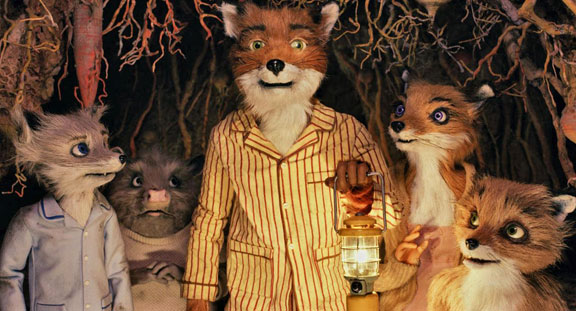
Fantastic Mr. Fox: At Least Fairly Good

Fantastic Mr. Fox, a stop-animation movie adapted from Roahd Dahl's children's book by unconventional auteur Wes Anderson, tells the story of Mr. Fox, a fox-about-town going through a fairly typical mid-life crisis. Now that his wife is a mom, and they have a pup to raise, he's vowed to settle down and stop the dangerous occupation of chicken snatching: but Mr. Fox yearns for his daring days of old, and to perform just one more glorious caper. Unfortunately, his caper goes up against three of the meanest farmers in the neighborhood: the imposing trio of Boggis, Bunce, and Bean.

This simple story has been rewritten by Anderson to focus, more than the original fable, one thinks, on Anderson's typical obsesssion with the existential despair of small family moments. Hence the character of Christopherson - Mr. Fox's nephew, who comes for an extended visit during Foxy's schradenfreud, becoming a rival to Ash, Mr. Fox's nerdish pup.

Let me say here that I've never been a big fan of Wes Anderson (his movies have never really gelled for me), but in working with Dahl's material, I think he finally here finds his voice - and the merging of eccentric fairy tale with existential family dynamic and the endearing quality of decidedly low-tech stop-animation produces just the right combination of quirky introspection.

The best thing in the film, by far, is the catchflung animation and the whimsical way in which the tale is told. By one small example: in explaining the complexities of the animal sport of Whackbat, a crickety thing with several layers of intricate complexities, we're presented with a non-sensical litany of quick rules performed in a monotone by Owen Wilson, all to comic effect. The joke is even better in the second go-around when Ash spontaneously performs his own real-life (stop-time life, whatever) Whackbat impression while getting his father Foxy and Dad's accomplice Kylie out of a tough life-threatening spot with farmer Bean. Seeing it all done with cute stuffed animals makes it even more entertaining.

By the way, that Bean is a determined sucker who pulls no punches in trying to hunt down Foxy and his hoard of animals. The relentlessness is a bit dark for younger children, but does a good job of capturing the heightened drama of adolescence and its sense of irreversibility. That is to say, I've always found existentialism to be a bit of a juvenile philosophy - lacking the stern conviction of nihilism, the formal rigors of phenomenology, or the literary complexities of a full-blown moral universe. But it does suit well a young mind struggling with the unfairness of life and searching for a reason to enjoy it all anyway. That seems to be the focus of the tale here: as much that Ash discovers his own inner fox despite his father's favoritism for his cousin; as it is Mr. Foxy freeing himself from the stultifying shackles of civilization to re-ignite his youthful, foxy nature. What Anderson is saying, apparently, is if you just stop all that worrying, your sleek animal nature will save the day.

Call it "Old Dogs" meets "New Tricks." Like a kid who wants a good excuse to skip school, the story labors laboriously to explain why rakish irresponsibility is cute, and good for an old fox. Mr. Fox's pontifications on the subject hardly make sense, but never-you-mind: it's really more Wes Anderson's movie than it is Roald Dahl's, which means it's really not at all about being a good husband or father or any kind of believable leader: it's just about growing up an awkward child, being challenged, and overcoming odds. Even the sly Mr. Foxy is just a big kid at heart, eager to be appreciated. I, for one, find the animation and writing thoroughly entertaining most of the way through, so I think this time, the kid deserves his due.

Tuesday, August 18, 2009

Julie and Julia: Should Have Halved The Recipe

I can imagine the conversation that must have gone on when Nora Ephram went to the studios to pitch a movie about Julia Child. "Julia Child?" some twenty-two year old executive must have said. "How will movie-goers related to a deceased French cook?" (or perhaps worse, "who's that?"). The solution: license two books, one about Julia Child, and the other the book based on the blog by the young woman who spent a year cooking all of Julia Child's recipes ("The Julie/Julia Project"). It's about Julia, see, but younger audiences will relate to the young chick.

Then mix thoroughly and voila: audiences will flock. Unfortunately, rich as the ingredients are, the final confection falls flat, and probably due to all that mixing.

The Julia story – played by the always wonderful Meryl Streep and supported by an equally wonderful Stanly Tucci – tells a warm and tender story about how an American diplomat’s wife, stranded in Paris, learns to cook in order to pass the time, and eventually finds her métier in besting the stuffy French and translating French cooking for the “servantless” American audience. Julia and her husband are very much in love, and the story is really about how women in the Fifties, servants to their husbands, were still able to occasionally find acclaim and satisfaction by discovering their hidden talents (if they were lucky enough to have husbands with the right careers, and the right politics).

Then there’s the Julie story – about a modern, twenty-something Brooklynite who discovers Julie Child’s cookbook and decides to cook every recipe over the course of a year. This tale is rather the opposite. Dour and unrelenting, this Julie has been turned into a stock Nora Ephram heroine: winey, self-absorbed almost to the point of weird obsession, more than a bit neurotic and the last person any man would want to spend any time with (the voice exhibited in the Julie/Julia Project blog is much more accessible than the character played by Amy Adams, and one feels sympathy with this author for what Ephram has done to the character.)

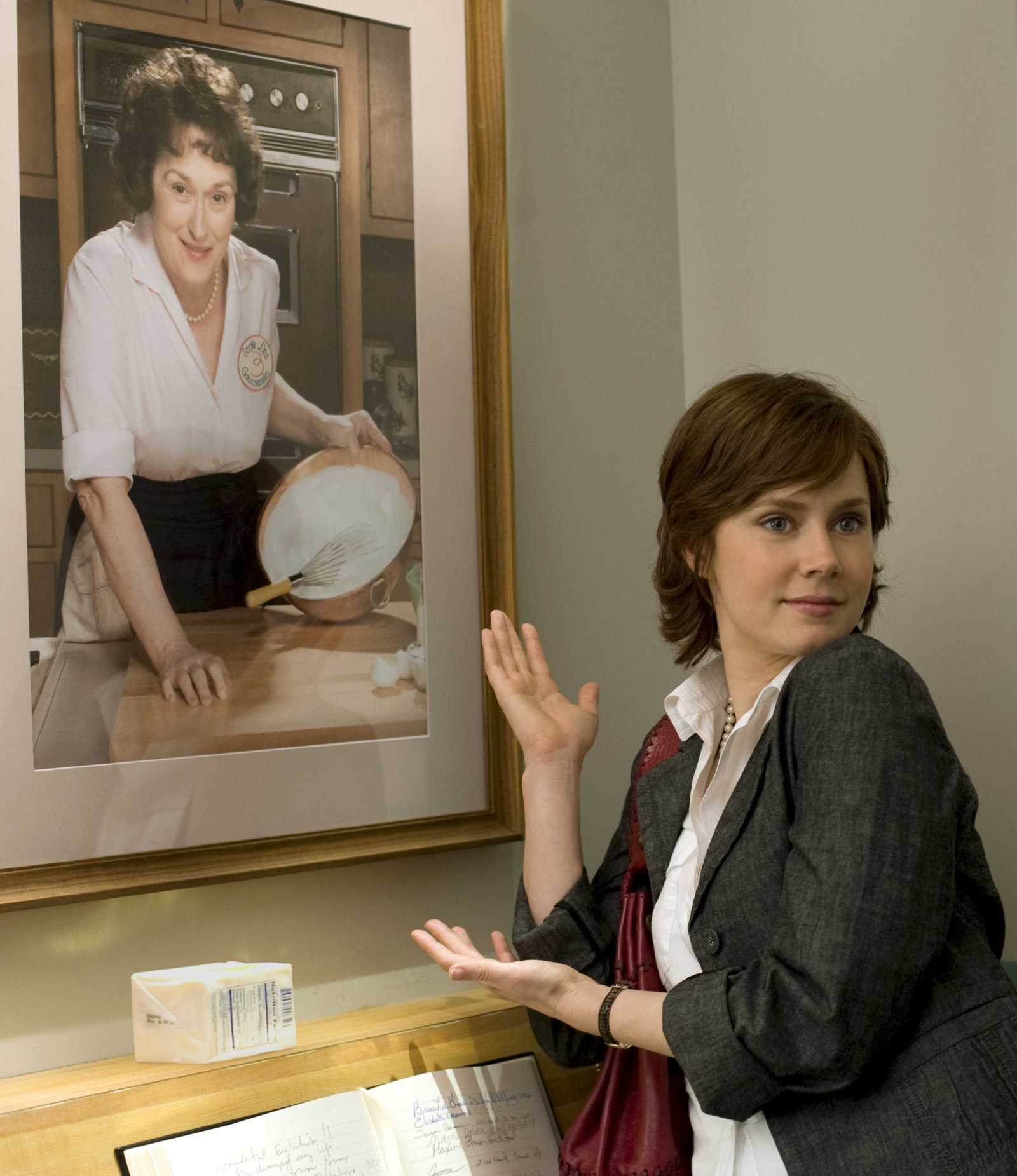
Ephram chops up the Julia story and sprinkles in the Julie story, shifting the mood between uplift and whiney, to the point that by the time the movie finishes, with Julie reminiscing in the Smithsonian over Julia’s kitchen, we feel cheated of both stories – the Julia story seems to be just getting going, and the Julie story should have ended long before, after an interminable sojourn in Julia’s footsteps with no new insight.

I don’t think the problem is necessarily Amy Adams (who’s serviceable enough) so much as it is Ephram’s cloyingly morose view of her heroine (and the fact that her story line must compete against the incomparable Streep, who elevates everything she touches). Adam’s Julie is a beleaguered assistant at the Lower Manhattan Redevelopment Corporation, hating her job and hating her new spacious brownstone loft, with its expansive deck and room for elaborate dinner parties, over a pizzeria in Queens. Yeah, that’s tough. Ephram shoots Julie’s trudge to work through the New York subway system through the “drab” filter, washing out colors and packing the frame with mundane details of office cubicle desk life. In part, this is meant to be a contrast to the romantic view of Julia’s 1950’s Paris, but it struck me as ungrateful: ninety percent of Manhattan’s middle-class intelligentsia lives this life, and enjoy it rather much – thank you. And I know the people working at the Redevelopment offices, and they are quite happy to be doing what they see as important, meaningful work.

Not so our Julie, who is pained by every workplace phone call and finds having a marvelously sexy and supportive husband who actually has a job he likes a real drag. My feeling is that this is all rather changed from the original blog project, which was written for quite different reasons (mainly to occupy time while unemployed, and establish a career). That Ephram changes the motivations of the heroine does significant damage to the story, I believe. I’d find it much more interesting to learn the strategic process of a happy blogger – or to just get the straight story of Julia Child’s life – than to sit through the sad lamentations of a female Woody Allen who draws inspiration from an imagined cooking Yenta. Yes, Woddy populates his New York portraits with nebbishes too; the difference is, he’s funny.

All of which makes it more painful to report just how wonderful Steep is in the backstory role. Julia Child is a character of easy parody, but Streep creates a person that is far deeper than, yet still recognizable as, the character we think we know. As Child, she brings the same kind of kooky intensity to discovering Paris and ingratiating herself into Parisian society that she later does to cooking and writing. Stanley Tucci lives up to his role as Mr. Child, loving his wife and lending his sympathetic ear as she finds her passion, and the straight story line of how Julia became Julia is the most moving and interesting thing in the film.

All the more reason to be disappointed by that ending in the Smithsonian, which stops us short of finding out the really interesting parts of Julia’s life, and refocuses back on the sad symbolism of our nebbishy heroine. I was fascinated by Julia Child’s kitchen – and curious to learn more of how she mixed her home life with her career. But by this time, I was thoroughly fed up, as it were, with the elaborately layered soft terrine of audience appeal Ephram was trying to make instead. Julia herself would have stripped out all that gooey gunk and served it to us straight, and perhaps raw.

Sunday, December 28, 2008

Doubt: A Study of Opposing Faiths. And Acting Styles


It's just at the climax of Doubt - at the point where Meryl Streep's Sister Beauvier and Phillip Seymour Hoffman's Father Flynn confront each other behind closed doors, and one of them ultimately relents - that you realize that the end of this marvelously acted drama is going to come sooner than you expected.

Not that the movie, at one hour and forty-four minutes, is unusually short. But the story seems unusually quickly resolved...at least on film.

In other words, despite the amazing performances by the two principles - and by Amy Adams as the innocently naive Sister James, as well - the movie suffers a bit from that old syndrome of theater directors translating their work to film: what works in a theater, in front of a live audience, struggles as a movie to deliver the same sense of satisfaction. And why? Because theater is a medium of words; movies are a medium of images. The images in this movie are rich, textured recreations of a 1960's Catholic school. Unless that holds some special nostalgia for you (and it doesn't for me), there's little else other than the words and acting of this parable of inquisition to hang your hat on.

But supreme acting it is. I would normally be writing a review about how much better it would be to see this story on the stage - but unless you had Streep going up the stalwart Hoffman, you would miss two amazing performances from two of our best actors. So it's worth buying a ticket, and especially so to see Streep give yet more evidence of why she's probably the best actor on earth.

Streep's Sister Beauvier represents, of course, the old ways of the church: relying on strict discipline and the aura of fear to keep young minds in line. What Streep does so well, of course, is make this a complicated character, not a stereotype. Sister Beauvier is strict, of course, but also capricious, humorous, self-deprecating, even compassionate, and convinced of her convictions, and the rightness of her actions. She has something to teach the young, idealistic, and somewhat incompetent Sister James about how to command respect, not just obedience, and Sister James listens, and learns. She learns a little too well, and becomes an unwitting accomplice to Sister Beauvier's suspicions about Father Flynn, and what he may be doing behind closed doors with some of the more susceptible alter boys.

Hoffman's Father Flynn, for his part, is the opposite, or counterpoint, to Sister Beauvier's strict authority: a full-figured fellow who loves life and hearty appetites, he represents the new age of Sixties enlightenment...a kind of early flower child, who points out that the word of the lord is "Love" and that doubt is an emotion that creates a human community. He also, it turns out, is a man of as much principal as Sister Beauvier. Hoffman brings the kind of iconoclastic intensity of his character Gust Avrakotos from "Charlie Wilson's War," only better groomed and cherub-cheeked. He is no real radical, of course, but his sermons of doubt and deeds of compassion do create a radical disruption to Sister Beauvier's community of austerity.

That the two would ultimately go up against each other is what this story is about. As is the truth behind the accusation that sets the conflict in motion.

All of which is to say, it is a great story, marvelously acted, and full of superbly delivered words, the most moving of which are no doubt Streep's amazing soliloquy to Adams at the end, a kind of poetic coda to the title of the play. Shanley frames his story so that, as one might say, the ultimate villain, and hero, is what you're meant to debate. All of which I appreciate, for I love a good ripping tale that leaves you with such delicious dinner conversation at the end (I think of the play "Art," which I saw in London, which has the same moral open-endedness and conversational effect).

My only qualm is that this marvelous play wasn't filmed by someone with a little more distance on the material who would have felt free to make the changes necessary to make it a superb movie. More on the boy's family, on Father Flynn's acquaintances, on other parishioners might have taken the movie out of its claustrophobic stage-set experience. The movie reminds me a bit of the series Mad Men, especially the character of Peggy Olson and her relationship with religion. But where Mad Men sets Peggy into a broad context of diverse characters, Doubt stays focused on the conflict between Sister Beauvier and Father Flynn. In a theater with live performance, such tight focus creates a gripping experience of high drama. On the more distant movie screen, it creates moments of brilliantly composed acting, and a feeling that all that acting should have someplace more definitive to go.