Saturday, August 29, 2009

Taking Woodstock Immerses In Metaphor


Ang Lee is a director who likes to immerse his films completely in a time and place. Whether it's suburban Connecticut in the '70's (The Ice Storm), classical China (Crouching Tiger), or the '60's West (Brokeback Mountain), he wishes to capture not only the scenery, but the feeling - the essence, if you will - of being in a specific moment in time, in a specific landscape.

His films are also about sexual awakening - whether the awakening is naive and dangerous (Ice Storm), furtive and repressed (Brokeback Mountain), or symbolically coded Freudianism (The Hulk), he's seemingly fascinated with the roles between parents and children and the fraught sexual tensions of adolescent transformation into adulthood.

It's perhaps inevitable, then, that Lee would eventually gravitate towards filming the biggest cultural moment of sexual and adolescent awakening in our collective memories: Woodstock, that late-Sixties concert on Yasgur's farm that became synonymous with a generation's blossoming into sexual freedom.

Yet this is not the straight-on Woodstock movie that many might expect, that a director of realism like Ron Howard or of moral drama like Spielberg might make. There is little of the music, none of the performers - nothing, in fact, of the "subject matter" of the concert itself. What Lee wishes to focus on is the experience - the feeling - in fact, the meaning, of Woodstock, not only to the thousands who attended but to an entire generation, more than anything else. Lee goes so far deeply into the meaning of this moment that what he creates is a supremely "laid back" film - a film with a breezy style and subtly of drama that seemingly might have even been made in the Sixties, but with such awareness and fullness of the moment that it could only have been made from our present perspective.

Taking Woodstock centers on a particular man/boy, if you will, played with halting charm by the young comedian Demetri Martin. Martin is Elliot Teichberg, the dutiful, industrious, creative son of two bat-shit crazy Jewish hotel owners in the Catskills who are going broke in their lazy, run-down old town. (Elliot's mother, an Eastern Europe refuge who looks a bit like a drained beet, drives away customers by charging for towels and showers, berates the banker who's about to foreclose on their property, loves shooing the hippies renting their barn back inside whenever they pop out, and is an eternal albatross and embarrassment to Elliot. Meanwhile, Elliot's father is a thoroughly defeated roofer who lets Mom run the boy around.). This is the story of Elliot, how he ends up bringing the concert to his town, and how the concert transforms Elliot - a buttoned up Jewish intellectual with hidden drives and tender obligations - from a divided, unhappy soul into a fully actualized, integrated human being.

That's pretty much the plot of the film, and as with his movie Brokeback Mountain, the pace of Taking Woodstock is slow and easy, the main character is a gay man (only this time, one who finds comfort in discovering who he is), and Lee is more concerned with building metaphor and moments of beauty than creating drama and tension (this film couldn't be more opposite to something like Tarantino's Inglourious Basterds.) I'm afraid all this may make it a bit unpopular for certain theater goers. (Exiting the film, the people behind me said, and I quote: "What happened? Nothing. It was gay. That's all that happened." Then again, I saw it in New Jersey.)

I too was a bit bored during the movie. Lee uses a split screen (as he did in The Hulk), a technique that was too clever by half in The Hulk and which seemed, at first, discredited here (the reason for it I'll explain in a bit). It bothered me, as did a beefed up Liev Schreiber in wig and dress playing an ex-Marine drag queen, the corny little breaks in character (like a cop with a flower in his helmet) and the sometimes slow scenes of spaced-out dialogue. Yes, like many, I wished Lee had used more of the music of the festival to punctuate the soundtrack (were the rights unavailable, or was this a conscious decision?). I sat through the film not sure what I thought about it. But as I left the movie, and as it sat with me, it grew and grew - seeing it was like taking a pill, and as the memory of the movie flowered inside me, it increasingly left me with a good feeling. Finally, as I fully realized how Lee's symbolism had worked throughout, how well he had touched upon a critical moment of adolescence, I realized that a movie hasn't made me feel this good in ages. Lee had done something much much more than simply shoot a boring movie about a gay boy's peripheral view of Woodstock. It's like taking a little bit of the Sixties with you.

How he does that is actually quite complex, and what a director like Lee is so brilliant at is creating layers of metaphor. He does that here and it's just not apparent how so until the movie is over. But start at the opening scene: a shot of flowers growing in the decaying, ordinary landscape of the Teichberg motel, and the empty pool. This landscape is Elliot's landscape. There are flowers growing (Elliot is a painter) but the life is drab and dull. The pool is empty. Lee has chosen these metaphors - flowers and water - because this is Woodstock, a cultural moment about sexual blossoming, and the age of Aquarius.

As the people of Woodstock come to town, the pool becomes full - first to bathe in, later to drink. Elliot begins to become more of himself as he bathes in their almost extra-terrestrial glow, and he begins to use his entrepreneurial skills to help organize the concert promoters, to convince his parents and to fight the hostile townspeople. The character of Michael - the lead promoter, who once lived on Elliot's street - is handsome, virile, laid-back, chilled, and completely actualized. He's the dream of what Elliot could be (he even comes riding in on horseback at one point): a combination of a creative soul with business smarts and leadership...the perfect Aquarian.

But Elliot is divided - clearly evident in his paintings, which all exhibit dark and light swatches intersected by a single bright color. In fact, much of this movie is divided into Yin and Yang: there are the two townie brothers, one the uptight older fisherman, the other the war-ravaged whacked out wild soul. There's Elliot's mother and father, who have reversed roles, with the mother dominating and the father shy and shut down. And there's the motel itself - which has both a barn, in which live the Earthlight Players, a communal, semi-naked, pansexual chorus of free thought and love, and the main motel, in which live Elliot's uptight, hostile, repressed parents. The parents, like Freud's ego, must keep the naked players inside the id of the barn. But Woodstock is about letting all that free love energy out...by the millions.

This is why the split screen technique ultimately makes sense: like Elliot, the film is split between repression and freedom, and is about breaking down that barrier through the crucible of the concert (it's also apparently a direct tribute to the Woodstock documentary, which used the same technique). The character of Vilma - Liev Schreiber's drag queen - shows up as the hotel bodyguard, as the first embodiment of that mixing: a hard man and soft woman in one person. But the real mixing happens the first day of the concert, when Elliot is sent "to the center of the universe" by Vilma and his father. What he encounters when he gets to the concert isn't the concert itself but a van, where sits a hippie from California and his chick. The two spot Elliot and immediately deduce that "he's thirsty." He is thirsty - for the age of Aquarius - and they offer him wine, and ultimately seduce him into the van, where he's given a tab of acid. What comes next is probably the most delicately created, insightful, and accurate representation of a drug awaking experience ever put onto film. As Elliot lies in the van, seduced by both the man and the woman, the mandala paintings around him begin to move, swirl, and mix. This is the beginning of the journey to dissolve the dualism, to mix the Yin and Yang of the movie's themes.

When Elliot finally emerges from that van, he's a new man: literally dressed now in the relaxed garb of the Sixties, he goes to a hill to look at the concert with his new friends. What he sees becomes an entire ocean of people, a moving, rolling sea, with the center of it the light of the concert, blossoming and exploding like a verdant flower. This: this moment of sexual awakening, this moment of self actualization and integration - this, Lee is saying, is the center of the universe. But this is not just Elliot's story: this is a story of an entire generation that awakened at that concert, and that's why his film is so powerful. This rolling sea, this is the Age of Aquarius. "Perspective," Elliot is told, "is the death of love." To fully love, one must lose one's perspective: one must become part of the rolling sea.

When Elliot returns home, however, his parents are still there. What he must do then is come back from his journey of self-actualization and fix his life. That isn't always so easy, and Lee punctuates this by giving us a wonderful closing scene of the destruction left at the end of the concert: the muddy fields, the trash, overflowing urinals, the empty stages. After integration, one must still pick up the pieces and carry on.

It might seem to some like nothing much happens in this movie. The concert comes, and the concert goes - we never see Joplin or Hendrix, we never see the guitars and singers. But Elliot knows who he is now, and clearly, that's the most powerful thing that could happen to anyone. It happened to millions of us in that August of 1969, and happens to many more of us every day. It takes a beautiful movie to make us feel that again.

Wednesday, August 26, 2009

Inglourious Basterds – Kosher Porn for Cinemaphiles

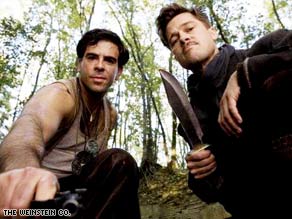
“This may be my masterpiece,” are the final words uttered in Quentin Tarantino’s latest film. Tarantino’s hero, a slow-drawling Tennessee commander (played by the ever scruffier Brad Pitt), who leads a brigade of Jewish Nazi-killing mercenaries, says this as he lovingly carves a swastika into the forehead of another character. It’s no coincidence that these are the last words of the movie, or that Tarantino might wish the audience to take them as his own appraisal of this film. There’s a lot in the movie that’s self-referential, to the point where the movie is much more a cultural pastiche of cinematic techniques than anything else; certainly more so than it resembles anything that might parallel actual World War II history, let alone an Aristotelian story, with beginning, middle, and end.

And presumably, Tarantino wouldn’t have it any other way. Eli Roth, a director whom Tarantino casts as “the bear Jew,” calls the film “Kosher Porn.” What he presumably means by this is that the movie is essentially a Jewish revenge fantasy: a group of Jewish mercenaries so ruthless and deadly that they strike fear into the hearts of Nazis everywhere, bedevil Hitler, and ultimately bring an end to World War II. That may be (though one is left to ask what connection Tarantino feels to such subject matter…as no Jewish director would dare be so disparaging of “real” history). But I think the word “porn” is operative in a different way as well. Like pornography, Tarantino has structured his film as series of character set pieces only loosely connected by a thru-story, with each piece structured as a long, verbal seduction that builds to a sudden release of violence (with the last set being the kind of grandiose all-members orgy of death, the kind of group release the best porn films usually save for last). Porn, indeed.

The plot, such as it is, is essentially borrowed from a series of World War II and spy movies as wide-ranging as Guns of Naverone, The Dirty Dozen, James Bond, and every movie ever made about the French resistance (with, as Jeffery Golderg points out in The Atlantic, a bit of Springtime for Hitler for good measure). The movie opens as Colonel Hanz Landa – a renowned “Jew Hunter” – interrogates a French farmer about a neighboring Jewish family and their whereabouts. Landa is cultured, charming, and something of a connoisseur, at least when it comes to hunting Jews. Next, we get an introduction to Aldo and his band of Jewish mercenaries (including the “Jewish Bear,” who gives Hitler the schvits); Aldo is the opposite of Landa: the rough American with a Southern drawl and a penchant for scalping his victims. After this, some of our characters start to meet in various combinations, and we are introduced some new and interesting actors, including a British movie-critic-turned-spy and a German-actress-turned-traitor.

Each of these pieces really do, I think, exhibit Tarantino working at the top of his form (pun intended, as you’ll see). I’m reminded of the “Big Mac” discussion in Pulp Fiction: the kind of cultural trivia that fascinates as it builds an undercurrent of tension. That scene became a kind of signature discussion piece of film-students everywhere, and each of the scenes in Inglourious Basterds does the Big Mac discussion one better. We get the clever interrogation of the French farmer, who is cornered into a Sophie’s choice of a decision. We get the nerve-wracking interview of a Jewish woman, passing as French, by Joseph Goebbels, who wants to use her theater for a German movie premier. And we get what probably will go down as a classic scene of espionage as two Jews, a British Spy, and a German film actress leading them all on a secret mission to assassinate Hitler during this very premier, play a game of “what celebrity am I” with a group of German soldiers on leave, trying not to give themselves away. There is no doubt something archly fun in the way the game – in which the players put cards on their foreheads to indicate the hidden personage they must guess at – echoes the game of hidden identity the spies are simultaneously playing…not to mention Aldo’s penchant for marking his victim’s identities on their foreheads. Each of these scenes is individually great, even if taken together they don’t add up to anything more than the sum of their parts. (Intentionally, according to Tarantino’s interview with Charlie Rose, where Tarantino essentially explains that he doesn’t believe in morality. Which explains why his films are absent of any moral character arc. They are, in Tarantino’s own words, written as actor vehicles, not really as expressions of story.) There is no doubt that Tarantino is an actor's director, and he gets fine performances out of his entire cast.

But the real point of this film is deceptive – even if we are meant to focus on character over story, acting over arc, Tarantino’s subject here is not so much the characters of the war as it is the characters who wage a war of cultures. The real villain in the film isn’t Hitler, but Goebbels, the German minister of culture who created a “pure” German cinema that glorified the exploits of the Nazis. Goebbels is after a kind of purification of cinema, and the verbal calisthenics of the other Nazis seems to emphasize this obsession with culture. What, after all, is racial cleansing but a kind of ultimate expression of aesthetics? One wonders if Tarantino isn’t after (or fears) something quite similar, in his own fraught relationship with film form; after all, like his obsessed Germans, Jew Hunters, and Nazi killers, all roads in this movie lead to the cinema, where Tarantino seems to be saying that history can be transformed, if not escaped entirely, by virtuosos with enough courage to “break through” classical sentiments about morality.

However, without the morality, it’s rather hard to tell if Tarantino wishes his film to be a tribute to cinema, a rabble-rouser, a personal indulgence, or just another exercise in stylistic borrowing. But what he seems to be doing in the closing scenes of his movie is intentionally copying the German Nazi film style: He creates a celebratory fantasy of violent triumph that is a kind of catharsis; but so similar is Tarantino’s treatment to the Nazi’s film treatment in the film-within-a-film that Hitler’s salivation over the scenes of Germans killing American soldiers is an uncomfortable mockery of our own. To what purpose might this be done, other than mere titillation? And this scene isn’t the only highly stylized borrowing in the movie. The entire film exhibits this homage of styles, one style each for each of the main characters: the style of French cinema to match the Catherine Deneuve-like French heroine; the style of the American Western to match Aldo Raines and his band of Jewish Indians; James Bond for the British spy (“At least let me go out speaking the King’s English”). The characters speak multiple languages and Tarantino slips in and out of multiple film styles, ultimately going out with his Riefenstahl-ish triumph of the pornographic will over history. It’s fascinating, but ultimately, what’s the point? To exhibit Tarantino’s mastery of cinema? Granted, anyone who’s followed Tarantino’s work takes this as a given. To create lasting art, however, I believe one must ultimately offer more than a study of form.

Perhaps what’s most aggravating about this movie though is that while Inglourious Basterds wants to erase history in its wake, and be blissfully free of morality, it’s also trafficking in the morally-weighted subject of the Holocaust. Why this subject matter? It’s weirdly insulting – at first – or possibly insanely brilliant, in the way that sometimes the autistic or the socially inept student can hit upon some brilliant insight in their obsessed recitation of arcane detail. But if it is brilliant, one is still left to wonder why a movie like this is even needed, and why now. Americans certainly aren’t lacking for propaganda, nor does either an homage to Germanic cultural exceptionalism nor an education in an orgy of pornographic cinematic violence seem necessary in our present moment (anyone who saw the G.I. Joe movie this summer must certainly agree). Nor does it seem like the story of the Holocaust need credulous deconstruction…unless you’re a Holocaust-denying anti-semite, which Tarantino (one assumes) is not. So the motivation for the movie is a bit of a puzzle. One imagines Tarantino at the end of the film looking it over and saying to himself either, “I’m a genius, and this is my masterpiece” or “Boy, if anyone actually buys this crap they are such suckers.” One can possibly imagine him saying both simultaneously.

I know, this could be said to be a criticism of the whole Tarantino/Rodriguez nihilistic oeuvre, with its fascination of form over morality and its love of carnage. There is indeed much to be admired here in Tarantino’s facility with writing and directing, and Inglourious Basterds seems to have elevated this sort of thing to a true art, as much as that word can be applied to a formalistic exercise. Yet I fear that Tarantino may have created a masterpiece that has no moral value, other than to exhibit the filmmaker’s fluency with film. In this sense, then, Eli Roth is right: this is a kind of Kosher Porn, though it’s not quite clear who’s supposed to be getting screwed.

Sunday, August 23, 2009

Distric 9 - Classic Sci Fi

Way back in the day, sci-fi used to be about something: specifically, it was a coded way of providing a social critique. HG Wells and other writers who invented the form placed their stories in the future, or created metaphors of strange monsters and aliens, as a way to help their readers escape their present social or economic class, in order to see a present-day issue like poverty or class resentment in a new light.

Such is the spirit of District 9, set in Johannesburg and written as a clear metaphor for apartheid.

The movie has sparked some controversy – some who believe its portrayal is racist, others who think it’s merely trivial . Most of these reactions are due to the way the aliens are portrayed: as “digusting” insects who ravage through garbage and seem both disoriented and violent. Then there’s also the portrayal of the society that reacts to them with a mix of fear, revulsion and exploitation.

I think it’s a brilliant film intentionally challenging racial assumptions as well as our reception of news, international events, and our own places in society. It certainly is a challenging movie, extremely violent as well as trafficking in stereotypes both cinematical and racial.

The movie opens in mockumenatary style, interviewing the factotum of a U.N.-like semi-military aid agency (“NMU”), Mathias, charged with relocating the aliens, vernacularly referred to as “prawns,” from their make-shift camps near Johannesburg to a tent-city well away from civilization. The interviews are conducted with members of the press, academia, and general public; we also get the back story of how the aliens came to Earth, the mystery as to who they are and why they are stranded here, and the somewhat threatening and odd behavior of the aliens in their raggedy camps.

That all this has a direct parallel to apartheid is obvious, and the movie doesn’t really get going until Mathias is accidently spayed with some alien gunk. The gunk begins a genetic transformation in Mathias that allows him to operate the advanced alien weaponry (which has been coded only to respond to alien DNA).

The DNA transformation from human to alien is a stock sci-fi trope (Star Trek: Next Generation did a nifty episode on this theme), but what elevates this movie are precisely the controversial chances it takes with its racial/alien metaphor. Much like Bruno, District 9 wishes to explode safe assumptions – in this case, racial assumptions - even as it traffics in the same stereotypes it’s examining.

The “prawns” are not pleasant – they rummage through trash for their meals, respond to the violence of the MNU with equal violence, and are seemingly addicted to cat food (the alien equivalent of heroin?), for which they trade technology, weapons, and stolen goods on the black market supported by an evil Nigerian gang that rivals MNU for their violence and ferocity. They are also trapped here – unable to restart their spaceship to return home. In this sense they also serve as a metaphor for any displaced people, from Palestinians to Afghani’s, who find themselves dispossessed. The mockumentary treatment helps to reinforce our view of this tragedy as something apart from us, the way world news is something we simply watch on our TV. The movie seems to be saying that in our media saturated environment, even the presence of aliens from another world would soon become just another nightly news story, hardly worthy of disturbing our daily routines. The aliens and their situation have become something we can hardly understand, let alone sympathize with.

But when Mathias starts to become a prawn himself, he quickly discovers personally what it’s like to be on the other side of the MNU stick – as well as befriends one of the key prawns, and his son, who equally have to wrestle with their suddenly found allegiance with their former persecutor.

At the core of this movie is the alien / human bond, which develops richly over the course of the bloody action, giving the film a strong emotional underpinning which I think is the key to the appeal it’s finding with its fans. I complain often in my reviews about movies that lack a character arc; it’s hard to find a more pronounced arc than the one Mathias must travel, changing in the course of two hours not only his social station and his politics, but his species as well. Mathias’s change is met with an equal growth on the part of his prawn ally, who is able to discover a bond of friendship that goes beyond worlds. It’s a classic story of war and oppression, only the alien DNA and weaponry give it a unique kick, and the documentary style ads the right measure of curious distance and subtle, sarcastic humor.

There certainly is some truth to the criticisms about the movie. The Nigerian bad-guys are right out of central casting, and couldn’t be a more offensive stereotype. As are the white military commanders and the bloodthirsty CEO’s. There’s no subtlety lost on this film.

But for a sci-fi that’s mean to entertain, District 9 does so in the best fashion. Like the great episodes of Battlestar Galactica or the sci-fi classics of an earlier generation, it asks us to re-look at our present sociology with the strange orientation offered by an alien culture. It does so originally and with spirited gusto, and for those who love a classic sci-fi yarn told well, it doesn't disappoint.

Tuesday, August 18, 2009

Julie and Julia: Should Have Halved The Recipe

I can imagine the conversation that must have gone on when Nora Ephram went to the studios to pitch a movie about Julia Child. "Julia Child?" some twenty-two year old executive must have said. "How will movie-goers related to a deceased French cook?" (or perhaps worse, "who's that?"). The solution: license two books, one about Julia Child, and the other the book based on the blog by the young woman who spent a year cooking all of Julia Child's recipes ("The Julie/Julia Project"). It's about Julia, see, but younger audiences will relate to the young chick.

Then mix thoroughly and voila: audiences will flock. Unfortunately, rich as the ingredients are, the final confection falls flat, and probably due to all that mixing.

The Julia story – played by the always wonderful Meryl Streep and supported by an equally wonderful Stanly Tucci – tells a warm and tender story about how an American diplomat’s wife, stranded in Paris, learns to cook in order to pass the time, and eventually finds her métier in besting the stuffy French and translating French cooking for the “servantless” American audience. Julia and her husband are very much in love, and the story is really about how women in the Fifties, servants to their husbands, were still able to occasionally find acclaim and satisfaction by discovering their hidden talents (if they were lucky enough to have husbands with the right careers, and the right politics).

Then there’s the Julie story – about a modern, twenty-something Brooklynite who discovers Julie Child’s cookbook and decides to cook every recipe over the course of a year. This tale is rather the opposite. Dour and unrelenting, this Julie has been turned into a stock Nora Ephram heroine: winey, self-absorbed almost to the point of weird obsession, more than a bit neurotic and the last person any man would want to spend any time with (the voice exhibited in the Julie/Julia Project blog is much more accessible than the character played by Amy Adams, and one feels sympathy with this author for what Ephram has done to the character.)

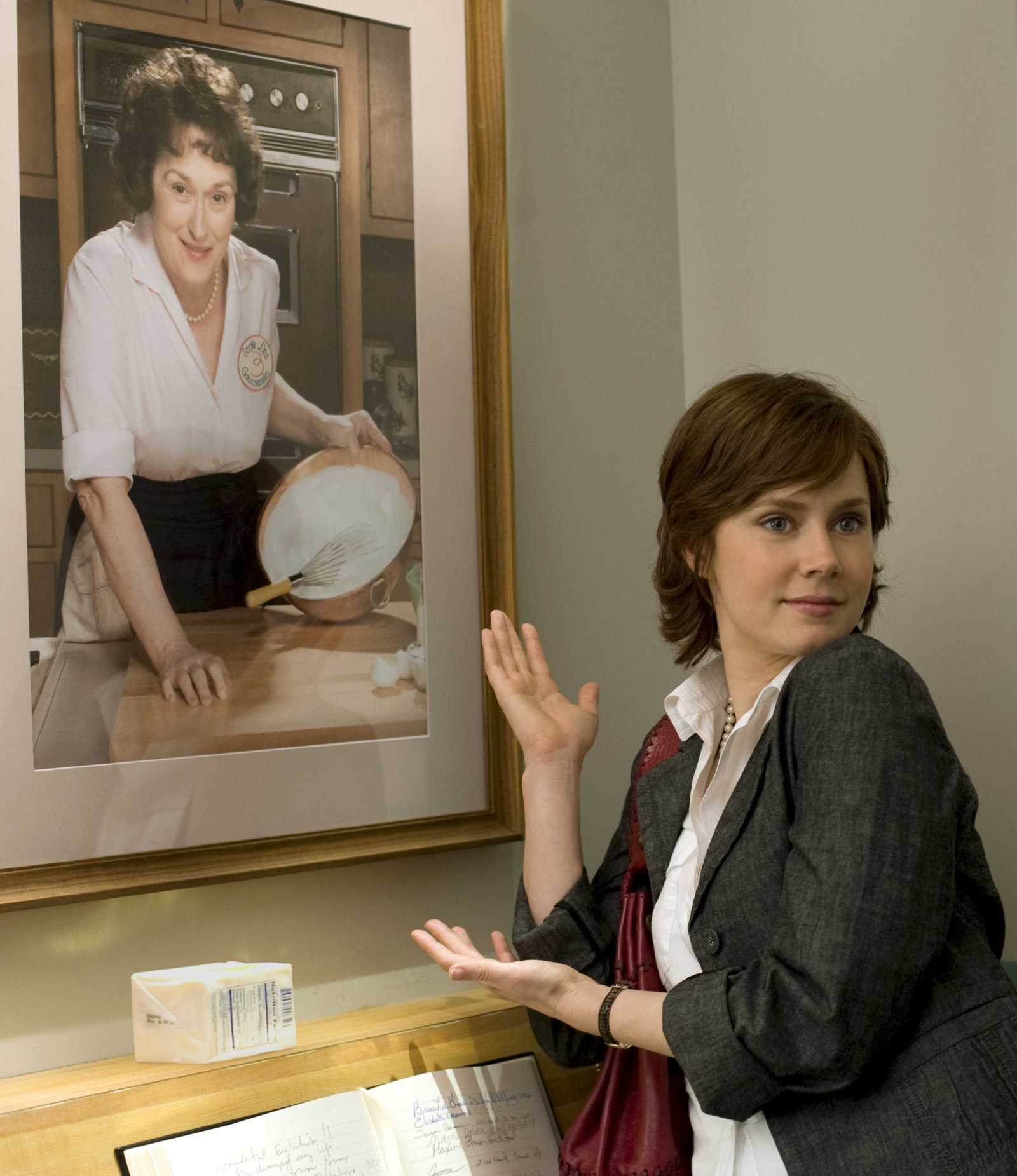
Ephram chops up the Julia story and sprinkles in the Julie story, shifting the mood between uplift and whiney, to the point that by the time the movie finishes, with Julie reminiscing in the Smithsonian over Julia’s kitchen, we feel cheated of both stories – the Julia story seems to be just getting going, and the Julie story should have ended long before, after an interminable sojourn in Julia’s footsteps with no new insight.

I don’t think the problem is necessarily Amy Adams (who’s serviceable enough) so much as it is Ephram’s cloyingly morose view of her heroine (and the fact that her story line must compete against the incomparable Streep, who elevates everything she touches). Adam’s Julie is a beleaguered assistant at the Lower Manhattan Redevelopment Corporation, hating her job and hating her new spacious brownstone loft, with its expansive deck and room for elaborate dinner parties, over a pizzeria in Queens. Yeah, that’s tough. Ephram shoots Julie’s trudge to work through the New York subway system through the “drab” filter, washing out colors and packing the frame with mundane details of office cubicle desk life. In part, this is meant to be a contrast to the romantic view of Julia’s 1950’s Paris, but it struck me as ungrateful: ninety percent of Manhattan’s middle-class intelligentsia lives this life, and enjoy it rather much – thank you. And I know the people working at the Redevelopment offices, and they are quite happy to be doing what they see as important, meaningful work.

Not so our Julie, who is pained by every workplace phone call and finds having a marvelously sexy and supportive husband who actually has a job he likes a real drag. My feeling is that this is all rather changed from the original blog project, which was written for quite different reasons (mainly to occupy time while unemployed, and establish a career). That Ephram changes the motivations of the heroine does significant damage to the story, I believe. I’d find it much more interesting to learn the strategic process of a happy blogger – or to just get the straight story of Julia Child’s life – than to sit through the sad lamentations of a female Woody Allen who draws inspiration from an imagined cooking Yenta. Yes, Woddy populates his New York portraits with nebbishes too; the difference is, he’s funny.

All of which makes it more painful to report just how wonderful Steep is in the backstory role. Julia Child is a character of easy parody, but Streep creates a person that is far deeper than, yet still recognizable as, the character we think we know. As Child, she brings the same kind of kooky intensity to discovering Paris and ingratiating herself into Parisian society that she later does to cooking and writing. Stanley Tucci lives up to his role as Mr. Child, loving his wife and lending his sympathetic ear as she finds her passion, and the straight story line of how Julia became Julia is the most moving and interesting thing in the film.

All the more reason to be disappointed by that ending in the Smithsonian, which stops us short of finding out the really interesting parts of Julia’s life, and refocuses back on the sad symbolism of our nebbishy heroine. I was fascinated by Julia Child’s kitchen – and curious to learn more of how she mixed her home life with her career. But by this time, I was thoroughly fed up, as it were, with the elaborately layered soft terrine of audience appeal Ephram was trying to make instead. Julia herself would have stripped out all that gooey gunk and served it to us straight, and perhaps raw.

Monday, August 10, 2009

The Hangover: ReDefining "Night on the Town"

This nice little misogynistic movie, The Hangover, actually is rather entertaining, if you're willing to overlook it's anti-female attitude and buy into its improbable premise.

That is, four friends (each of a certain type, which we'll delineate momentarily) decide to head to Vegas for a wild night for one of the friends - Doug's- bachelor party (the wedding in this film is entirely ancillary). The wild night becomes a bit more wild than they anticipated when someone slips the group of "Micky." Three of the friends wake up the next morning with a tiger, a chicken, a baby, and a naked lady in their hotel room, entirely unable to remember the night before. Oh, and Doug is missing.

The log line makes a nice joke, but the real test in a movie like this is where they go from there. The movie is essentially a treasure hunt, as the free friends must use the clues they discover to re-trace their steps from the night before.

What makes the comedy here work, mostly, is that the friends are four distinct personality types: Doug is the cuddly, good-natured groom, who ends up getting the worst of it. Phil is the pretty-boy womanizer, who also happens to be the only married member of the bunch. Stu (played nicely by Ed Helms) is the neurotic dentist, who in his micky-induced stupor somehow pulls out one of his own teeth and marries a hot stripper; and Alan is the not-all-there, tag-along, brother-of-the-bride, in the nominal "John Belushi" role.

Naturally, the movie lavishes oodles of time nicely characterizing our four fellows, while reducing all the women in the film to caricatures (the bride, the whore, the police dyke).

Despite that, it has some good moments, and the comedy is more self deprecatory than mean (the film is a spiritual inheritor of the Meatballs and Caddyshack school). Some jokes work better than others (I found the gangster bits a bit lame, and the tiger more growl than bite, but I loved the naked Asian in the trunk of the car and some amusing bits involving a grade-school taser demonstration).

In other words, it's a light-hearted romp with a number of the standard "Daily Show"/"Saturday Night Live" graduates making appearances; on the whole probably more entertaining than egregious. It won't end up in any comedy hall of fame: However, the final sixty seconds of the movie - when the four friends find a camera and are finally able to see the shots of what happened that night in sequence - are laugh-out-loud hilarious, and worth sitting through the film to see.

Sunday, August 9, 2009

G.I. Joe Deserves Dishonorable Discharge

I guess I could have more fun making up snarky review titles about this film than I did seeing the movie. Let me start by saying that I found the trailer intriguing, and was actually looking forward to a solid summer action pic. The super-suits seemed cool, and I loved the effect of flying through the light-rail train and leaping over cars.

It turns out that scene is the high-point of the film. Everything else is a sour mashup of Team America and Star Wars. Maybe that's not quite fair: the team America puppets had more life than the actors in this film. (Though we do get a couple of gratuitous male beefcake shots. Who's the audience for this again?)

The film opens with a flashback to fifteenth century France, where a Scottish arms merchant is tortured for selling arms to both sides. The merchant turns out to be the distant ancestor of our movie villain, modern-day arms merchant McCullen (I don't think I'm giving too much away here - it's not like his villainous role isn't obvious from the start). Since when did Scotts get a reputation as super villains? I've always thought of them more as bumbling well-intentioned tinkerers, like Simon Pegg and other incarnations of Scotty on Star Trek. Well, if nothing else, maybe this movie will do something to toughen the Scottish reputation.

McCullen sends a group of U.N. troops to escort some nasty nanobites in a silver briefcase across an ambush; two troops who survive the ambush get recruited by the G.I. Joes (run by Dennis Quaid as General Hawk); the shadowy COBRA, behind the ambush, finally get their hands on the nanobites, and the Joes have to get them back. That's about as basic a "get the briefcase" movie plot as you can get.

Which is fine, and Hasbro turned another children's toy, Transformers, into a simple action pic earlier this summer. But Transformers had Michael Bay. This movie just has only...extreme violence, and juvenile back stories, which seem to be built on the level of five-year-old sibling rivalry, and targeted directly at a kiddie audience who need to see everything at least five times in order to place a connection (the movie isn't taking any chances on subtly). It's also assembled from an uninspired assortment of stolen action movie scenes. I know, I was asked to see Julie and Julia, but to my regret, insisted on this macho confection instead. Anyway, let's see if I can re-create the recipe for this film:

Day the Earth Stood Still: three measures of nanobite special effects
Men In Black: teaspoon of testing procedure
Team America: sprinkle with lair banter, and loaf of Paris destruction
Kung Fu Panda: lightly toasted back story resentment
Star Wars: two cups of Darth Vader, and a dash of Sith fight in reactor room

Pound heavily with metal music, chop finely, then flame broil on high violence.

What results is not really digestible, if you ask me. It's more like an extended ad for G.I. Joe action figures, and I already got enough ads before the trailers (seeing the trailer for Tim Burton's "9" was actually the best moment in the theater). But what bothers me most about this film is that it's clearly targeting children, and yet I haven't seen a more violent movie in years. The movie kills probably two or three hundred innocent civilians, but with no more a care than a video-game. I'm not usually sensitive about these things, but I feel it my civic duty to warn any parent who cares at all about their children's mental health to keep anyone under twelve out of this movie, which since it has no real character development, has no real moral message to speak of, and does nothing except desensitize the viewer to killing.

As for the rest of us, why bother? The movie is almost five minutes from the ending when it suddenly realizes it needs to set itself up for a sequel. Hence, "The Rise of Cobra." It's obvious this G.I. Joe is the first in a planned line of seasonal movie merchandise. Put me on the 'do not call' list for the rest.

Thursday, August 6, 2009

In The Loop: Great Political Satire, Lousy Title

If there were a movie store somewhere where I could go order a custom movie, filled with all the humor, insight, cleverness, biting political satire and wit that I'd ever want to see from a film, then the new British comedy, In The Loop - loosely about the British and American political culture that led to the Iraq invasion - would be that movie.

It's hard to imagine a cultural product that has been more spot on in satirizing the Bush/Blair culture of the early decade that led to the stove piping of made-up intelligence justifying the march to war. Though the movie never once mentions the words Iraq, Bush, or Blair - and introduces characters who in the first thirty minutes could really be any politicians in any modern times - you soon get enough background to surmise the real targets of this laugh-a-minute lampoon.

John Stewart would be hard-pressed to come up with a five minute routine this good, but director Amando Iannuci and writers Jesse Armstrong and Simon Blackwell (behind some popular British TV comedies) have an intimate knowledge of their subject and the political animal rarely scene on screen, and they keep the keen entertainment going for a solid hour and a half. Someone on that team must have spent time as either a Washington intern or British communications officer, as the characterizations are just filled with such subtle insight it's hard to imagine any writer coming up with these characters out of whole cloth.

The movie opens with British political communications chief Malcum Tucker chewing out the somewhat inept minor cabinet official Simon Foster for inadvertently suggesting on a radio programme about some interior health blah blah that the eventuality of war in the Middle East was "unforeseeable." The inscrutable "unforeseeable" comment naturally opens a whole can of worms for Simon (as well as Malcum), as the U.S. Assistant Secretary of State Karen Clarke comes to London, seeking support for her political machinations against the power-hungry Linton Barwick (a Donald Rumsfeld stand-in) and his secret war planning committee (which goes by the intentionally boring name of the "Future Planning Committee").

The ensuing shenanigans ensnare a riotous assemblage of political consultants, planning secretaries, diplomats, army generals, assistants, and seventeen-year-old cabinet appointees on both sides of the pond. The sacred cows that get skewered are too numerous to name, but do include Oxford-educated Debussy-listening diplomats, U.N. protocols, Rumsfeldian declarations about altering the text of meeting transcriptions to make them, as John Stewart would say, "truthier," office politics between twenty-somethings and fifty-somethings -- and probably the most humorous bit of the film, in which the army general and the secretary of state plan out the number of troops needed for war on a three-year-old's speak-and-spell adding machine (the bit is pure genius).

There are also some truly inspired running gags that are done with just the right level of subtlety: "communications" officers who can do nothing but cuss; seventeen-year-old planning secretaries who get chewed out for ordering "I Heart Huckabees" for viewing by the troops. A rickety garden wall that's a bit like Checkov's loaded gun, just waiting to go off at a critical moment in the plot.

There's much much more: the movie is just chock-a-block with gags and two viewings minimum I think is necessary to catch them all. But don't worry: even getting half the humor of this film would be tens times more than any movie I've seen in the last decade. Yes, this is not just the best movie of the summer - it's the best in years. It's not a perfect movie by any means: though the script is witty, it does have a bit of a TV feel: more craft could have gone into the locations and cinematography, we get a bit lost navigating the various scenes around the U.N., and Gandolfini is mis-cast as the General. And that title does nothing to sell the film. But if there's been anything of late with the insight and wit to cheer me out of the Bush years, this movie is it.

Funny People: Apatow’s 40-Year-Old Comedian

Ambitious as it is, the more you know about Judd Apatow’s latest excursion - Funny People, about a 40-year-old comedian (played by Adam Sandler) who’s diagnosed with cancer, and the twenty-something comedian wannabe (played by Seth Rogan) who tries to cheer him up - well, the less exceptional it seems.

For instance, I didn’t know, going into the movie, that Sandler was Apatow’s college roommate. I didn’t know which of these guys, Sandler’s George Simmons - the successful, cynical elder comedian, or Seth Rogan‘s younger and inherently funnier Ira Wright, that Apatow was intending as his stand-in (probably both). I also didn’t know how much of the story was based on Apatow’s real life.

Even though there's much excellent material here, it's just hard to take away from it the kind of sharp mental picture a movie like this needs; the screenplay is written with the Apatow breezy style but much more of a ‘slice-of-life” plot than we’ve seen in his earlier films. This is a comedian attempting to broaden his wings into more serious matters of life, death and everything in between. It’s not unexpected that comparisons would be made to Woody Allen’s transformation from his early career. Because Apatow, a talented comedic writer/director in his own right, has succeeded, in the most part, in tackling these more serious issues, even if he hasn‘t delivered a supremely crafted movie experience, I think the Allen comparisons are apt.

George Simmons (the name sounds more like a lead guitarist for a rock band than a Jewish comedian born in the early 60‘s) lives in a celebrity world of sea-side mansions, instant pussy, and well-paid servants that a) pretty much seems to be what we would expect and b) probably pretty much, I imagine, reflects the real life of Adam Sandler. When he receives his diagnosis of terminal cancer, Simmons finds that the only person around him capable of exhibiting any real emotion is Ira, Rogan’s eager puppy of a student comedian. Simmons takes Ira under his wing, introducing him to a corporate gig at MySpace and showing him the ropes at various stand-up and theater venues, while Rogan attempts to keep Sandler‘s character from sinking into a morose depression.

Those expecting the film to be a light-hearted romp a la 40-Year-Old Virgin are likely to be disappointed. As are those who think Adam Sandler is inherently un-funny. Rogan and his pals (played by the other two new younger statesmen of Jewish comedy, Jonah Hill and Jason Schwartzman) get the good jokes and the easy Apatow banter. Sandler, meanwhile, plays his irascible character from Punch Drunk Love, not being funny so much as darkly nuanced: his character is meant to be a fame-seeking narcissist, beaten as a child, who now makes big-budget Hollywood fluff and engages in comedy in order to get attention and keep darker demons at bay. The operational insight in the film is that this, essentially, is the personality type of all comedians (though one must wonder what Sandler’s parents - who give a walk-on as Simmon’s parents - think of this premise). Various other real-life comedians make walk-ons in their failed attempts to “be George’s friend,” further demonstration of the thesis that comedians use humor to keep real emotion at bay. Many of these appearances work, some don’t (the best is an interaction between Emenem and Ray Romano, culminating in Rogan’s observation about Romano that “I thought everybody loved you.”)

All this seems to be building to a breezy but slyly-crafted Allen-esque triumph of writing and direction when Apatow carelessly runs in to the accident of his third act. Here it seems real-life may have overshadowed the writer‘s craft, as Apatow introduces George‘s ex, Laura (played with perfect pitch by Leslie Mann), an ex-actress now married to a supposedly overbearing Aussi played w/ irritating gusto by Eric Bana (Apatow’s daughters play Laura’s daughters in the film). George must woo Laura away from the alpha-Aussi’s muscles, with Rogan looking on providing comedic relief. What results is mostly sit-com shtick, and though the act has the movie’s best moment - Sandler, Rogan, and Mann watching Laura’s daughter and realizing that Sandler’s character is simply incapable of relating to other people - even this moment is over directed and lacks the subtly that would have made it the core insight the film wanted.

It’s unfortunate that Sandler’s George, cynical and gifted as he is, can’t really find any truly comic moments in the film. Whether this is due to the inherent sentimentality of Apatow’s premise or whether the Sandler critics are right, it’s hard to tell. (I think Sandler is an oddly effective dramatic actor, but didn’t find Zohan funny, either). In the end, it’s clear then that this is more like an Oxygen channel version of a bromance, and not so much a “ha ha” comedy. As a bromance, it tackles subjects that I wish more movies would tackle: Geroge’s character arc is driven by serious issues about loneliness, talent, and family that go more deeply to the heart of the nature of friendship between men than most movies care to. Even though the relationship with George’s ex is badly handled, the one between George and Ira evolves well, ending with George’s gesture to Ira at the end to finally offer him the career help he needs. But since Ira is basically a younger version of George, even this nice final moment is a narcissistic reflection as well.

Monday, July 27, 2009

Harry Potter's Half-Blood Prince Goes Half-Way to Ending

I've lost count as to where we are in the Harry Potter franchise, but it seems like we must, ever so slowly, be nearing the end.

The latest film - The Half-Blood Prince - teases us with yet further revelations about the nature of Tom Riddle / Voldemort, as well as introduces the devices by which he'll need to be defeated (called Horcruxes, these are objects into which Voldemort has placed a portion of his soul, making him immortal as long as the object exists.) The film also exposes the ultimate allegiance of some of the enduring characters, and propels Harry into the leadership position that he'll need for the final confrontation of Voldemort.

All of which is to say, the film is entirely preparatory for the ending - and though it is directed with aplomb by David Yates, this is rather thin gruel for entertainment.

The fault could simply be the length of the series, which is starting to look a bit long in the tooth, especially as the three principals have far surpassed the adolescence that they're supposed to be exploring in this movie. All the sudden randiness amongst the kids left me with a rather icky feeling - and the effect of twenty-two-year-old actors (whom we've watched in these characters since they were children) pretending to be horny seventeen year olds is disconcerting, if not downright weird.

The real stars of this film - Michael Gambon as Professor Dumbledore and the ever delicious Alan Rickman as Professor Snape - carry along their scenes with appropriate scenery chewing dialogue, but the film bogs down whenever Harry and friends make way with the primary screen time. I imagine that the sudden blooming of teenage lust as Harry and Company find themselves on the verge of graduating from childhood was much more appropriately fairy-tale in the books than in the film, which stoops to the most unfunny of teen-movie tropes to make its points.

What we have in the story of the Half-Blood Prince is a pivotal turning point in any young person's life - the point at which childhood must end, when mentors and adults must inevitably be insufficient, and we must learn to make our own way in the world: facing for ourselves all the trials, wonderfulness and danger of both love and death, loyalty and courage, leadership and allegiance. Facing them finally without the teachers who have gotten us to the verge of adulthood.

This is a profound and unique time in anybody's life, but unfortunately, The Half-Blood Prince fails to capture the dramatic feeling of such a moment. Instead, we get excerpts of other summer movies, long episodes of comical lust, and short scenes of confrontation that should have been pivotal instead of thrown-off.

Yates does a great job of making the visuals ever fascinating, and of revealing what we'll need to know for the final treasure hunt and battle. But as for explaining the feeling of the film - and what I imagine was the underlying appeal of the books - I'm afraid this movie rings hollow.

Tuesday, July 21, 2009

Moon Movie Makes Dramatic Landing

If it’s starting to feel like you’ve seen Mr. Potter and his wand doing the same adolescent battle against the forces of boarding-house mischief a few too many times, you may want to instead check out a tiny sci-fi film called Moon, staring Sam Rockwell as a mining engineer spending a long-term assignment isolated on the far side of the moon.

Moon - a simple movie plainly made without the massive effects budgets of the Harry Potter franchise and other summer blockbusters - clearly relies on the cleverness of its story and the acting talents of Rockwell (and Kevin Spacey, as the voice of GERTY, the astronaut’s computer companion) to deliver its thrills. Moon is much more the inheritor of a Stanley Kubrick sensibility, bringing his 2001-moon-base commercialism into the world of the mid twenty-first century.

The movie in fact opens with a commercial for the moon energy of “Helium 3” with so practiced a corporate tone of anonymity that many in theater thought they were still watching the pre-film commercials, rather than the main attraction. This is the first hint that the movie wants to play with what we think we know and what we think we’re watching: and it does so quite successfully.

For all apparent purposes, Rockwell’s astronaut, Sam Bell has been on the moon now for nearly three years, and is about to end his tour of duty. But the isolation is driving Sam a bit crazy - he misses his wife and young daughter terribly. There also seems to be some unexplained interference that has prevented real-time contact with earth all these years: all his communications come with a twenty-minute time delay.

That those communications have been oddly edited seems to escape his notice, and perhaps that’s due to his mental state - he is beginning to have hallucinations of a strange woman visiting his moon base, even standing outside on the moon in the middle of a hail of rocks from one of the Helium 3 harvesters.

To say much more about the plot would be to ruin the clever surprises. Let’s just say that one particular special effect plays a critical role in the movie, and it challenges Rockwell to create two identical but subtly different characters. The subtleties in the acting here are fabulous and – along with his turned out performance in Frost/Nixon – help establish Rockwell as one of the most interesting actors of our day.

The film has many touching moments – supported by Rockwell’s performance – that underscore the nature of humanity as it moves into frontiers of science. Bell is not a perfect man: he’s driven to bouts of anger and destruction, he’s reckless, and in the end, we can understand, as well as sympathize with, the situation he’s created for himself. In one of the final shots, as Sam stars up at the earth from his rover on the moon, it’s hard not to feel the longing he feels as the metaphor it’s intended to be: how our science has changed who we are, and made it impossible to touch the things we hold most dear. Like many sci-fi’s (think back to the Alien series), the movie casts a corporation in the role of bad guy; yet this movie also poses a deeper question about our own complicity, our own willingness to sell our soul, so to speak. That question is strongly hinted at in this film and I think it could have been a better movie had it been explored a bit more.

Yes, this is a movie with just one actor holding most of the screen time – a tour-de-force if you will – and yes, it does travel in stock sci-fi tropes (though it tweaks them nicely, particularly the AI played by Spacy). I wish the film had been able to spend a bit more time on Sam’s psychology and find a bit more resources to lavish upon the texture of the story – in the building of the sets and the composition of the scenes, which are mostly clever and serviceable yet don‘t all deliver the moment as well as, for example, Sam‘s ending stare at a distant blue Earth. This is a story that really could have benefited from the sorts of grandiose budgets and studio support visited upon the more “hit” driven childish fare of summer. But, sigh - the adults will take what morsels we can get.

Sunday, July 12, 2009

"Whatever Works" Works Beatifully

With over fifty films now to his name, Woody Allen has become as profligate as Shakespeare ever was. Like Shakespeare, Allen comes out with a new work regularly (seemingly whether inspired or not), and will probably not be remembered for his many more lightweight attempts (Hollywood Ending comes to mind). Also like Shakespeare, Allan's work can be broadly divided into tragedies (Hannah and Her Sisters, Broadway Danny Rose, Crimes and Misdemeanors, Sweet and Lowdown, Match Point) and comedies (Annie Hall, Bullets Over Broadway, Manhattan Murder Mystery, Celebrity, Proof) which treat the same subjects as the tragedies, only with a comedic rather than tragic outlook (with the one exception being Melinda/Melinda, which is a tragedy and comedy in a single movie).

In Whatever Works - a definitive comedy in the Allen oeuvre - Allen takes his standard existentialist, crank husband from Husband and Wives, Small Time Crooks, Deconstructing Harry, Manhattan, etc., and this time distills the character into a pure representation of existential dread in the form of the totally misanthropic and unlikeable Larry David (playing a cantankerous professor and self-professed geniuous of quantum mechanics, Boris Yelllnikoff, who was "nearly nominated" for a Nobel prize).

The story is wrapped in a story (the movie opens with Yellnikoff and his buddies chatting outside a Manhattan bakery, where they address the camera to tell Tellnikoff's story). One day Boris realizes that his beautiful Upper East Side apartment and intelligent Upper East Side wife are completely meaningless in the grand scheme of the cosmos, and decides to throw himself out the window. His suicide is foiled by an awning, and he ends up transporting his miserable existence to a basement apartment apparently in some fictional remaining "untrendy" district of Manhattan somewhere (though the '70's and '80's Woody Allen seemed synonymous to New York, but ever since the movie Celebrity in 1998 - a movie in which Woody Allen essentially confessed that his life bore no relationship to ordinary mortals who might inhabit the city - Allen's Manhattan has seemed increasingly disconnected from the city I know, even as he clearly still knows certain key details intimately: the way an alien who's made a career studying this elusive isle might see it).

What happens next is essentially a sketch of the Woody Allen/Soon Yi Previn story that has permeated most of the romantic story lines in Allen's movies since his marriage in '97: an extremely young (in this case Southern) ingenue, Melodie St. Ann Celestine (played by Evan Rachel Wood) falls into Boris's lap, and eventually the girl realizes that she loves the smart but crazy old coot and woos the insufferable Boris into marrying her. Of course, Allen has a way of complicating such relationships with other minor characters - in this case, Melodie's holy-rolling mother (Patricia Clarkson) and father (Ed Begley Jr.), who individually come to New York seeking out their daughter only to find their religious Southern rigidities swept away by the magic that is this city of dreams.

As I said, the story is a mere sketch - Allen at this point merely needs to signal the character types and quickly gets to making over his Southern caricatures into fully blossomed New Yorkers, replete with multiple sex partners, art installations, and brand new neuroses. But on this sketch Allen hangs some of his best one-liners and insights in a decade, and the movie turns out to be a real pleasure.

In a way, it's as if Allen spent the Bush years oversees in England, and now that Obama's in office, he's decided it's safe to come back to New York: but in picking up the New York Times, has found himself depressed and in despair at the stupidity and mindlessness that has become our national politics (Boris introduces his theory of existentialism by basically explaining that anyone who simply reads the New York Times every day can't help but conclude that human beings are miserable fools and the world is meaningless.)

But Boris guides us - his audience - through the transformation of the mindless drones who come to intersect his life into passable human beings, providing wonderfully poised insight ("she was like one of those white, Mormon, perfectly poised young men who suddenly grab a riffle one day and start shooting everyone in sight from a tower...only with sex.") along with his brilliant comic touches ("Why don't you listen to Beethoven, it's like fate knocking." Followed by a knock at the door in time with the music, to introduce us to Melodie's mother.)

He also seems to have finally caught on to a bit of the zeitgeist of the times again, lampooning both the prevailing pomposity of right-wing sexual rigidity and the cantankerous pessimism of the besieged intelligentsia.

As good as it is, however, this isn't a genius movie like Annie Hall or Bullets Over Broadway. The filmmaking seems rushed - Allen should have rehearsed his actors more, and many of the scenes needed a second or third take. And in a way, the distilled existentialism we get in the end is really a bit sophomoric, compared with his greater works. Allen seems to be the only 70-year-old existentialist writing movies today, when everyone else has moved on to either pure nihilism (i.e., the Tarantino/Robert Rodriguez school), or traditional Aristotelian tragedy and conveyed meaning (cum Michael Mann, David Fincher, or Ron Howard). That gives this movie a kind of quaint feel, like a French New Wave Cinema piece for the Obama era - which seems to be the kind of smaller gesture Allen has been going for in his movies lately.

That he's decided to minimize his ambitions, however, doesn't mean that Allen doesn't have the writing/directing chops to still give us a minor classic, like he does here. The one issue that hangs over the movie, though, is the ending - which never ties us back to the opening timeline and thus leaves us hanging on an essential question: is the happiness and acceptance that Boris finds at the end an attitude that he realizes after his suicidal despair at the beginning, or just a prelude to his eventual return to the suicidal despair of the introduction? Allen's existential answer seems to be that it doesn't matter, since every feeling is temporary anyway.

That's a bit sloppy, but hey - whatever works.

Bruno Breaks Barriers: Including Taste

(but read review first - it's not for everyone.)

Once more into the breech, my dear Sacha Baron Cohen, creator of "Da Ali G Show" and 2006's Borat: Cultural Learnings of America for Make Benefit Glorious Nation of Kazakhstan.

Once more Cohen has taken a character from his show - a strange foreign fellow with flagrant cultural insensitivities - and brought him to America to make fun of the local fauna. This time, instead of an oafish, boorish exhibitionist anti-Semite with a mangled middle-Asian accent, he's created a mincing, gay-pride-parade stereotype Austrian fashion plate who wants to be "more famous than Hitler" (and has a mangled Teutonic accent.)

Some people will call this the worst movie ever, but that's only because sometimes great comic catharsis is perilously close to travesty - and this is one of those times. But there is brilliance in Brüno's formula. I give any recommendation to see this movie with a grain of salt: it is not for the weak of heart, or the easily shocked.

Yes, the formula here is the same as Borat. But this time the character is more complex, tweaking multiple sensitivities at once (including celebrity culture, homophobia, racial political correctness, and middle-eastern politics). Brüno is a myopically narcissistic fame-seeking celebrophile - so naturally, he starts his hunt for his prey in Los Angeles, where he bags some real celebrities (like "American Idol"'s Paula Abdul, who falls prey to a twistedly brilliant gag involving naked Mexicans posing as furniture). Easy pickings: they fall for the gag and reveal their own flagrant narcissism. Only this time, Cohen adds a second level of humor that also works in reverse: while he cozies up to celebrities the way that Borat cozies up to nascent anti-Semites, Brüno also effectively breaks down cultural homophobic taboos by flaunting his outrageous stereotype in the face of unsuspecting politicians (Ron Paul), southerners, and other fish in a barrel in order to provoke outrage, scorn, derision - and at times, violence.

This is dangerous comedy - pointedly so, since five uniformed police officers were guarding the theater when I went in the door (either there to keep out the underage, or hired by Baron Cohen's publicist, it's hard to tell). And I know this movie isn't for everyone - there are people who will adamantly refuse to see it, and that's fine - but for the folks in the theater, the uneasy laughter at Cohen's gags was a highly vocal combination of shock, outrage, and uncontrollable laughter. This is comedy shock-therapy for our politically correct generation, and Cohen holds, shall we say, absolutely nothing back - including his dancing penis.

Did I say dancing penis? In any other movie (I think back to Year One), that might be a simple Borscht-Belt sight gag: here, it's a witty, shocking deconstruction of - well, whatever assumed prejudice that Cohen is deconstructing at the moment (in that particular scene I think it had something to do with the obsequious blandness produced by focus-group-testing American TV broadcasting). The gags go on from there, including everything from fondling Congressman Ron Paul in a hotel bedroom to a simulated mid-seance blow-job to showing pictures of a black baby in a hot tub of men having sex in front of an outraged African-American studio audience and then doubling-down on the gag by saying he's given the baby a proud African name: "O.J."

Why the movie is hilarious (and also so disconcerting) is that Cohen has a brilliant sense of just where our sexual, racial, and economic boundaries are - and he doesn't just want to tweak them, he wants to blast right through them shouting from the rooftops. In an age where we've come to delude ourselves that we have no more prejudices, that we can all get along, and that "alternative" culture is the mainstream, Cohen is there to tell us quite pointedly what hypocrites we are: we have boundaries, stupid...and while we're laughing at the rednecks who are so easily riled into violence at two men kissing, we're also laughing at our own shock at Brüno's easy homophobic caricature. Yes, we ask ourselves, should we be watching this? Is this stuff "good for us"? Will some people not get the joke, seeing in Cohen's character only a silly faggot to laugh at? Cohen makes us uncomfortable for feeling uncomfortable, and for laughing in a crowd where we have no idea whether others are laughing with us or at us, and why.

In a way, then, what Cohen has produced with Brüno is an updated Rocky Horror Picture Show, with real people playing the seduced nerd roles of Brad and Janet, and a new generation of a cooler, more multicultural audience laughing in participation. Brüno goes much farther than Frank N' Furter did in his day, but he's no less the tragic idealistic sexual dreamer, looking for a world of hung-up stiffs to deflower. He does it memorably and with the kind of shockingly powerful comic release that I probably haven't experienced since the first time I saw Frankie, Riff Raff, Magenta and Columbia do the Time Warp in 1978, back at the Grandview theater in Columbus, Ohio. If you can stomach this kind of thing, and really want to be taken to the edge, it's best to experience it with a crowd.