Saturday, July 3, 2010

Top Ten 4th of July Movies of All Time

What makes a great Fourth of July movie? It has to be a summer tent-pole flick, sure. It has to be big – with top stars, obscene budgets, and an A-list director. But it also needs to capture something else to be a really good July 4th event. It needs to have a theme that resonates with the American character: something about patriotism, or heroism, individualism, or just plain goofy joy. It needs to have a really imaginative, scary, menacing bad guy: an invading army, a killer animal, an unstoppable machine, icky bugs, an evil genius, a big rock about to destroy the world. It needs to set these two forces up in opposition, so that the American heroes are tested sorely, the big-bad-world-destroying whatever is about to crush/eat/destroy everyone, and our heroes rescue the world but not without some serious loss of life. And it needs plenty of fun and fireworks – sarcastic quips, things going boom, laser beams, rock music, and maybe some beer and cigars. It essentially needs to be a big block party/fireworks show on a movie screen, and it needs to be really really fun.

With this in mind, then, I unveil my selections for the top ten 4th of July movies of all time. Please feel free to comment or add your own suggestions in the comments section at the end.

10. Men in Black (1997) – Riffing on FBI agents chasing down cartoonish aliens, this Will Smith helmer was most successful when indie-film regular Vincent D’Onofrio did his shtick as an outer-space bug wearing a not-too-well-fitted person suit. More coolly kooky than ferocious, Smith sashayed through the movie and we got a new spin on the term “bug zapper.”


 9. Live Free or Die Hard (2007) – This fourth installment of the Die Hard franchise opened the week before the 4th and posited a technological “fire sale” that causes mass chaos by shutting down the power grid. Invokes a nice sense of America’s new-found fear of going dark. Also a nice combination of Justin Long techno-geek wiz-kid-ism with old-fashion beat-em-up Bruce Willis stunts. Features a cool villain in the form of Timothy Olyphant as a villainous super-hacker and some great old-fashion flying car crack-ups and blown-up buildings, it successfully rebooted a long-in-the-tooth franchise.

8. Armageddon (1998) – Jerry Bruckheimer has seemingly staked a perpetual claim on 4th of July weekend with the Transformer movies, but Armageddon is probably the his better entry. There’s nothing like saving the world from an impending asteroid to stir up the appropriate jingoistic joys. This movie – like most Bruckheimer fare – is a bit too self-congratulatory for me to fully enjoy (the slow-mo hero shots go on interminably), but it does capture the spirit of the weekend well, with a classic Aerosmith soundtrack and plenty of fresh corn from Bruce Willis.

7. Spider Man 2 (2004) – The original Spider Man debuted to block-long crowds and rave reviews. It was the first time a comic-book movie had “heart” – or enough character development to make you both thrill and cry. Most important, the movie struck at the heart of teenager-dom and hit a chord with young audiences and adults alike. Spider Man 2 reprised the magic on the 4th of July with a better villain (Doc Oc) and some serious soul searching for Spidey.


6. Terminator 3: Rise of the Machines (2003) – Once more into the breach, dear Terminator. This time, new director Jonathan Mostow gave us a lovely but deadly female Terminator with flaming firepower and some great careening chases. It was what we’d come to expect from Terminator movies, but it delivered.

5. The Patriot (2000) – Mel Gibson and a hot new kid named Heath Ledger teamed up to give us a unique poli-sci lesson on the American Revolution (a subject one might think would be more popular this time of year). This film stays away from history class clichés by illustrating a family of young fighters and an American army more suggestive of a terrorist insurgency than the organized military we know today. Intriguing and filled with enough battles to qualify it as “action packed,” the real heart of this film was Ledger, who with his soulful eyes and youthful vim stole the show, and established himself as a leading talent.

4. Back to the Future (1985) - Marty McFly won our hearts with his skateboard and time-traveling Delorian in the first movie that really set out from the start to create a fourth-of-July weekend craze and delivered on its promise. That makeup to age his parents wasn’t too convincing, but boy did that time travel paradox of Marty interrupting his own insemination make us scratch our heads. The movie may seem tame, now, but is was racing to catch lightning, and it did.

3. Terminator 2: Judgment Day (1991) – The first Terminator was a cult classic, but when James Cameron came back to reprise his surprise hit from a decade before, you knew he was after something both new and big: and he didn’t disappoint. Terminator 2 took the idea of the metallic unstoppable killer and “kicked it up a notch,” creating a coolly modern, seemingly indestructible and infinitely adaptable silicon assassin and an endless chase scene that decimated cars, houses, buildings, trucks, and pretty much anything in its path. The brilliantly staged assault on the Cyberdyne building was an instant action-flick classic and has served as a blueprint for numerous top sci-fi battles, including the Transformer series, the Matrix movies, and too many others to count.

2. Independence Day (1996) – One of only two movies on our list that actually takes place over July 4th weekend, Independence Day was both an end-of-the-world sci-fi thriller and a feel-good all-American celebration of patriotism. It simultaneously resurrected the destruction/disaster movie and established Roland Emmerich as a tent-pole director (though it’s seemingly all been downhill for him since then). Independence Day’s scenes of iconic buildings being blown up by invading aliens set the tone both for future summer movies (Die Hard 4 gives a knowing nod) as well as our reaction to real-life terrorism (many people I know compared watching September 11th to this film). Helmed by Will Smith at his peak, with a snarky Jeff Goldblum to boot, this one is perhaps the perfect blend of popcorn, fireworks, and summer sci-fi.

1. Jaws (1975) – Released in the second half of June, the movie takes place over the 4th of July weekend, and it was the same weekend in 1975 when Jaws became a smash hit and literally invented the summer blockbuster. Spielberg practically created the classic villain with his seemingly intelligent killer shark (which we hardly ever got to see) and that iconic music. Probably the perfect thriller, no one will listen to Roy Scheider’s police chief Martin Brody as he struggles to close the beaches – no one, that is, but a hippie oceanographer and a scrappy old fisherman. When they three of them go out to face the shark alone, the movie becomes pure genius. Next time you hear the phrase, "we're going to need a bigger [fill in the blank]" in a movie, you can tell 'em that this was the one that started it all.

Wednesday, June 30, 2010

MicMacs: Jean-Pierre Jeunet Makes Serious Fun

The latest film from French Director Jean-Pierre Jeunet (Delicatessen, City of Lost Children, Amelie) once is again full of the type of whimsy that the director has become famous for. A young boy, Bazil, loses his father to a land mind; later, as an adult, he’s hit by a stray bullet while tending to his station in a video store. The bullet becomes lodged in his brain, leaving him susceptible to death at any moment. Due to the accident he loses his job, becomes homeless, and falls in with a troop of underground salvagers who restore discarded junk. One day, while hauling some salvaged scraps home, Bazil drives past a pair of buildings – arms merchants, both, responsible for the land mind that killed his father as well as the bullet in his brain – and hatches a plot to extract his revenge.

The underlying subject may seem both serious and timely – the arms merchants supply weapons to wars around the world, including terrorists and the states combating them. But MicMacs wants instead to revel in a comedy of underlings scumbling about to combat powerful bad guys (the CEO’s of the two companies). Essentially a Clay Shirky “Here Comes Everybody” treatise on the power of the individual to take down the corporation (the original translation of the title means “non-stop shenanigans”), MicMacs has our heroes assemble a series of intricate Rube Goldberg devices and improvisational theater out of salvaged parts and recirculated clichés, all to attack what the bad guys hold most dear (their possessions) and extract embarrassing confessions.

Jeunet’s style, ever so entertaining, is once again to pull together a Dada-ist ensemble of circus-like characters (including a contortionist, a human cannonball, and a woman who can measure distances and speeds by simple observation) along with flickering montages of seemingly re-used film clips and illustrated flashbacks. I found the effect of this film startlingly refreshing. Jeunet has been doing his art-house/clown-like approach to film for a while, but when you compare this movie with other contemporary fare (whether it be the serious animated melodrama of Toy Story or the knowing earnestness of film-festival favorites like Holofcenter or DeFelitta), the difference in approach and tone is dramatic. Where much of film these days has taken on a life-or-death seriousness, Jeunet insists on finding the play and whimsy even in the most serious of subject matters. That’s a strong point of view to hang out in the wind against the prevailing zeitgeist, and you may, as I did, really appreciate it. In comparison today’s self-serious fare, MicMacs may seem lightweight and even a bit silly. But it’s a very smart and calculated silliness – one designed to tickle our sense of life-and-death propriety (even the doctors operating on Bazil’s bullet take time to wax philosophic), while at the same time allowing us to indulge in our heroic revenge fantasies. It’s precisely this break from convention that makes this movie so satisfying as well as entertaining.

In the end, Bazil and his new-found friends enact an almost “Mission Impossible”-like dramaturge designed to extract their revenge on the two hapless CEO’s (who are both natural enemies as well as compatriots). When Jeunet reveals the set-up, he does so with the usual flair for amusing re-enactment, and the gag is well worth waiting for. In the end, Bazil has his revenge, as well as a new family – indeed, he has his life back. Since it’s at the expense of both CEO’s, Jeunet seems to be implying that this is a zero-sum game: that there are winners, and losers, and often power makes the difference.

This time, YouTube makes the difference, and the final sequence of amused web surfers is Jeunet’s most “realistic” portrait he’s given us of our modern world to date. Jeunet has always been the champion of the ordinary guy, a clown who wants us to understand the pathos and joy in the bumblers and the castaways, a giddy populist railing against the fat cats. This film is no exception, but perhaps, finally, events are catching up with him.

Saturday, June 26, 2010

Invictus: Apartheid Meets Rugby In This "Inspirational" Film

Invictus was one of those movies that I intentionally missed watching in the theater but was curious to rent, and I was exactly right. An "inspirational" drama (you can hardly signal "inspirational" any more than by casting Morgan Freeman), it's one of those movies built around examining a noble social injustice (in this case, the election of Nelson Mandela to lead his country out of apartheid) by providing a stolid three-act structure that instructs the characters in how to overcome their unjust circumstances to be more than they are (in this case, how the South African mostly white Springbok rugby team can become world champions, and how the entire country - black and white - can be proud of them).

That's exactly how this movie works - from Act 1, when Mandela (Freeman) takes over the presidency and has to handle both the anger of the blacks and the resentment of the whites...through Act 2, when Mandela decides that rugby is the symbol that will unite his racially fractured country and gets behind coaching Francois Pienaar (Matt Damon) into turning his team from a joke into a serious contender for the championship...through finally, an interminable Act 3, when all South Africa is united behind the Sprinboks as they battle New Zealand for the 1995 World Cup.

It's a predictable plot that moves along saved only by the deeply textured performance by Freeman (this movie, almost a gift to this talented actor, really displays why Freeman is such a movie fixture, and the effortless talent he can bring to disappearing into a fully realized character). Mandela sees not only the symbolism that the Sprinboks hold for white South Africans; he understands that only by transferring black anger against white symbols into sympathy for a new, racially integrated country can he hold together a country that's ready to erupt in racial resentments for past injustices. It's a shrewd calculation, and Freeman vividly illustrates the dilemma and characterizes a man who's own political vision has not been hardened, but rather...expanded, through years of imprisonment.

Damon is bulked up and serviceable as the rugby captain who's mysteriously tapped by the new president as the country's symbol of unity, and turns around his team...but there's not much to bring to a role that's essentially a symbol.

There's a single black player on the Springbok team, and naturally, this player - at first an Uncle Tom - becomes a hero to the black children of South Africa, inspired largely by Mandela's insight into the connection between childhood inspiration and sports. This seems to be the heart of the movie, and perhaps the most successful moment. Mandela essentially has saved a new generation of black youth by inviting the Springboks on a "cultural tour" to demonstrate rugby to them, turning them into fans. The new president - contrary to his advisers, who wish him to focus more on matters of state - has wisely seen the power of symbols to shape a country's joint destiny. Clearly, those advisers are there to provide some sort of tension for the film, but they certainly struck me as pretty inept at political symbolism. Given they way they're portrayed, it's hard to understand what Mandela saw in keeping them around.

It's also all too inevitable that the political drama that Mandela is managing gets ultimately turned into a rugby match...so that we find ourselves having to observe South Africa's resolution through various scenes of black and white crowds cheering on the same Springbok team - or white policemen and black children hugging (in slow motion, yet!) and cheering as the Springboks win. Racial tensions are never resolved as easily as a football game, and the movie's simplified resolution is necessary to provide the essential third-act "inspirational moment," yet is also clearly false in terms of its simplistic social analysis.

Such falseness is why many avoid these types of inspirational movies in the first place. Yet I was curious to learn more about the Mandela moment, and about South Africa in general. The film does deliver that - especially through Freeman's fine performance. If you find yourself fast-forwarding through the maudliny false final scenes, however, you can forgive yourself....that's why you rented, instead of sitting in the theater. And you won't miss much.

Sunday, June 20, 2010

Toy Story 3: Putting Away Childish Things

Eleven years have passed since Toy Story 2 (fifteen since the original), and in their decision to revisit this Pixar classic (the original was nominated for three Oscars), the studio clearly must have searched for some way to dust off these toys for a new generation of kids and their parents.

The most logical solution - and one that largely works - is to enter the story after a similar passage of time, so that Andy, the kid who owns the bevvy of come-alive toys, including the classically loyal Woody and the irrepressible Buzz Lightyear, is now a teenager, about to go to college. Like all boys who have grown up, Andy must put away childish things: including the gang of loyal toys, who are destined to go into the attic (except for Woody, clearly the favorite who will go with Andy to college).

That Andy isn't too bright, however. Instead of packing the toys into the box marked "attic" he carelessly puts them into a trash bag, and...well, you get the set up. The toys end up at Sunnyside Daycare - at first a seeming paradise of kids who forever play with toys, but looks can be deceiving. The Daycare is ruthlessly ruled by a big huggy bear named Lotso (Ned Beatty) who has the entire place under his thumb. The new recruits are sentenced to be battered by under aged toddlers (a fate worse than death), Buzz is rebooted into a prison guard, and it's up to Woody to figure out a way to rescue the lot.

I happened to see this film at a vulnerable time - while visiting my mother in the hospital at my childhood home - so the film's themes of childhood lost and toys being torn asunder struck me, perhaps, a bit more than it might otherwise. There's no pulled punches here as the film pulls out all the stops: old dogs grown fat, pet horses with wide eyes crying as their friends say goodbye, a lost city of unwanted toys with all the pathos of Spielberg's AI. The movie seems a bit relentless and I suppose I'm not the only one feeling unexpectedly (and perhaps a bit unpleasantly) touched.

However, despite the wide praise for re-imagining the truisms of age, growing up, and separation, the movie is at its most inspired when its reprising the Sixties classic, The Great Escape: Woody comes up with a plot to distract the monkey guard (the monkey, who alerts Lotso with a maniacal clanging of his cymbals and a wild look in his eyes whenever he spies an escaping prisoner, is the best joke in the movie), while his compatriots plot to cross the prison yard patrolled by Tonka trucks and a sparkly purple squid.

This movie feels very influenced by Pixar's latest success - Up - another picture that dealt with the changes of life and which was able to capture the sadness of life's passages with prickly characters, a clever metaphor and vivid imagination. Toy Story 3 doesn't have the piquant succinctness of Up - it's an ensemble picture rather than a character study - so instead of building toward a deeply moving reconciliation, it needs to tug insistently on our heart strings every so often in between frantic, half-comic run-ins with life and death. This both makes it more serious and deep than earlier Toy Stories and not quite as deftly good as Pixar has become with movies like The Incredibles and Up. This Toy Story may in fact be both a little dark for younger kids and a little young for adults. One almost wishes it didn't have the history of the first two Toy Stories behind it: the approach here is to try to get at something more serious this time, but since we already know the characters so well, the movie suffers a bit from not letting us get to figure out what these toys still have to learn about each other.

Even if it's uneven, and not quite emotionally pulled together, it clearly illustrates the facility that Pixar has learned for this kind of thing. First The Increadibles gave us a comic riff on rekindling the magic in middle-age. Then Up delighted us with the pathos and rejeuvination that comes with old age. Now Toy Story 3 gives us a treatise on growing up and a lesson in leaving childhood behind. That studio has really become the most effective storyteller of life lessons in well over a generation, of the likes we haven't seen in ages - a postmodern Frank Capra. And they do it all with clever animation. Incredible, indeed.

Friday, June 18, 2010

City Island: New York Family Saved by Acting


The cute and quirky City Island is certainly one of the best films playing in this lightweight summer season.

Set on the Manhattan redoubt of City Island – an island in New York sound that’s officially part of the Bronx and easily accessible to Manhattan, but has more the characteristics of a New England fishing village- this film follows the hidden ambitions of Vince Rizzo (Andy Garcia), a New York City correctional officer with dreams of being an actor, and his family of unhappy misfits. One part Moonstruck, one part Bullets Over Broadway, and one part Ugly Betty, the story weaves together Vince’s desire to break into acting with the effect that finding his long-lost 24-year-old son (now a petty thief) has on his family.

Vince’s newly found son, in fact, is a convict in his jail – one of the many too-pat set-ups that give the film the light lilt of situation comedy. His wife has no idea that he’s studying acting at night – she thinks he’s off playing poker, the kind of thing a correctional officer should be doing. Meanwhile, his teenage son has a feeding obsession with fat women and his daughter has dropped out of college to become a stripper. They’re the types of goofy character ticks they teach you to come up with in screenwriting class; and the movie has all the Sundance bonafieds needed for a young director to be making his mark, including a bevy of experienced actors who bring a lively improvisation to their craft (especially difficult when precisely these acting techniques – such as long pauses – are being highlighted in Vince’s class). That is to say, we believe this family, even if they’re impossibly broad. When Vince’s teacher gives the class the assignment of giving a monologue about their deepest secret, Vince decides to take custody of his long-lost son and bring him home to live with his family (without telling them who he is, of course) as a way of confronting his own deepest secret.

The cases of mistaken assumptions and ultimate payoff that the movie is headed for is obvious way too early, but City Island keeps us enchanted with its original take on the old chestnut of breaking into the biz and self-actualizing one’s deepest desires. It’s actually a young man’s story – the idea of coming either to New York, or from New York, and breaking out of one’s family ties to find one’s true calling. City Island asks us to imagine this now as a middle-aged man’s story, not so much a mid-life crisis as a reawakening. Much of the credit for the success of the film goes to the actors, who dig into these characters to find true feeling. From Ezra Miller as Vince Jr., the bubble-butt obsessed snarky teenager, to Emily Mortimer as Vince’s acting partner, Alan Arkin as his grumpy teacher, or Strait as the hunky son who throws the household into a tizzy.

That son is like Vince’s younger self come to life – virile, sexy, and a bit dangerous. He not only gets Vince’s wife hot, he breaks down the daughter’s defenses, enables Vince Jr. to express his true desires, and gives Vince a career-changing monologue, to boot. Not bad for one day’s work, but the elegiac Strait seems up to the task. What makes this movie hard not to love is how modest yet earnest are the character’s desires, from simply being appreciated to making it as an actor – and how the movie goes about steadily rewarding all of them. Everyone in this movie starts out as an Island (they all are smoking in secret, believing that everyone else in the family disproves of smoking). But once the shirtless, sweating Strait enters the household, neuroses and secrets start to be revealed, and the messy passions of the City start to come to the fore.

There are clearly things about this movie that could be improved but are largely the acceptable deficiencies of a small-budget breakout film: the music is wrong (no music budget), the editing often misses the right moment for a scene cut (not enough money for multiple takes), there are moments that go on a bit too long or metaphors (musclesucker / clamdigger) that seem a bit too strained (could have used one more script polish). But despite all that – or perhaps, because of it – we’re treated to a film that actually cares about writing, acting, and family enough build some deeply felt, humorous insights about all three. In a summer of Iron Men and “Abu-Dhabi-Do,” that’s a real accomplishment.

Sunday, June 13, 2010

Sex in the City 2: Slipping In to Decade Old Shmata

For the first, time, Cincritic divides its recommendation - for non-fans of the series:


Fans of the series:


In a way, what makes Sex in the City 2 stand out over the deadly dull original movie is exactly why I've split the recommendation - the movie, and the actors, now both completely know the audience for their creation (metrosexual women of a certain age and their gay cohorts - probably those that have few straight female friends of their own), and they pull no punches going after it.

This time, the movie makes absolutely no effort to be good, or even create a script to hang its hat on (yes, Carrie runs into her old flame, Aiden, but like that unintended kiss, it's meaningless). Instead, its just a series of estrogine-soaked cat-nip: fabulous gay weddings, Liza Minelli in drag as herself, girls in tizzies trying on outrageous clothes, panning crotch-shots of bikini clad rugby players, world travel, fabu hotels, shopping sprees, girls creating tension with fake couples crises, and excuses to show naked boy-butts grinding sex with the now way-to-old characters. If that sounds delightful to you, you might want to check it out. If it sounds painful - stay away, far far away.

There's absolutely nothing else to this movie other than distilling down the essential elements of the original HBO hit series from the 1990's and giving all of us aging girls another romp through the expensive indulgences. For fans of the series, this is, in fact, better than the first movie - which had to spend way too much time winding up old flames, resolving unresolved plot-lines, and creating an excuse for spending two full hours with these tiring chatterboxes. This time, no excuses: just catnip. Prrrrr.

In Sex and the City 2, time has not marched on: the characters are the same self-seeking hollow city-girls that we new and loved back when the internet was a cute novelty and online dating meant sending someone an email. The only difference: now they're all married. But you would hardly think so, given the way they all carry on. In order to get them all out of the house, the film concocts a few excuses: first, Carrie Bradshaw's two gay friends get married in Connecticut. Next, she and her newfound husband John ("Mr. Big" - Chris Noth - of the series) argue about staying in too much, so she heads out on the town to simulate a movie opening (media glamor is always just another kind of sex for this city). Finally, Samantha comes up for an excuse for the four girls to travel on a private jet to spend a weak lounging in United Arab Emirates. However, Sarah Jessica Parker (as Carrie Bradshaw) should be well on her way to wearing "bubbie" on her gold necklace, not just figuring out how to share a bedroom with a man, and Kim Cattrall as Samantha has to wear way too much makeup to keep that face from sagging, and her humping buff thirty-year-olds is starting to seem creepily well beyond Cougar and into borderline necrophilia. Listen, honey, we're all breaking down (sometimes I can't walk down the stairs anymore...I should be one to complain) but most of us aren't still acting like star-struck twenty-year-olds in a New York that's way-too-rich and just about to spit up gold-stardust into the streets.

Since that mid-nineteens indulgence and extravagance would seem way out-of-place if set in the Great Recession New York of today, the producers of SITC2 wisely move the action to Abu Dhabi - the last place in the world where extravagant indulgence can seem "in" and harmless. Never mind that Abu Dhabi has nothing to do with the plot, that Arab states repress women, or that Samantha's trip to meet with a sheik there turns out to be a fashion red herring designed for no other reason that to give the girls a weekend overseas. Where else --except possibly at a gay wedding -- could four women spending insane amounts of money on clothes, sex, and shoes possibly make sense these days? Even if they have to do it all underneath a burka.

The actors clearly feel the same way. All four treat the roles with an ironic detachment, like these characters are some kind of old Nineties thing they've found in the back of the closet and have decided to slip on, for old times sake. For those of us who enjoyed the characters the first time around as a kind of secret, non-intellectual indulgence, that insouciance gives the movie some of its real pleasure: no one takes this stuff seriously, least of all the people behind it. So just shut up and enjoy the soft-core porn. However, given how ratty its starting to seam and how much none of us fit into it anymore, I kind of fear this may be the last time we try this dress on.

Yes, that extravagant gay wedding scene is insultingly over-the-top to gays, just as is the idiotic Abu Dhabi fling to fifty-year-old women and Arabs, even if the clothes and the naked butts are fabu in both.

No, PC this movie is not - and a two-and-a-half hours, you may think you've literally entered a time warp - but if you're looking for a...well...certain kind of escapism this summer, you'd be hard-pressed to find as many Liza Minellis in one place or as many R-rated dicks standing at attention than you'll find in this movie.

Monday, June 7, 2010

Get Him to the Greek: A Sex & Drugs, Rock-n-Roll Detour

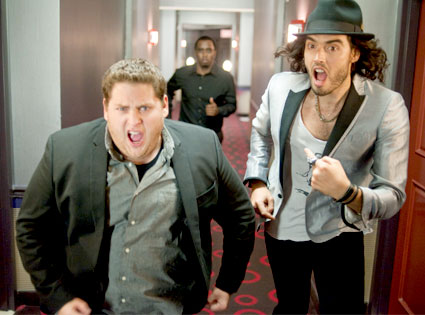
This Apatow-sponsored flick written and directed by Nicholas Stoller opens with Sean “P. Diddy” Combs playing a music producer looking to rehabilitate his sagging music industry revenue flows. “We’ve got to thicken my ***n’ flow,” he declares to his team of sad-assed wannabes (including Apatow regular Jonah Hill as the assistant with the bright idea), and the half-caricature / half-insight tells you all you need to know about where this film is going. Basically, this is a movie about a wide-eyed young music producer's (Hill's Aaron Green) bright idea of rehabilitating the career of rock disaster Aldous Snow (Russell Brand), and how he's sent to England to transport the party-boy back to L.A. for a ten-year reunion concert meant to save both the label and the artist. The movie has all the rock-legend feel and sassy vulgarity of Cameron Crowe’s Almost Famous without the nostalgic nuance.

Despite its simplistic take, this is actually one of the better rock-and-roll flicks of the last couple of years. The movie has a real feel for the idiom, not just of rock-and-roll but the entire spectrum of celebrity music culture, from the street ironies of rap (a rapper and his manager have a debate over pink Izod versus leather zipper jacket which is “one zipper away from Thriller”) to the Entertainment-Tonight bubble-gum antics (captured with aplomb in the opening number, “African Child”), all the way to rock music inspiration (nicely summarized with the closing bad-drug-trip-inspired “Furry Walls”). While the tub-tapping music itself is one notch beneath parody and makes its point with but a few repetitive chords, it hits the satire dead on.

The script mostly follows tried-and-true rock-and-roll drug-and-sex stereotypes: Aaron is immediately stymied in his intentions when Aldous takes him to have drinks with his mates, then sex at a club, and so on – barely making their flights to New York, creating a comic mess on the set of the Today show (with some well-placed cameos from random celebrities such as economist Paul Krugman), then on to yet another drug-detour in Las Vegas. Stock stuff, to be sure, but done with both a tinge of wit and evident love for the rock scene: only a true music fan would slip a still of the Chelsea Hotel into a transitional montage of NY music venues or position the climactic moment in a hotel balcony overlooking Sunset Boulevard.

In the vein of all Judd Apatow produced flicks, this is also a bromance. Hill’s Aaron has to learn to loosen up, while Aldous needs to re-connect with his passion for music, so the two are thrown together in this road-movie of outrageous antics so they can learn these lessons from each other. In the middle is Daphne, Aaron’s girlfriend (played by Elizabeth Moss of "Mad Men" fame as a bit of sly casting), an overly tired intern who’s trying to negotiate career moves with Aaron. The three actors are nicely matched: Brand’s cynical insouciance is a great counterbalance to Hill’s uptight earnestness (on the road, they’re a kind of modern Martin and Lewis), while Moss adds a touch of sensible-yet-badass sweetness. There’s a quite icky but nicely handled three-way that activates all these characters into their closing resolutions and ties up the movie in a nice post-modern, metrosexual bow.

Apatow meets Sid and Nancy, then, seems to be the formula: a post-modern, rap-rocker mash-up that’s probably two-parts stereotypical cliché to every one part media satire. For a fun, summer flick, you could do worse.

Sunday, June 6, 2010

Prince of Persia: Sands of Time, Kernels of Popcorn

Disney has clearly set its eyes on creating a land-locked version of its Pirates of the Caribbean franchise, so it’s no surprise that this movie comes out feeling like the blueprint for an amusement park roller coaster set amongst the sand dunes. Since money needs to go to sprockets, protein shakes for Jake, co-promotions, jumping-jack stage sets, and posters, there must have been little left to spend on a script, so they’ve apparently lifted this one whole cloth from the Laura Croft franchise and substituted a little bit of Sephardic boy action to give it that Arabian feeling.

Not too much feeling, however. Leading boy Jake Gyllenhaal creates a Persian persona by adopting an upper-class British accent. Actually, all the characters do, which gave me a bit of cultural vertigo watching this odd cultural mish-mash that thinks its Middle-Eastern setting is the most successfully recreated when it resembles the video-game its based on rather than any actual representation of history or the Middle East.

All that being said, the story set- up isn’t half bad: a wise Persian kind adopts an orphan boy from the market one day (that celebrity habit apparently started early). Dastan become a part of King Sharamon’s family – the youngest of three brothers who, upon growing up, each have their own bone to pick with Dad. There’s also Nazim, King Sharamon’s brother, who lives in the shadow of the King after having saved his life when they were younger. The brothers and uncle are decamped in the hills surrounding Alamut, a holy city housing some mysterious time-bending maguffin that activates the plot. After the capture of Alamut and the looting of the maguffin, Dastan finds himself set up to take the fall for someone else’s plot for power, and this sets the wild chase through the desert in motion.

The rest is well-directed, visually popping predictable summer pabulum, filled with the requisite amount of goofy sidekicks, nefarious villains, and mystical assassins. There’s not much care to be culturally relevant (the assassins are more Ninja than Persian), unless by relevant you mean giving a nod to contemporary politics (there’s a long Tea-Party like discourse about taxes on the small businessman given by an ostrich-racing entrepreneur, which feels completely incongruent. I’m surprised they didn’t name the guy Joseph ben Plumber.)

The aim here seems to be to capture some of the campy fun of the Pirates franchise, but Gyllenhaal is too sincerely goofy to pull that off, and the rest of the cast doesn’t seem to have been let in on the joke. While the film is well edited and there’s some nice swordplay and sorcery action to entertain the kiddies, the whole thing feels a bit like an amusement park dramaturge catering to bored roller-coaster riders waiting for the next car departure. Even the time-bending effects feel a bit like last year’s canned Adobe filter (as does the editing, which has that clichéd tendency to speed up the action in mid-swoop and then pause for a second just before the final jab – like we see now in soda commercials and wrestling ads).

Nothing worth noticing here, then (and there’s only the briefest flash of Gyllenhaal ’s abs if that’s what’s pulling you in), though it does suggest Gyllenhaal might be interesting casting to play against the next Croft number.

Thursday, May 27, 2010

Shrek 4-Ever After: It's A Sort-Of Wonderful Life

With Shrek 4-Ever After, we've reached the final Shrek movie in the series, and clearly this franchise has run its course. Yes, once Shrek has married and has kids, there's not much more to this fairy-tale left to tell.

That's why this time, the movie has to resort to the device of flashing back to a parallel history of "what happens if Shrek had never been born." Shrek now has three kids, and adoring wife, and an obsequious public, and he's kind of a celebrity trapped in a fashion cocoon of his own making. Even Shrek is so bored of his monotonous married life that in fact, that's the major plot point of the first act. Shrek Groundhog-Day's his way through the married routine enough times until he...and we...literally scream.

Enter plot device and villain number four: Rumpelstiltskin. Shrek unwittingly makes a bargain with Rumple: he'll trade one of the days of his youth for a fantastic day where he gets to be his old, free ogre self again. Unfortunately, the day Rumple takes is the day Shrek was born (creating the incongruous paradox of Shreck's ultimate non-existence).

The result is a re-hash of the plot from It's a Wonderful Life. Shrek wanders through a changed Far Far Away where Rumelstilskin is king, his children were never born, the world is in shambles, and his wife Fiona leads a band of ogre outlaws. There's one critical difference. While Jimmy Stewart wished he were never born - a kind of depression and self abnegation due to the heavy burden of life's circumstances - Shrek has had this fate thrust upon him not because of too little but too much ego. He's basically a typical over-heckled father who simply wishes to live the high life and be single again. So while It's a Wonderful Life built up a powerful story about personal redemption and seeing the value in oneself, Shrek 4 sets out instead to teach its hero some basic humility and thankfulness. It's a much simpler...and I dare say, less sympathetic... moral.

One is tempted to call this a story of our time - instead of needing to be bucked up, what today's generation needs is to be brought down a peg. But I suspect that's just not right, and one reason why this movie feels tuckered out. It's lost it's edge - the edge that the first two Shreks had particularly delivered, undercutting the Disney-fied morals of "ordinary life." Instead of feeling secretly relevant, it feels needlessly moralistic, as if its finally become the type of movie that the earlier Shreks used to parody. No wonder Shrek feels trapped.

There are other things about this film that make it less interesting than it could be. All the action takes place in Shrek's head. And in this alternative reality world...that must ultimately end...all the characters are much more interesting than in the world we're ultimately going to head back to. Wouldn't it have been fascinating to have had a real Fiona who was all Robin Hood and king of the forest, and a real Shrek who had to re-negotiate a modern marriage to a strong woman? All that fantasy is bottled up and dispensed with when it could have led to some of the more intriguing cultural subversions of the series.

Similarly, this Rumplestilskin is nice villain - he's got a particularly nice flare for wigs, a way with the witches, and a lovely way with words - but lacks the self actualization of, say, Fairy Godmother. However, I'd rank him second in the panoply of Shrek villains, and in a lot of ways, his semi-fey shenanigans keeps this story from totally sinking.

All this being said, Dreamwork's Shrek, even at this late date, is still one of the best-produced summer franchises, and the sly cultural parodies are all still there, even if they're all being severely undercut by the plot. "Happily Ever After" and "married with kids" just doesn't aren't supposed to be a reconcilable contradiction in the Shrek universe, which is why we get instead an inside-out movie where the real Shrek has been reduced to mere fantasy. It was great coming this far, but one can't help actually feeling a bit sad seeing Shrek ending up this series so conventionally... well... "whipped."

Saturday, May 22, 2010

Please Give: Nicole Holofcener Vies for Woody Allen's Legacy

Yes indeed, in this sweat, gentle film about two families of New Yorkers brought together by a splenetic 91-year-old woman, writer/director Nicole Holofcener has created that type of New-York slife-of-life picture of middle-class ennui, casual affairs, and anxieties once the exclusive province of Woody Allen. This Sundance favorite director has done it with her own style and a decidedly feminine eye. She may not yet be able to capture Allen's biting wit or the depths of his pathos, but this is a picture - and a director - worth keeping an eye on.

Rebecca (Rebecca Hall) and Mary (Amanda Pete) are two sisters caring for their cranky, aging grandmother Andra (Ann Guilbert). Rebecca is the dowdy, sincere one (but clearly an ugly duckling waiting to become a swan), a radiology technician who makes a living scanning women's breasts for cancer. Mary is the pretty, sarcastic one who works in a salon giving facials and popping pimples.

Meanwhile, Andra's neighbors are precisely that type of Woody Allen put-upon, half-yuppie couple ripe for something to happen to their lives. Kate (Catherine Keener) and Alex (Oliver Platt) run a mid-century modern furniture store, and have a fifteen-year-old daughter with body issues. Kate spends her days visiting the homes of the recently deceased, buying up the furniture, so that she and her husband can price it up to resell to their customers in the store. They also have their eye on scavenging Andra's apartment, and have already made plans to break through the wall for their new master bedroom once the old crow finally kicks the bucket.

This is a film that moves along on character and theme, rather than plot - so there's not much action to speak of, other than the endless introspection, inevitable liberal guilt, brief affair, and...I doubt I give away too much...inevitable passing of the despised old crow. But the movie builds its themes nicely. One of the thematic touches here are the differences in the two families - the one that's material (furniture) and the other body-oriented (medicine/facials), and the daughter who seemingly belongs more with the sisters than her own parents. For Kate, the dead still haunt the furniture she sells, and there's no getting around a world that's both more than material, and less than flesh.

What Holofcener is ultimately getting after are issues around getting older: not only for Andre but for all the characters. Age - and life, which is but age standing still - is a type of weariness, pregnant with the heavy weight of inevitable death, and the characters are judged on their attitudes torwards this injustice about being alive: do they find the beauty, or do they focus on the annoyances? The opening song, that classic ditty about "I had no shoes and I complained until I met a man who had no feet..." sets the mood, here, and its merry juxtaposition against a series of breast mammograms tells you the tone Holofcener is after.

Ultimately, however, the movie is about Kate and her struggle to reconcile her free-floating sense of guilt and remorse (which is just fine more me, since I think Keener is an actress who has yet to be given the role she deserves, and this one may get her one step closer). Kate's evaluating her own outlook - her liberalism is a form of crankiness and willful ignorance of her own role in the world (just as Andra tells people she was considered "smart" even though she had no more than an elementary school education, and she wears this earlier generation's form of liberalism as her own defense against people). Over the course of dealing with the little annoyances that life in New York puts in her way, she comes to realize her own prejudices and blindnesses, and in the end, decides not to turn away.

Perhaps this it's this optimism that ultimately distinguishes Holofcener from that other great chronicler of New York life, Woody Allen. Whereas Allen celebrates the cranks, Holofcener, I think, sympathizes with the rest of us. We may not be quite as interesting as the cranks. But our problems are no less significant.

Friday, May 21, 2010

Robin’s in the ‘Hood: Russell Crowe and Ridley Scott Make a Somewhat Pleasing Mess

There are definitely different location directors or some other such issues of inconsistency in this re-telling of the Robin Hood legend, for this unduly long Russell-Crowe vehicle is uneven and at times incoherent...even though it's ultimately interesting throughout the broad middle. However, with its Showtime-level focus on historical “authenticity” mixed with its 300-style fight scenes and “release the Kraken!” level dialogue, I can see how it might be falling in between the cracks of different audiences, racking up poor reviews, and failing to gather the viewings that its studio might hope.

Basically, Russell Crowe and director Ridley Scott have set out to remake the classic Robin Hood story as a star vehicle for Crowe, so though we get appearances from Big John and Friar Tuck, this reimagining is less “one for all” than it is “all for one.” They've also chosen to make this an origin story - essentially the setup for how the band of merry men assemble, all foreplay for the main action to come in a (perchance) next sequel, much like the recent Star Trek. However, the first act of what we get here is practically indecipherable: it seems like we’re watching the outtakes reel from Lord of the Rings. King Richard the Lionheart is sacking French castles on his way back from fighting the crusades (at times, the movie – unintentionally? – slides into Montey-Pythonesque dialogue, including French taunting and phrases like “though shall not pass until thou answereth my riddle”; I was surprised not to be treated to a refrain of “Bring out Your Dead.”) When Richard is slain, Robin sees his opportunity to desert the army (out of moral rectitude, mind you – the army has killed innocent women and children), and he and his band of merry men head for the hills, and eventually to England.

Upon their arrival they find themselves in the midst of castle intrigue, as Richard’s younger brother, John, seeks to defy his mother (and get out from his older brother’s shadow) by appointing a new commissioner: movie heavy Godfrey, whose job is to collect taxes from the noblemen (though his secret plot is to sow dissent so he can lead a French invasion of England). Godfrey suspects that Robin knows his secret, and so the blood feud emerges: this section of the film could well have been right at home in any episode of "The Tudors."

But it’s once we get into this second act – and a clear cat-and-mouse game takes over the plot – that the movie starts to get its legs, and where it began to win me over. Robin is a warm-hearted, stolid sort who ends up hiding out posing as the son of a deceased lord at Nottingham; Sir Walter Loxley (played by Max von Sydow), knows Robin from childhood and asks him to stand in for the deceased son – and play the husband of his daughter-in-law, Maid Marion (Kate Blanchett). The courtship of Robin and Marion is nothing new, but Blanchett and Sydow both bring a commanding force to the movie that centers it emotionally, something the first act lacked totally. Blanchett as always is immensely watchable as a woman fending for her honor and dignity in a world ruined by men.

Given the subject matter of this film – essentially about a King who ruins the wealth of his country through needless foreign wars, and his successor who needs to make up for it by excessively taxing his countrymen at home…and the bandit that will eventually decide to redistribute the wealth on his own – one might expect the film to capture some of the spirit of the Tea Party, or give some other political allegory for our time. But this film largely stays away from political overtones. When Robin finds out that his long-dead father was a “visionary” who foresaw a brotherhood of free Lords who had rights under the King (the film essentially posits Robin Hood as the origin of the Magna Carta), and takes up his cause, it’s less about politics than it is about sons discovering the legacy of their fathers. Ultimately, although the plot puts Robin in the center of the Lords' power struggle against King John, this is a movie about sons becoming leaders – via fighting, courage, honor, and finally, even a sense of love.

So even though this film was dreadful at the beginning, by the time we find Robin giving a speech to the nobleman about uniting to defend England in exchange for rights and liberties, I’ve come to find I rather like this charming lout and his band of good-hearted mercenaries. I think that’s the effect that Robin Hood is going for: something about how justice and vision are something grown organically, out of the rough-and-tumble of fighting, mead, and mud.

That rough-and-tumble philosophy does pervade all aspects of the film – from the directing, which is all over the place in style, and borrows heavily from modern films ranging from Saving Private Ryan to 300 (we get a beach-invasion scene which seems like the love-child between the two) – to the dialogue, which barely bothers to get the Middle-English colloquialism sounding half-right.

Still, a movie doesn’t have to be perfect – just enjoyable – and by the end, this one is. This is by far no masterpiece, but whether intentionally or not, Crowe and Scott have created a muddy mess with a simplistic but affable moral center: kind of like that Robin Hood character himself.

Tuesday, May 11, 2010

Iron-Man 2: Trade-Show Disappointment

Having enjoyed the first Iron Man (especially its commentary on modern warfare) – and intrigued by Marvel’s interest in creating an entire Saturday matinee serial of Avengers movies – I, like most, was eagerly awaiting the new Iron Man. Finally, I thought, we would get to see a comic movie move past the creation saga and into the realm of modern relevance mixed with serious fun.

Alas, such is not the case with this Iron Man reprisal. Tony Stark – having effectively “privatized world peace” with his Iron Man suit, has retired into the role of bemused oligarch and trade-show host, handing the reigns of his company over to his under-confident factotum, Pepper Pots, while he struts his stuff on stage with scantily clad gun-toting bimbos, or gives a sardonic lecture to the perpetually annoyed congressman Gary Shandling (who is apparently representing the only useful inclination left for Congress – Borscht-belt comedy), practically inviting some foreign baddy to invent technology worthy of messing up his shit.

Somebody eventually does – a bulky, brooding Russian named Ivan Vanko, played effectively by Mickey Rourke. After dissing Mr. Stark with some ingenious high-voltage lion-tamer outfit powered by the same technology invented by Stark, but failing to cause any serious harm, Ivan explains his strategy. He doesn’t need to take out Iron Man. All he needs is to show the world that Iron Man can bleed. And so, after forty-five minutes of interminable setup, we finally get the most promising line of the movie: “Then there will be blood in the water, and the sharks will come.”

The idea is delicious: that we might see a super-hero movie effectively about the dangers of social media PR, and the ability of a single disgruntled customer to take down a corporate giant (one is reminded of Dave Carroll’s "United Brakes Guitars." If Ivan were to have created a theme-song – instead of a plasma-powered cat o-nine-tails – it might have been titled, “Stark Kills Millions”).

Unfortunately, the movie doesn’t take this idea seriously enough to pursue it. Instead, Ivan gets commandeered by rival weapon’s manufacturer Justin Hammer (played with that ever-entertaining “huh, what?” insouciance by Sam Rockwell). Hammer is supposed to be the movie’s bad guy – though he’s hardly much different than Stark in his morals and ambitions, which, in this movie’s topsy-turvy militaristic ethos, makes him something of a good guy as well. Hammer convinces Ivan to make something impressive for him – but kind of like a private chef, gives him free range to invent whatever his distorted mind can come up with. Unfortunately, the guy seems to think he’s in a Terminator movie, since what he comes up with looks like a cheap version of a Cyberdyne ripoff. This gives the whole remaining plot of mechanical Cylons shooting down trade-show goers, and Iron Man’s kung-fu methods of dispatch, the moral airs of a 1980’s video game. Meanwhile, Pepper Pots – as the representative woman on the spot – gets to stand around like a lost marketing assistant trying to find a way to reboot the sabotaged droids. Even a cameo by Larry Ellison, of Oracle fame, can’t give this trade expo any tech savvy.

Iron Man 2 also does some yeoman work struggling to establish the Nick Fury character and set up the upcoming Avengers movie franchise. However, neither Fury nor his minions ever seem to make much sense, for most of what they are up to is taking place off-stage and off-script, as if we've yet to sign the NDA to see what the rest of the movies are supposed to be about. It’s about half-way through this, however, as the Fury entourage dawdles about the Stark digs, talking to him about finding the answers within while text-messaging some other (presumably more interesting) action happening elsewhere, that I began to worry whether the entire franchise would end up seeming so absent from itself.

Combine that with a prattling script that trades on trade-show tits and flying robots, and what started out as a gleaming film franchise is now beginning to seem a bit rusty, and showing the seams of a cynical, somewhat misogynistic, basically soulless money machine. Don't ask me how they got here so quickly, but it's as if Tony Stark himself has, at least for this outing, taken over Marvel Films.