Wednesday, May 20, 2009

Angels and Demons – A Catholic Scavenger Hunt, With Malice

Angels and Demons - Ron Howard's febrile sequel to 2006 telling of Dan Brown's Da Vinci Code, resurrects symbologist Robert Langdon (Tom Hanks) as our plucky Harvard-educated hero battling the forces of religious mysticism and occult history. Only this time, instead of unmasking the church, Langdon is recruited to help save it: specifically, to help track down a ruthless gang called the Illuminati - a sect of persecuted scientists who have a long-running centuries old feud with the church, and who have apparently kidnapped the four cardinal "preferrati" (the cardinals favored to replace the recently deceased Pope) in order to sacrifice them spectacularly over a specifically planned schedule of evening activities designed to advance our plot with exacting precision; and who also have, as well, acquired a spooky can of anti-matter, and planted it somewhere in the Vatican where it is poised to blow the whole church - and its admirers - to Kingdom Come, at the end of the entire charade, sometime around midnight.

While the first twenty minutes of getting us to this set up - including the plodding theft of the anti-matter from the CERN laboratories - seems unimaginative and a bit unpromising, there are, I admit, times in Angel and Demons when I feel Ron Howard’s yeoman direction and Salvatore Totino's Raphaelite cinematography ineluctably drawing me into the delicious tension of the movie. This occurs principally about twenty minutes in, as we start on the chase for the first clue: A church of earth, where one of the captured Cardinals may meet his fate. (The other churches complete the Earth, Wind, and Fire setup, giving us Air – Fire – Water as the other cornerstones of the Illuminati’s scientific faith). Never mind that this seems more like alchemy than science: or that this was the same plot device used to illustrate the final puzzle of the much more breezy and fun The Fifth Element. Howard pulls the suspense taught, the camera worms its way into dark corners and creepy alleyways, and the candlelit priests’ conclave is beautifully composed. It’s a religious scavenger hunt, replete with symbol and mysticism, and I’m game for scavenging.

Unfortunately, the clues in the first church turn out to be a bit stretched (basically, Renaissance statues pointing unpersuasively somewhere in the distance), but hey, there’s no fun if the clues don’t build. The second clue is equally convoluted, though the open-air Basilica does make a nice metaphor for Air. And the religious sado-masochism of the killings is intriguingly suggestive. But it’s by the time we get to the third church/clue – fire – that I realized that in none of these locations would we be provided with any greater mystical, or even motivational, insight. The beautiful cinematography and click-a-pace directing is designed to sum up to nothing more than pure ticking-clock potboiler, the kind of artificial movie deadline with which both Jack Bower and Dick Cheney would feel right at home.

It doesn’t help that one of the few key characters with whom we sympathize – and with whom a non-Catholic like myself can find a way in to relating to the story – meets his demise suddenly and early, and with no gleaned meaning.

Some moments do work quite well. Langdon finds himself trapped in the church archives along with one of the policemen when the power goes out, and they have only a limited amount of air. The decision of whether to expend air and effort trying to devise a method of escape – or simply wait for power to be restored – captures nicely the film’s questions about the balance between science and faith. As does the decision by Cardinal Strauss to reward Langdon for his service with a copy of the Galileo manuscript he’s been desiring for years. These are the kind of touches that gloss the story with a larger sense of theme and feeling.

Unfortunately – and this may really be the source material more than the filmmakers – the story goes off the rails for me with its unnecessary surprise ending, in which the true criminal is revealed. Though it makes sense enough plot-wise, the ending has been left completely unprepared emotionally and psychologically: the character has hidden throughout the movie as the complete philosophical opposite, and so the unmasking at the end feels more like a story cheat than something motivated by psychology. Yes, I know we get a brief two-minute (and rather confused) explanation of this character's relationship to the Pope, which might serve as his justification for what's been undertaken - and again, it takes a few minutes after the film ends to put this together - by orchestrating the entire shebang all along. But there just isn't enough told to us for us to figure out why this should make any sense - or even more importantly, why we should care.

Ultimately, the reveal at the end completely changes the film’s message. Whereas before, there seemed to be hope that the church might learn from its mistakes vis a vis science and progress, and adopt a new attitude, the ending reveals in fact the opposite: not only won’t the church learn, it will feel supremely justified in continuing to embrace its intransigent past, and to use any pretense to progressiveness merely as a further means of deception and control.

This, then, is where I disagree with those who read Dan Brown’s work as a palliative for religiosity. In fact, I see it as a scathing criticism of the church, wrapped in a cloak of consumerist mysticism. In Angels and Demons, Brown seems supremely aware that the church will view his work with animosity: if Langdon is a stand-in for the author, then his reception by church officials is chilly and suspicious, at best. And deservedly so. And while this story purports to be about how Langdon saves the church – and thus, in a way, is its deepest friend – the church he saves is corrupt and despicable and its core. And Brown's depiction of it is nothing short of brutal.

Perhaps, then, what is intended as Brown's palliative is this: that we are indeed meant to see that these religious institutions are in fact insidious, perverse, corrupt, retrograde, and deceitful. But the buildings are grand, and those Bishops look wonderful in flowing red robes, so we should love them anyway. And yes, though I agree that the robes are fabulous, I’m not sure it’s a message that works for me.

Saturday, May 9, 2009

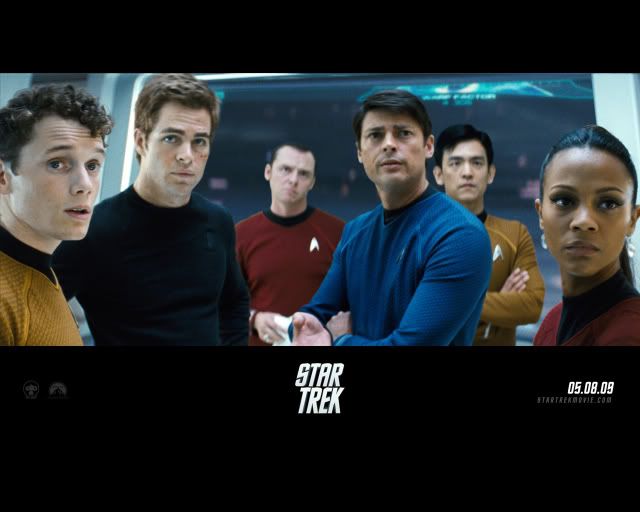
Star Trek:Young Kirk / Spock Kick Romulan Bootie

(in 70 mm)


As I write this, it's quite apparent that the new Star Trek Movie is a hit with both critics and audiences alike, receiving a startling 96% on the tomatometer and a two-to-one positive sentiment result on blog sentiment analysis tool newssift. Not to mention my informal analysis of the Twitter stream, which has yet to show a negative comment.

First, I must confess to being a Trekkie (yes, I've seen every original Star Trek episodes at least four times or more - starting as a kid, when they were originally broadcast - as well as the movies and series spinoffs), so I perhaps am not the most unbiased reviewer. Yet I'm certainly someone who awaited this movie, and the bold, origin story reinvention, with high anticipation, and so writing this review is perhaps one of the most difficult I've had to consider.

Perhaps that's too much anticipation for one movie, and no doubt I will see it again soon to re-assess my opinion. But though this new Star Trek is audacious and visually stunning, and refreshingly re-captures the zest and kitch of the original series, I did not find it quite the superlative that others have claimed, and maybe not even the best Star Trek movie (Nemesis had more menace; Khan a more ruthless and original enemy; and First Contact still takes the prize as the most fun, S&M inflection of the Star Trek universe yet).

That's not to say it isn't good - it is - and it's not to say I don't think the "reinvention" idea works - it does. It's just that the story these characters are given is a bit of a re-hash of past TV ideas and movies (the ship and world-destroying animus from Nemesis, with a special effect added from Fantastic Four; the slugs from Khanh; the Romulan-loving Spock from the "Deep Space Nine" series, and all the idiotic time traveling ideas from "Enterprise.") Yes, all Star Trek movies reference the Star Trek oeuvre, but there's just not enough new added to this soup to make the story interesting.

On the other hand.

The movie takes a risk resurrecting the original characters in younger form, and this gambit certainly does pay off. Not only are Chris Pine and Zachary Quinto - dare I say it - better actors in the Kirk / Spock roles than Shatner and Nimoy, we also get fun younger versions of Sulu, Checkov, Uhura, and McCoy. And Simon Pegg is certainly scene-stealing with his ebullient interpretation of Scotty.

But the two principals, the Kirk and Spock here, are really the best we've ever seen of these characters. Pine backs up Kirk's bravado with an emotional energy and sympathetic sincereity that Shatner, after so many re-interpretations of it, had thoroughly drained out. Quinto is especially astute in giving us a Spock who really is a half-breed - a seething cauldron of emotion barely kept in check by mental discipline and a universe-sized desire to fit in. These kids chew the scenery and deliver the snappy dialogue with the kind of fun-loving bravado that Brannon Braga and other mystics of the Star Trek legacy so slowly and assiduosly excised from the franchise over four long decades. THANK GOD we now have a Star Trek freed of the painful PC platitudes of Counselor Troy, the cloying sentimentality of Data and the tiresomely explained references to Gilbert and Sullivan. Such strained political correctness really did stifle the other movies and drive away audiences, and perhaps a "reboot" was necessary to finally strip all that painful stuff away.

Additionally, Paramount has brought in a director in J.J. Abrams who is not enthralled with Star Trek pageantry (yes, there's some, but it's brief) and who has more in kin with Roddenberry's damsels & swashbuckling attitude towards space adventure than with the creeping corporateness evidenced by later interpretations of the series. Yes, this Star Trek is sexy and fun, and people who haven't seen the original series may be surprised by that. But I think Roddenberry would applaud Abrams as a fellow spirit, and the direction of the new Star Trek gets us back to the core excitement of space, which is something the series has desperately needed for a long, long time. The movie perhaps most takes off when a mouthy Kirk is dumped by a well-irritated Spock on an ice planet while Spock takes off to do his duty. Lifting a page from Lucas here, Abrams gives us a few fearsome snarling beasts and a warren of an outpost that looks like an abandoned high-school locker room, and inhabited by an equally loquacious young Scotty. It's a fun few scenes and for a moment, I felt I was back in the original series discovering a new episode we'd never seen before.

But I do have two problems with the movie. The first, as I mentioned, is the plot, which to me just didn't seem original. I've seen this revenge story before (and it feels like the writers just finished watching Fantastic Four: Silver Surfer before sitting down to dream up the big effects for this story), so even with the wonderful additions of extreme adventure sky diving, great Enterprise sets, and amazing special effects, it left me with a bit of a "so what." I suppose if this were your first Star Trek movie - or maybe your first sci-fi - that might not be a problem. Still, this film takes liberties with parallel time lines and destruction of worlds that just feel unnecessary. I know the minds at Paramount wanted to strip away our expectations of what might and could happen by sending us off into a parallel history, where they are now free to do things without concerning themselves too religiously with the text of forty years of storytelling. But it feels, to me, like a cheat: the first rule of good science fiction is, no one cares what happens in the "parallel" timeline, people want to know what happens in the real one. I kept wanting to get back to the Star Trek universe I know, and because we're so clearly meant to never return there, it feels false to me to also ask that we bring what we know of that universe into our love of the characters. My preference would be to have either one or the other: either totally break with the history we know, and introduce brand new characters - or resurrect the originals, but let them keep the history we love about them. Paramount obviously wanted both, and I'm not so sure I'm ready to jettison everything I know about a lifetime of watching Kirk and Spock in order to follow these two NEW versions of them who are free now to invent a totally new history of their lives.

There's also the - as Spock might say - extremely high improbability of how Kirk goes from F-student probationary stow-away, to captain of the fleet's flagship, all in one fell swoop. And why Spock would volunteer for a reduction in rank to follow him. But then, as has been made apparent, this movie is not meant to trek in your father's logic.

The second problem I have has to do with the labor of the "Reboot," which is the idea of an origin story. How did Kirk get to be Kirk (or a parallel Kirk, I suppose), Spock parallel Spock, and so on. Clearly, the "reboot" itself has become a genre in Hollywood, with Bond, Batman, X-Men, Hulk, and now Star Trek all partaking. The problem with this reboot is that it is all mostly the labor of the set-up, and doesn't get to the good part until the very last seconds. In other words, this reboot is all about positioning the characters to take their chairs on the Enterprise. We'll have to wait till the second movie to see what they do in those chairs.

No doubt, with the success Star Trek is having, Paramount will green light Star Trek Two with this ensemble, and this new cast of characters will be able to finally go somewhere interesting - and quite boldly - introducing a whole new generation to the pleasures and thrills of exploring space with a rowdy ensemble of cocky and talented youngsters. I think the one thing this movie does well is set us up for where the series is going next. We have great actors in great roles, and a wonderful director at the helm. Now, we just need an interesting story for them to explore.

No doubt, I will be lining up for that movie on opening night as well, once again hopeful that the next outing, we'll finally have a Star Trek experience like no other.

UPDATE: May 19th, 2nd viewing in 70mm

Well, after receiving many urgings from friends and colleagues that this was really a much better movie than I gave it credit for - and of course, it is Star Trek - I saw it again in 70 mm.

What I noticed: the special effects really are excellent (70 mm is the real test, as poor effects don't hold up well. But this movie has a look that's crucial to the excitement the film has generated). For the end credits, Abrams decide to do a zoom into various planets - I think this particular sequence really summarizes the zippy mood of this film: at once a ode to the eye-popping wonder of 60's sci-fi combined with the visual poetry that today's CGI wizards are able to create. As I said before, this film really captures the slightly campy/sexy/adventurous mood of the original series better than any other incarnation, and these sequences exemplify that.

Also, the humor really holds up - better than anything that passes for humor in the Berman / Braga universe. Simon Pegg turns Scotty into a truly inspired comic character, and McCoy chasing Kirk around the Enterprise with a hypo is a wonderfully comic nod to the tendency of the McCoy of the original series to want to inject everything in sight.

In fact, there are really quite a few nice inside nods to what's come before - whether it's a reference to teleporting Archer's "prized Beagle," McCoy's eagerness with a hypo, Kirk being kicked out of his chair (remember all the times Kirk kicked others out of that chair?) or Chris Pine's near perfect Shatnerism as he takes the bridge in the final scene, Abrams gives us Trekkie's many inside tweaks and subtle send-ups that are really both irreverent and quite fun.

On the other hand, upon second viewing, the implausibility of the plot stands out even more. Why doesn't Nero try to save his home world when he easily could? If the drill is so vulnerable to a few torpedo shots, why not take it out earlier? How can Spock plausibly "see" Vulcan from a nearby planet? And why go to the elaborate time-travel ruse with Kirk when Spock could just beam on board with him and solve everything?

I know, I know - I'm getting too hung up in the logic, not seeing the full emotion of the film, or the wonderful exploration of man's emotional/logical duality. But I like the emotion...and the promised duality - so is it too much to ask that the logic hold up as well?

In the end, this film has hit a home run with both fans and non-fans, and deservedly so. After seeing it a second time, I do believe that most people will find the lapses in logic excusable (and perhaps less noticeable than I do). There really is no excuse not to see the film, so I've upgraded my recommendation.

Even so, I still expect the sequel to be better. This film has to do so much work to set itself apart from its predecessors - blowing up a major planet, twisting the timeline, and dredging up an uninspired villain - that I think it still suffers from all that strain. Next time, we will be blissfully free to finally go where no Star Trek has gone before.

Friday, May 1, 2009

X-Men Origins: Wolverine. An X-Men Retread With Four on the Floor

The latest X-Men movie, which fills in the Wolverine back story that was so heavily alluded to in the previous three X-Men movies, delivers the first major punch of summer, and successfully so.

This movie has more testosterone flowing than all the syringes of Major League Baseball, and three times the biceps. There's also a hefty dose of swordplay, gun play, grotesque medical experiments, and violence, so it's not for everyone. If I had an alter-ego who reviewed films from only the perspective of movies like, say, The Reader, I might give this a single star. There's no subtlety lost in this film. But for fan-boys eager for a big dose of masculine growling and brawling, and a pretty healthy dose of buff mutants going at it in Extreme Cage Fighting style, it's a hit. So take my endorsement with a grain of salt: I'm addressing it to fans of the comic-book action / brains-turned-off popcorn-movie type of flick.

First, let's review why this movie pleasantly surprised and gave me the first big thrill since last summer's Iron Man. For one, I'm thankful to finally be rid of the Good X/Bad X dynamic of the past three X-Men - not to mention the geeky uniforms and hokey cartoon elements like invisible super-ships. This film is free of those easy categorizations and cartoon gimmicks, so the moral dynamics are more complex and...shall we say...muscular...and really allow us to get more involved in the action. Even better, we finally get a full-on fill-in of the back story alluded to in all the other movies. For an X-Men fan, we finally have a film that pulls no punches, and does so in an environment where the powers are both new and powerful, a raw force tied to survival and passion. I found that both refreshing and invigorating - the kind of real emotion generated by the original Aliens or Terminator. There's also finally a real-life adult romance, and a rather nice use for an Indian legend - at least the best one I've seen in an action movie, of late. All of which is to say, this film really delves into character, as much as a cartoon can, and hits a raw emotional note that pulls the audience deeply into the film.

In this case, the raw emotion is revenge. You might call this film an action-man's Sweeney Todd, and it progresses inexorably towards a similar kind of dread and death. Yet it also presages the original three movies, allowing the ending to tie up nicely all the allusions the other films left hanging unsatisfyingly.

One does miss Bryan Singer on this outing. Singer has a particular felicity with ensemble films, and without him at the helm, this X-Men feels singularly thin: Hugh Jackman does his best imitation of himself, and now that he has to carry the entire film, we realize how much Singer allowed the other mutants to support him. He may not be such a star as recent Biography bit would have us believe.

On the other hand, Liev Schreiber makes Sabretooth come alive, and shares a masculinity with Jackman that adds a level of complexity and counterpoint that other X-Men really missed. This is a movie that trusts its instincts more than its intellect, that explores the dark side of violence and war, and shares more with military-inflected movies like Watchmen and Three Kings than typical X-fare.

There are also cameos by real actors like Will.i.Am and Ryan Renolds (giving one of his best performances) as well as interesting characters like Gambit - who I must confess is the only X-Man whose superpowers I can't figure out. It's like he's got some kind of a mutation of the Cool gene.

Ultimately, though, X-Men Origins is an origin story, or rather, a coming-of-mutation story, and so it is basically about how Wolverine got his claws. As such, we pretty much already know the plot...and there are a couple of glaring holes in how this one is told. Particularly, Stryker's plan makes no sense as it unfolds (how can one NOT have any contingencies for Wolverine when he's got the same contingencies for everyone else? Oh, I suppose because he's being played by Hugh Jackman. But Stryker's astonishment at Jackman's escape left me flabbergasted for a full twenty minutes before I could get back into the story).

Oh, but plot doesn't really mean much here: we get cool fight scenes, cool mutants, and some really disturbing military experimentation. All so much the creepier.

Star Trek also borrows and rehashes an old plot for its reboot. I guess the borrowing works better for me in X-Men because Wolverine vastly improves the plot it borrows: there's a nicely done contrast in this movie between the raw nature of the Wolverine, at home in the pristine pine forests of northern Canada, and the sterile medical creepiness of The Island, where Stryker experiments on his mutants. That contrast forms the backbone of the movie's evolution, and moves the story in a way that resonates much more viscerally than earlier X-Men films. Never mind that this is the exact same plot from X-Men II: this movie kicks ass significantly more. Plus, these X-Men are both deadly and pretty damn cool. They leap, float, fly, shoot, and swash buckle with twice the speed of their Matrix counterparts.

That may not equal double the fun, but it was more than I was expecting from a stew made of summer's past retreads. And certainly an entertaining way to kick off this year's summer movie season.

Sunday, April 26, 2009

I Love You, Man Defines "Bromance" Genre

It's official. The "bromance" has now become a Hollywood genre. And I Love You, Man is the poster movie for this new cinematic chimera.

What is a bromance? If one watches this first feature movie by TV director John Hamburg, the bromance is essentially a dating movie where the female object of desire is played by another straight man, rather than a woman. Other than that, it follows the usual dating comedy format: man discovers himself lonely, decides to go into the wild and crazy dating (bro-meeting) scene, is about to give up when he stumbles across the woman (or in this case, bro) of his dreams: who turns out to be his temperamental opposite and and must be convinced of the main character's sincere intentions (and true love).

It's perfect casting then that the bro-hunting romantic in this movie is played by Paul Rudd, who seems to be making a career of this role as the feminized straight man. Meanwhile, Jason Segel plays Rudd's real-man opposite, and object of male-bonding desire. I really do think Rudd has a potentially great comedic career in the making, but he just hasn't been consistent: witness the recent Role Models, in which he delivers lines with half-hearted irony. Here, he's much more the Rudd we enjoy, and actually carries the film well and with the goofy likability that he originally pulled off in his first big film, Clueless. The movie opens with Rudd's character, Peter Klaven, proposing to his fiance, Zoeey. Zooey immediately notifies her girl posse of the good news, but Peter, it seems has no male friends to bond with: he's always been a lady's man. And so, with Zooey's blessing, Peter goes out on the hunt to find his best man, who turns out to be chick-magnet and roustabout Sydney Fife.

The rest of the plot follows predictably, but with great good humor and the kind of comedic banter that Rudd and company perfected in 40 Year Old Virgin. This is Rudd at the top of his charming, self-effacing game, and Fife's sloppy, semi-employed, Rush-loving doppelganger provides just the right foil for him to bounce off of. There's also a few lovely sidesteps and misunderstandings on the dating scene, guided with workmanlike matter-of-factness by "Saturday Night Live"'s Andy Samberg, who plays Peter's gay (and apparently better adjusted) brother.

There is one major disappointment in the ending - which in the usual dating genre requires that the characters learn from each other by working into their personalities the characteristics of their opposite. In Peter's case, that would mean becoming a bit more ballsy, like Fife, while Fife learns to be more sensitive. Neither character has that realization, so the ending lacks the character arch that would make it more satisfying. However, one suspects that the enjoyment of a movie like this is more in the light-hearted interchanges than in satisfying the formula.

This is light-hearted pre-summer fluff, all right. But it's good natured and the characters are entertaining and likable. There's a running gag with the way Peter signs off his phone conversations that at first seems like accidental improv and eventually finds its way into becoming an important comedic element in the plot. This is the same technique that 40-Year-Old Virgin pioneered, and it seems now that that movie has spawned quite a few stylistic spin offs. This movie isn't quite as inspired as its predecessor, but for a team of newcomers led by a leading man with something of a hit-and-miss record, it does pretty well.

Tuesday, April 21, 2009

State of Play Provides Internet-Age Newspaper Thriller

Everyone in State of Play, the new Russell Crowe/Ben Affleck thriller, is appropriately stressed about their job. Cal McAffrey (Crowe), veteran newspaperman and reporter, is stressed that his job might be replaced by younger and sexier blogger Della Frye (Rachel McAdams), who is stressed that her fluff-friendly internet coverage won't get the respect deserved from senior editor Cameron Lynne (played with wonderful courseness by Helen Mirren), who is stressed that her paper is quickly losing the revenue it needs to continue doing real journalism as the civic watchdog investigating politicians like Ben Affleck's Stephen Collins, who is, one must say, most supremely stressed since the untimely and suspicious death of his illicit girlfriend. And oh, by the way, did I mention that McCaffrey and Collins also happen to be old college roommates and best friends, who share more than just a late night remembrance or two? So this question of which relationship is more important - their friendship, or the reporter/politician relationship - makes all of them even more stressed.

And all that would be quite enough if they weren't also hunting - or at times being hunted by - a mysterious murderous marksman who might be behind the slaying of Collins girlfriend, and perhaps an even larger conspiracy as well.

Mix newspapermen, bloggers, politics, and conspiracies, and you've got me hooked, so I thoroughly enjoyed this movie despite its letdown ending and ragged sloppiness along the way. Crowe and Affleck bring the kind of intensity that makes you forget their lesser work and enjoy the heated game of cat and mouse between two heavy-weight stars.

But perhaps what I enjoyed most about State of Play are the self-conscious quotations to another great newspaper/conspiracy movie, All the President's Men. There's the strategic use of the Watergate Hotel. There's an appropriately tense encounter in a parking garage. There's even a Woodward and Bernstein type money shot at the end of the movie. The only thing this film is missing that All the President's Men has going for it is a really well-thought-out conspiracy.

The conspiracy we do get is certainly timely (dealing as it does with private military contractors - one cannot help but compare to this season's 24), though it doesn't get to deliver the goods with as much deliciousness as one would hope. Still, what makes up for this is the interplay between Crowe's Woodward and McAdam's Bernstein along the way, as they hunt down the clues that start to bring all the lose threads together. Meanwhile, Mirren does her masterful interpretation of the Jason Robards/Ben Bradlee gruff and cynical editor, and the trio make a rather entertaining bunch. Affleck's sweaty politician isn't bad either.

So while the ending might not stack up to the rest of the movie, and Crowe's schleppy "ace reporter" attire and beer gut get to be a bit of a distraction after a while, there are plenty of scenes here to keep you holding tightly to the seat while you wait to see what's behind the next door, or give you that satisfying "ah-ha" when they drop the next clue. And while we probably won't see this movie at the Academies next year, this is definitely the kind of Saturday night thriller that you won't regret hiring a babysitter for and planning the night around.

It also has a pretty good message. If it does one thing well, this movie reminds us why our Democracy depends upon real newspapers, not just bloggers. That's a message even a blogger like me can get behind.

Monday, April 13, 2009

Pineapple Express: A Rogan/Apatow Apetizer That Goes Well with The Munchies

I was on Twitter the other day having a debate on what exactly a “stoner” movie was. Is it a movie about stoners, or a movie you enjoy while stoned?

Pineapple Express – yet another Judd Apatow vehicle for Seth Rogan and Company (this time directed by David Gordan Green) – seems to be one of the few movies that qualifies either way, and one of the only movies I can think of that glorifies pot smoking and high-school hijinks in the same comedy.

One of the principals of an Apatow/Rogan outing, it seems, is to take an otherwise countercultural and outré youthful affair – virginity, pot smoking, teen pregnancy, pornography – add the kind of self-deprecating Jewish-inflected lead character once perfected by Albert Brooks – and turn it into a teen comedy starring a loveable schlep who tweaks convention while finding true love after all.

In Pineapple, Dale Denton, our lovable schlep played by Seth Rogan, gets in some nasty trouble with the local drug kingpin when he witnesses a murder while smoking the extremely rare Pineapple Express doobie. He stupidly dumps the incriminating doobie, thus setting up the one-and-one-half-hour chase cum buddy-bonding comedy engaged in by him and his dealer (played with charming good humor by James Franco).

Clearly, Apatow realized that the true love in Pineapple was between the two lead male characters: stoned rustabout Dale Denton and lonely drug dealer Saul Silver, and so this is also an I love You, Man, bromance that gets about as close to Logo TV territory as one can go without actually getting pornographic. Not that there’s anything wrong with that – or that the characters do anything more than tweak the bromance convention in high-comedy style – but really, guys, with the number of corn holing references tallied up in this flick, one has to wonder.

Fortunately, Pineapple Express is populated by the usual cast of excellent Apatow supporting comedians, including Danny McBride, Craig Robinson, and an especially good Ed Begly Jr. – all of whom add the necessary hilarity that keeps this barely plotted affair humming along. The film works a little bit like a clown jalopy – if we look too closely to the messages about pot smoking, violence, and underage dating, it all might seem a bit frightening – but happily, things fall apart and blow up at the necessary intervals to keep us pleasantly distracted.

All of which is to say, the movie is a bit incomprehensible, mildly disturbing, and passably enjoyable – and probably all the more so if you happened to be, like the main characters, extremely stoned.

In Synecdoche New York, Art Stands In For Life

There’s a famous technique in postmodern literature referred to colloquially as “The Quaker Oats Box” effect. If you’ve looked at the original picture on such a box you may already understand the reference: in this picture, there’re a couple of kids pouring cereal out of a Quaker Oats Box. In order to make the effect complete, on the box in the picture is the same picture we’re looking at: two kids pouring oats out of another, smaller Quaker Oats Box. And if you look closely enough, yes, yet again, another picture appears on that tiny box of two more kids pouring out oats from yet another, even tinier box that one presumes has a picture…and so on and so on, ad infinitum.

For the artist, this reference refers to the “story inside a story, inside a story,” technique, and such is the technique at the heart of Charlie Kaufman’s Synecdoche, New York, a convoluted yet intriguing tale of an artist who contemplates his own life in such self-referential detail.

Fortunately, this isn’t the only technique Kaufman employs: he also wishes to create the effect of life speeding by, and so the story of the life of the film’s main character begins to pick up a dream-like momentum as the story progresses: time passes faster, smaller details drop away, major life events take on symbolic significance. All much as it is in life, itself, which is what makes Kaufman’s film so engrossing, and perhaps his best effort to date.

Caden Cotard, played by the always amazing Philip Seymour Hoffman, is our artist: a playwright whose wife and daughter leave him just as he is achieving his first real creative and critical success. The pain of separation, combined with the freedom delivered by a government grant, allows Caden to begin his greatest and most comprehensive work: a play large as life about life itself. For such a theme, Caden needs to rent out an entire warehouse, in which he constructs a replica of his own life, hiring actors to play the people who populate his real existence (including Tom Noonan as actor Sammy Barnathan playing Caden with brilliant understatement). Naturally, as those actors act out the trajectory of Caden’s life, they come to a point where they must create their own masterwork – a box inside the box – and hire their own actors to portray the artist, and so on, and so on, all while Caden continues to direct the entire affair (or, perhaps, be directed by it), to the point where we know not, any more, where one level of reality ends and another begins.

Kaufman is no stranger to postmodern indulgences in his work. He took the movie world by storm with his quirky and odd Being John Malkovich, in which he explored celebrity as a kind of purchased identity that one might try on for a while, much as a puppet master would try on the identity of a new puppet (or an artist his character). The story was odd but amusing, and put Kaufmann on the map. His next works – Adaptation and Eternal Sunshine of The Spotless Mind similarly explored postmodern conflations of reality, between books and real life and real life and memory, in each case…but those works lacked the freshness and audacity of Malkovich and seemed to deliver little fresh insight from the artificial techniques.

Now, with Synecdoche, Kaufman has entered a new territory. The work now lacks all conventional cinematic entertainment – the characters are difficult and self-involved, yet neither famous (as in Malkovich) nor zany (as in his other films) and thus, this new piece has found little popular audience (it’s no coincidence, really, that Caden’s wife, played by the always entertaining Catherine Keener, is named Adele “Lack”). And yet, for the first time, Kaufmann’s rather juvenile sense of postmodernism (and the self-reflections of artistic creation that many high-school writing class students love to indulge in) have finally matured. Here, Kaufman is finally taking on the larger themes of life, love, loss, and death that is typically at the heart of great postmodernist literature.

It’s hard to know how much of this is due to Hoffman’s assistance, for the actor knows what Kaufmann is going for and brings unprecedented depth of feeling to the role of a Kaufman protagonist. As his life progresses and his work takes on new levels of self-referential complexity, the cadence of Caden begins to propel along with poetic harmony, and Caden learns about himself in ways that no other Kaufmann character has. Unlike previous stories, Caden enters relationships, has complex feelings for women, and finds his fictional counterpart executing different turns and thus different outcomes that illuminate the decisions that each has made. The counterpoint between Caden’s huge, all-encompassing warehouse of art and his Adele’s tiny, postage-stamp-sized miniatures is particularly exquisite, and underscores how each artist’s pursuit of truth is not only different, but at times can be completely in opposition. As Caden’s play nears its final act, just like Shakespeare or any artist working at the top of his game, Caden begins to truly innovate, and as his “unconventional casting” takes over the story, we start to see how life and art are both circumscribed by the limits of time and human frailty.

This is not the only artist couple we’ve seen in Kaufman’s work, or the only contemplation of the artist’s life, and there is definitely an academic dryness to the life of two artists whose fights over artistic technique stand in for couple-things as wide ranging as child-rearing and love. But this time such insularity is used in service of Kaufman’s theme, for Synecdoche is ultimately about the value of an artist’s life, and whether any artist’s attempt at creation and understanding can assuage the ultimate reality of age, loss, and death.

Synecdoche is a very good, not great, work. The first act drags, there are flaws in how Kaufmann approaches his technique, and he doesn’t always manage the pacing with reality or the explanations with the audience as well as he might. But there are wonderful moments: the symbolism of a house on fire, a tattooed child, or a street map of Caden’s living play, all used to marvelous effect. Behind it all, we finally see what Kaufman has likely imagined himself to have all along: the talent of a great artist. With it Kaufman finally enters territory once explored by filmmakers like Kubrick, Kurosowa, and Tarkofsky.

This film deserves more attention than it’s gotten, and finally establishes Kaufman a director who deserves to be watched closely, as someone who has the potential to enter the pantheon of the world’s great film artists.

Saturday, March 28, 2009

Duplicity: Spy Versus Spy Romance Delivers The Goods

The period between the December/January's "serious" movies and the start of the May blockbuster season is usually the most cinematically dead. February, March, and April are typically filled with studio flops being dumped, formulaic thrillers, and second-tier comedy yuk fests, with maybe an odd Watchmen or two.

Which is why finding a well done, entertaining spy dramedy like Duplicity is so nice. With Julia Roberts as Ms. Spy plying her trade against Clive Owen's Mr Spy, Tony Gilroy's Duplicity delivers a nice, entertaining thriller of corporate espionage, head games, and heist romance that sends us to delicious locations (like Rome, Miami, and Cleveland) and delivers both the witty banter and well-designed ending that the best counter-intelligence plots achieve. You might call this film "Ocean's Two," and reducing the complicated motives and plots to just two characters tightens the story and heightens the drama.

What gets us off on just the right footing is that when Roberts's Clair meets Owens' Ray, they are both government spies employed by competing governments, and she's in the middle of taking him for a ride in order to steal the secret papers he's carrying with him. That initial moment of distrust becomes both a romantic barrier and a personal code for them throughout the rest of the story. The next time we see the two encounter each other, its five years later - and it turns out they are both working for the same company. Or are they? As flashbacks fill in what we've missed, we learn that the two may or may not have fallen in love, and may or may not have hatched a plot to take advantage of the corporate rivalry between two macho capitalist barons of fiercely competing consumer personal care product companies: Tom Wilkinson's Howard Tully and Paul Giamatti's Richard Garsik.

The fact that we don't quite know whether the two are gaming each other as well as their bosses keeps us on our toes while we try to unravel the plot that they might have hatched. On top of that, both Wilkinson and Giamatti deliver delicious over-the-top performances that let us begin to understand that Claire and Ray aren't the only ones playing deceptive, hard-ball shenanigans. What we come to understand: Garsik is ambitious, vain, and vainglorious. Tully is egomaniacle, paranoid, and vengeful. And both men are hyper competitive animals. Naturally, these failings let them fall right into the trap - set for them by Claire and Ray? or by someone else? - as the plot beings to thicken.

I also think that both Roberts and Owens give better performances than we've seen from either in quite a while. Roberts has one fantastically funny scene where she's sent to interrogate the office worker that Owens has just seduced, and plays the undercover schtick with hilarious aloofness. Meanwhile, Owens actually seems charming as he delivers pick-up banter that turns out to not only be well rehearsed, but carefully plotted as well.

That's why the duplicity here has the delicious complication of a movie like Mamet's The Game, but goes beyond Mamet's film to add an important sense of passion. There's a nice chemistry between Roberts and Owens that makes us believe that these two could be both fascinated and potentially burned by each other. Like their corporate counterparts, the two are driven by one overriding basic motivation: Greed.This is the Greed of being an American, the kind who wants that one big payday so we can retire to 500-thread count sheets in Rome. So we all understand each other. But these characters are destined to find something more valuable than their payday, and that's what's so nice about how the film unwinds - by the time Claire and Ray get past their distrust to fall in love with each other, we've fallen in love with them, faults and all, and we feel they get the reward they deserve.

It's also nice that someone else in the film learns to appreciate them as well. Not everything is as it seems, in this fine movie. And that's what makes learning about new people like Claire, Ray, Tully, and Garsik so romantic: what we fall in love with most are the people who can surprise us.

Sunday, March 22, 2009

Knowing: I Knew It. But It was Still Fun


Knowing, the new film staring Nicholas Cage, falls, at least at first, right into that paranormal sci-fi genre created by Stir of Echoes, but soon takes a turn into land recently travelled by another sci-fi movie investigating a similar "Noahs Arc" theme. In fact, one might say that the two movies end on eerily similar notes, as if the filmmakers had been cribbing one another's scripts. There is a tendency for Hollywood movies to come in pairs. I just hope this plot device doesn't become a trend.

But since I can't really go into the ending without major spoilers, let's put all that aside for the moment.

If every movie is an illustration of one principal or another, Knowing - which tells the story of a kid who finds a strange list of numbers planted in an elementary school time capsule fifty years ago - is an illustration of how a great director can turn a b-movie script into a pretty good movie.
What I mean by this is that the story of Knowing pretty much touches upon every sci-fi cliche of the past fifteen years, including apocalyptic codes, prescient children, weird obsessions, dramatic disasters, strange visitors, and well, you get the picture. You know that a script has been dumbed down for the audience when the hero takes ten minutes out of the story's introductory exposition in order to explain, in lecture format nonetheless, exactly what the nature of the sun is. Apparently someone behind this film thinks that most movie goers out there will be surprised to learn that the sun is hot. It's at this point that if you can't predict the ending of this movie, you get an F in sci-fi b-movie plot formula.

There's nothing in this story that needs to be too complicated, but another script rewrite could have helped. Some humble suggestions: what if the little girl who produced the original series of mysterious numbers wasn't long dead, depriving us of any fun – what if she were very much alive and scaring the bejeezus out of our heroes? And does Cage really need to play an astrophysicist? That makes him either grossly negligent or a fool for missing what’s happening. (He’s also miscast, but that’s another story.) He should be just about anything else, possibly an IRS auditor. And do we really need another story with an absent parent that stands in for teaching a kid how to accept loss? Why not something different, like divorced folks. It’d actually be kind of nice to see people who don’t like each other trying to negotiate their fate together. And there's a bit of a perspective problem with the ending, which focuses us on a single family when much more more is at stake – a narrowness of coverage that makes the final sequences feel a bit hysterical.

But rather than spend more money on the script, the studio instead attached a kick-ass director – Alex Proyus, director of The Crow, Dark City, and I, Robot. Proyus creates a taught pace for the film, starting from the opening where the strange little girl, Lucinda Embry, feverishly scribbles out a sheet of numbers (as part of a class assignment) that will predict every disaster to occur for the next fifty years. Each scene maintains that pace without letup, and Proyus keys up the suspense even more through his mysterious strangers lurking in the woods (whose getup he cribs straight from Dark City).

But perhaps most masterful is Proyus’s handling of the various disasters, which come at you from the gut and have the intensity and hyper-reality of the most elaborate nightmares. There’s even a dream sequence of a forest fire that I swear is something I’ve dreamed myself: terrifying scenes of animals fleeing on fire. The images here are modern, CNN-filtered and GPS located nightmares of our deepest phobias; there’s more than one sequence here (I can think of three off the top of my head) that stand with the best action sequences in movies over the past decade: the moment in Casino Royale when the plane sweeps the police cruiser off the ground; the plunging airplane in Superman Returns; the exploding hospital in Batman: The Dark Knight. Those scenes where each high-points in those movie but in Knowing Proyus delivers not just one but three – possibly four – breath-catching sequences. And he manages to tie all this imagery together with a powerful visually compelling ending CGI sequence that delivers what the director has promised.

So I recommend this movie to see these moments, which will be hard to get out of your head. Just go in knowing that the one thing you know about Knowing is, you already know the story.

Saturday, March 14, 2009

Swing Vote Gets On Base With Predictable Comedy

The best thing about Swing Vote may be that Kevin Costner has finally found a role that's right for him: a do-nothing sarcastic slacker who represents the average American dolt. Costner, though an intelligent writer and director, has never quite had the movie-star acting chops that has made me want to watch him from start to finish as he tries to carry a film. But this is a role that seems to come easy for him, though, as with his character, it certainly doesn't offer many challenges.

The premise of this unlikely dramedy is that the Presidential election comes down to the decision of a single voter in New Mexico (Bud Johnson, played by Costner), whose faulty ballot needs to be recast in order to decide whether the incumbent Republican (Kelsey Grammer) or the Democratic challenger (Dennis Hopper) will win the White House.

Ok: an unlikely scenario, I grant you. That's why the first third of the movie drags, since getting us to this convoluted setup seems more tedious than it needs to be. I wish they'd have just been able to give us a five-minute first act and get to the set-up and second act right away, since that's where the dramedy actually begins.

There's nothing here that can't be predicted by a precocious eleven-year old: first one Presidential political operative (Stanley Tucci) suckers our hero with craven political pandering, then the other one (Nathan Lane) tops it, and back and forth the political football bounces. What keeps this kind of well-trod political satire (think Wag the Dog or State and Main) entertaining is that Costner's Bud Johnson is more a symbol than a man: he is the apathetic American Voter, being courted by Cynical Politicians. There are no laugh-out-loud jokes and the satire is more folksy than cutting, but Lane and Tucci give a nice manic counterpoint to Costner's blankfaced laziness.

Meanwhile, Bud's daughter Molly, played by newcomer Madeline Carroll, represents the earnest wonkishness of those of us who truly care about politics. She the kind of kid who seems predestined to grow up to to be an anchor on the McNeil/Lehrer Nightly Newshour, or, as she suggests, chairman of the Fed (though that's unlikely to be as popular an ambition these days). I found Molly a bit too cloyingly civics-class earnest to really take to heart, but what the story does offer is a rather well-done backstory involving Bud and Molly's mother, played in a remarkably acted cameo by Mare Winningham. Winningham's few minutes blows out the other acting in the film and delivers an emotional punch at just the right moment in the narrative, so that we're successfully launched into the film's one and only possible closing. That turn into the improbable finale is an emotional leapfrog moment where a lot of dramadies fall down, but this one tackles it head on and earns - as well as possible given the premiss's artificiality - its inevitable closing grandiosity.

Which is to say that the film ends with a big speech from Bud where - and I doubt I could possibly spoil anything by saying this - he is revealed to have Character After All. I usually hate speeches like that and this one is no different, but since I've accepted the whole movie on its terms so far, it's the only possible speech that Bud could give to end a movie like this.

So it's not a great movie. But I see something of myself in Molly, and I'm a fan of political satire. You could do worse. So if you have to press me - and I figure I'm hesitating a little like Bud here - I suppose that for the five bucks it costs to rent on an otherwise boring Tuesday night, this movie would get my vote.

Sunday, March 8, 2009

The International: Bank Thriller Suffers from Lack of Leverage


In The International, Clive Owen and Naomi Watts star as a pair of law enforcement offers (one Interpol, one NY DOA) hot on the trail of a criminal international bank.

The movie, which seems to have been held back from its original release date and has received scant notice in theaters, may be suffering from having been overtaken by recent events. Nothing in this film about a very very very bad bank is no where as dramatic as the bad banks that Geithner and Obama seem to be dealing with every day.

However, for the sake of movie analysis, let's put all this aside and deal with the movie on its own terms: a cinematic story, much like The Constant Gardener, based on a real-life banking conspiracy that explores a high-finance, international critical criminal issue under the rubric of an action thriller. This is a perfectly acceptably plotted, well directed, well acted thriller about tracking down a murderous, international banking conspiracy, and yet, for some reason, the movie never quite achieves that certain something that most good movies need to really draw you in.

I could point out a number of culprits: while the cold steel & glass architecture where most of this takes place is quite impressive as sculpture, the steel gray cinematography and the sterile environments give the movie a cold sheen that seems distant and drab. The movie peels back layers upon layers of conspiracy only, really, to arrive at a kind of vague corporate oligarchy, where there are very ill-defined bad guys who we are never given any information about, or a real chance to hate. The detective work here begins to take on the excitement of a tax audit, only without any actual figures to review. Clive Owen's inspector Salinger character is the typical cop working around the system, but his protestations and flame-outs seem more stock than character driven. And when the real confrontation happens in the movie - in which a critical character must be turned - the dialogue devolves into a banter of empty cliches, and the character gives in without any real reason or motivation. If only LA Police Chief Brenda Johnson on "The Closer" had interrogations this easy. And this all happens about twenty minutes before the movie ends...leaving the rest of the film to hang flat.

On the other hand, the movie has one great scene involving The Guggenheim Museum that was truly Hitchcock inspired. The hired hit man here also turns out to be one of the films best characters. The postmodern artwork in the museum gives the scene the perfect thematic punch, just the way Hitchcock would have done (it seems to say, just as postmodern art deals in recycled imagery, banks deal in recycled obligation). I guess that shows that if you're going to steal, steal from the best. If only the rest of the movie had that same energy, that kind of resonance, and that same sense of character, I'd be recommending it. Unfortunately, aside from this scene, everything else in the film feels phoned in.

So while there's nothing really terrible about this movie, there's not enough here to recommend it. Perhaps one day if it's on TV, and the banking crisis seems long ago, you might watch this film and wonder - how could it have been that people ever imagined that banks were powerful.

Saturday, March 7, 2009

Watchmen: Sci-Fi Meets Ramond Chandler In Dali-eque Melange

There is a lot to say about Zack Snyder's (300) just released Watchmen, based on the 1985 graphic novel by Alan Moore (who also penned "V for Vendetta" and is widely credited for birthing the "dark" side of modern comics.) Not having read the original comic novel, however, I cannot say whether it is better, or worse, a travesty or a marvel of audaciousness. However, I do know that there is a tense relationship between the two, which seems to have affected how this movie has turned out. And so I will tell you that this is quite an original movie that at well over two and a half hours is, sadly, too long, too distanced, and a bit too tedious to really have the impact that I think this unique film deserved.

Firstly, if these Watchmen are also meant to be watch men - makers of clocks and watchers of human destiny and time - then the types of watches dealt with here are more the melted clocks of Salvador Dali than the neatly backward-ticking timepieces in a movie such as Benjamin Button. And I appreciate that. I like a movie that's willing to play with narrative and that travels in alternate realities. Snyder here has chosen to keep the movie set in Moore's original mid-eighties milieux as its base time frame of reference, which itself is a parallel 1980's to the real one (Richard Nixon is still President, somehow having repealed the Twenty-Second Amendment - and avoided Watergate - to be enjoying his fifth term). However, I think this decision to freeze the story in its original time may have been a mistake (I'll get to this more later) though I can appreciate how hard the pressure must have been not to tamper too much with what many fans must consider Moore's Bible. But I think that had the movie updated the base timeline to present day, many of its themes and obsessions would have held more resonance. But more on that in a bit.

It is perhaps unfair to criticize a movie based on Moore's graphic novel as being cliche - since it is Moore's story itself that lies as the inspiration for later films such as The Dark Knight, The Incredibles, Hancock, Sky Captain, and even perhaps some twists and turns of X-Men. But the film does travel territory that we have been down now quite a few times before: the down-and-out superhero, the quandary of superhuman power given to mortal hearts, the dynamics of a group of heroes whose vigilante actions are questionable, to say the least, and whose loyalties hang together through nothing more than their common obsessions and enemies. Watchmen perhaps originated many of these tropes, and unfortunately, Snyder isn't able to update them quite enough to be fresh again: though in Watchmen, perhaps more than most other films of this type (with the exception, of course of V for Vendetta), the society in which the superheros skulk is blacker than even our Dark Knights, and so their actions do take on the kind of heroic cynicism that have fascinated male teenagers for generations.

What is original about Watchmen is that unlike X-Men, where ability IS character, in this movie, it is the reverse: character - as it is slowly revealed in the film - IS the super ability. And so we don't quite know what superpowers these watchmen are capable of until we learn who they are, how they came to be, and who they imagine themselves becoming. The characters in this story are revealed through a Raymond Chanlder-esque detective frame, so what we have here is a mystery in which, over two-and-a-half hours, the viewer learns what powers our heroes possess. All this is very rich and textual, and the abilities of the various characters - the Comedian, Dr. Manhattan, Rorschach - slowly come into focus as we realize that each represents a kind of position on the moral continuum.

My favorite, and the audience's as well, I suspect, is Rorschach, our narrator, a masked man with disturbingly moving blots rather than features, who is revealed to have a clear, uncompromising moral judgement of the "scum" littering the city streets, and who prizes this moral certitude above all else: Robert de Niro's taxi driver in Taxi given mystical abilities. Inhabiting the opposite end of the moral spectrum is another Watchman, the intellectually superior Adrien Veidt (a.k.a. Ozymandias), whose ability to reach moral compromise in his quest to establish a greater good is, shall we say, superbly dramatic. Inhabiting the middle ground between the two is Night Owl (or the second Night Owl, as this story spans two generations of Watchmen), the most human of the watchmen and the most humane; he needs the aid of his technological devices to see through the darkness more clearly - and he knows also that it is his judgement the others prize as representing the heart of the group.

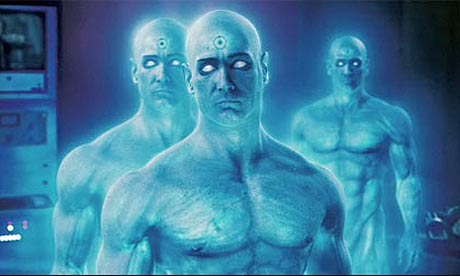
Circling these three are three other Watchmen: The Comedian, who's violently ironic comic detachment from life seems to be the initiator of many of the parallel stories herein; Dr. Manhattan, a glowing blue superhuman who, shall we merely say here, is detached from the living for entirely different reasons. And Laurie Jupiter (a.k.a. Silk Spectre II), who, I'm sad to say, seems to merely be the kick-ass babe the boys want to drool over. Why the women in this movie aren't given the same level of symbolic import as the men is, indeed, one of the ways in which this film squanders its potential.

Then there are the EARLIER generation of Watchmen to consider, some of which seem to have aged and some of which haven't, as well as a barely touched upon assortment of villains, girlfriends, colleagues, "real life" people, and other hangers on. All of which are entirely too much for a story that needs to get in and get out from an emotional core that is already distanced from us by that syrupy Raymond Chanlder-esque narration. Say what you want about Bryan Singer, but at least that guy knows how to craft a group of diverse, assorted characters around a single, centrally involving concept that they all must circle (think "who is Keyser Soze?"). The problem for Snyder is that he's lost himself to the Watchmen serial and the multiple parallel story lines without being able to pull from it a guiding central premise for the film.

That he seems to come up with one at the end is nice: the visual coda with Rorschach especially so. I just wish he had pulled that thread sooner, and trimmed out some of the unnecessary characters and fat.

And, back to my beginning comment, I also think updating the film to present day would have had even more impact. First, with the way time is shifted here, I am continually asking myself why we keep coming back to 1985. Why is that time the present? It was for Moore because when he wrote the Watchmen comics, it was the present, and this was a critique of Reganite culture - of the moment he was living in. Moore's story was written in the alternative present because it meant to be very contemporary: a comment on the cold war, an alternate version of the present, not the past. Perhaps Snyder felt that 1985 could stand in for 2005, Regan/Nixon standing in for Bush, Afghanistan (the first war) standing in for Iraq, without needing an update. But 2005 now too is already past (we're now dramatically in Obama's 2009 - a problem of historicity that a movie, which takes years to make, has to deal with more than a comic novel, which takes mere weeks to produce). And so, sadly, the central worry of the film (cold war standoff) feels out of date. And having an alternative past to our present moment feels like a betrayal of what Moore was up to, and the "real people" referenced in the film now feel entirely out of place. We are watching now not a critique of our culture but a critique of a history we no longer feel much worry or concern about.

And yet the film's dark vision and cynical view of realpolitik couldn't be more relevant. Shifting events in the story to Iraq, Pakistan, Bush I/II and terrorism rather than Vietnam and Afghanistan and cold war I believe would have spoken to the fears of OUR time and I think would have given the film the immediate emotional punch that it needed. For that was what Moore was going for originally, and by slavishly sticking to that historical element Snyder has drained all feeling from the movie, leaving us with something historical and clinical rather than immediate and meaningful.

There's also an issue of tone, which I don't think Snyder has gotten quite right. An example would be the real people: Nixon, Pat Buchanan, etc. They are caricatures of their real-life counterparts, yet they are neither extremely caricatured, nor are they at all similar. Rather, it was as if Snyder had pulled people off the street of the approximate gender and age of those people and told them to try and sound a little like them (perhaps never even having heard them). All this creates a kind of reality that is neither here nor there, when I think Snyder needed a reality that was most definitely somewhere: placed, perhaps, in an even more heightened alternative, and carrying us through to the world we recognize, or maybe barely recognize, today. George Stephanopolous, say, and an even more clown-mirror distorted version of him, rather than a stand-up comedian's version of McLaughlin Group.

Instead, it seems that Snyder was going for an interpretation, rather than a reinterpretation, of Moore: a loving introduction to the works of the maestro. And because this material really is subversive, what he's produced is a highly suggestive film that works backwards to introduce characters (intuitively rather than deductively), that wows us with transportation between time and place and suggestive images of war and murder that are both beautiful and disturbing (Snyder brings his 300 talents to this film, and it looks fantastic), that deals with the big themes of life and death, humanity and science, will and destiny, cynicism and belief. It is a movie that I have a hard time forgetting, and yet at times bored me to tears, and that I fear I may have made sound much more interesting than it is.

All of which is to say, it is a great film hampered by some very basic storytelling flaws: lack of focus, too much emotional distance, not enough risk-taking in digesting the source and giving us back something that captures the spirit more than the word of the original.

I really wish it had been better. A clear and moving deconstruction of our present political situation is highly called for, and the sci-fi / Chandler treatment of our particular moment on the brink of destruction, which is what's promised in the Watchmen vision, could have been fantastic. But as Don Rumsfeld used to say, sometimes you go to watch the movie you have, not the movie you might like to have.

Now if only Snyder had had the audacity to have quoted Rumsfeld, he really would have been on to something.